
先天免疫的进化:从无脊椎动物到鱼类再到哺乳动物的线索。
Evolution of Innate Immunity: Clues from Invertebrates via Fish to Mammals.
机构信息
Department of Veterinary Disease Biology, Faculty of Health and Medical Sciences, University of Copenhagen , Copenhagen , Denmark.
出版信息
Front Immunol. 2014 Sep 23;5:459. doi: 10.3389/fimmu.2014.00459. eCollection 2014.
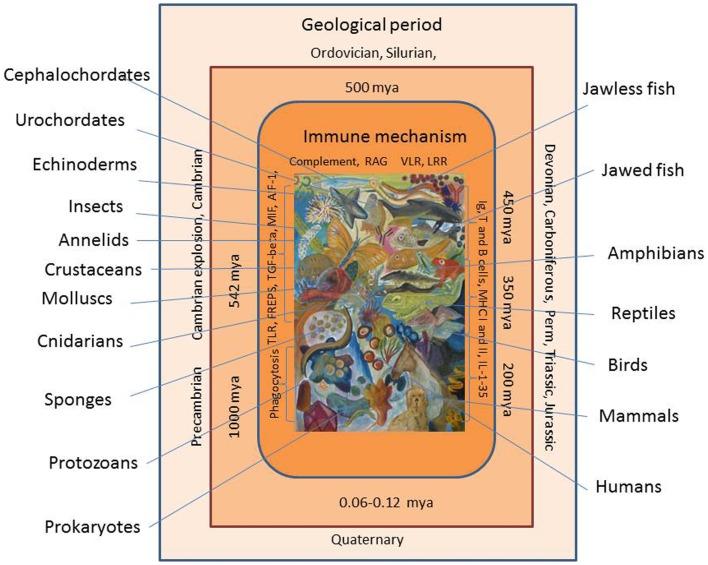
Host responses against invading pathogens are basic physiological reactions of all living organisms. Since the appearance of the first eukaryotic cells, a series of defense mechanisms have evolved in order to secure cellular integrity, homeostasis, and survival of the host. Invertebrates, ranging from protozoans to metazoans, possess cellular receptors, which bind to foreign elements and differentiate self from non-self. This ability is in multicellular animals associated with presence of phagocytes, bearing different names (amebocytes, hemocytes, coelomocytes) in various groups including animal sponges, worms, cnidarians, mollusks, crustaceans, chelicerates, insects, and echinoderms (sea stars and urchins). Basically, these cells have a macrophage-like appearance and function and the repair and/or fight functions associated with these cells are prominent even at the earliest evolutionary stage. The cells possess pathogen recognition receptors recognizing pathogen-associated molecular patterns, which are well-conserved molecular structures expressed by various pathogens (virus, bacteria, fungi, protozoans, helminths). Scavenger receptors, Toll-like receptors, and Nod-like receptors (NLRs) are prominent representatives within this group of host receptors. Following receptor-ligand binding, signal transduction initiates a complex cascade of cellular reactions, which lead to production of one or more of a wide array of effector molecules. Cytokines take part in this orchestration of responses even in lower invertebrates, which eventually may result in elimination or inactivation of the intruder. Important innate effector molecules are oxygen and nitrogen species, antimicrobial peptides, lectins, fibrinogen-related peptides, leucine rich repeats (LRRs), pentraxins, and complement-related proteins. Echinoderms represent the most developed invertebrates and the bridge leading to the primitive chordates, cephalochordates, and urochordates, in which many autologous genes and functions from their ancestors can be found. They exhibit numerous variants of innate recognition and effector molecules, which allow fast and innate responses toward diverse pathogens despite lack of adaptive responses. The primitive vertebrates (agnathans also termed jawless fish) were the first to supplement innate responses with adaptive elements. Thus hagfish and lampreys use LRRs as variable lymphocyte receptors, whereas higher vertebrates [cartilaginous and bony fishes (jawed fish), amphibians, reptiles, birds, and mammals] developed the major histocompatibility complex, T-cell receptors, and B-cell receptors (immunoglobulins) as additional adaptive weaponry to assist innate responses. Extensive cytokine networks are recognized in fish, but related signal molecules can be traced among invertebrates. The high specificity, antibody maturation, immunological memory, and secondary responses of adaptive immunity were so successful that it allowed higher vertebrates to reduce the number of variants of the innate molecules originating from both invertebrates and lower vertebrates. Nonetheless, vertebrates combine the two arms in an intricate inter-dependent network. Organisms at all developmental stages have, in order to survive, applied available genes and functions of which some may have been lost or may have changed function through evolution. The molecular mechanisms involved in evolution of immune molecules, might apart from simple base substitutions be as diverse as gene duplication, deletions, alternative splicing, gene recombination, domain shuffling, retrotransposition, and gene conversion. Further, variable regulation of gene expression may have played a role.
宿主对入侵病原体的反应是所有生物的基本生理反应。自从真核细胞出现以来,为了确保细胞的完整性、内环境稳定和宿主的生存,一系列防御机制已经进化出来。从原生动物到后生动物的无脊椎动物都拥有细胞受体,这些受体可以与外来元素结合,并将自身与非自身区分开来。这种能力在多细胞动物中与吞噬细胞的存在有关,这些吞噬细胞在不同的群体中具有不同的名称(变形细胞、血细胞、体腔细胞),包括动物海绵、蠕虫、刺胞动物、软体动物、甲壳动物、螯肢动物、昆虫和棘皮动物(海星和海胆)。基本上,这些细胞具有类似于巨噬细胞的外观和功能,与这些细胞相关的修复和/或对抗功能在最早的进化阶段就很明显。这些细胞拥有病原体识别受体,可以识别病原体相关的分子模式,这些模式是各种病原体(病毒、细菌、真菌、原生动物、寄生虫)表达的高度保守的分子结构。清道夫受体、Toll 样受体和 Nod 样受体(NLRs)是该宿主受体群中的突出代表。在受体-配体结合之后,信号转导启动了一个复杂的细胞反应级联,导致产生一种或多种广泛的效应分子。细胞因子甚至在较低等的无脊椎动物中参与这种反应的协调,最终可能导致入侵者的消除或失活。重要的先天效应分子是氧和氮物种、抗菌肽、凝集素、纤维蛋白原相关肽、富含亮氨酸重复序列(LRRs)、五聚体和补体相关蛋白。棘皮动物是最发达的无脊椎动物,是连接原始脊索动物、头索动物和尾索动物的桥梁,在这些动物中可以找到来自其祖先的许多同源基因和功能。它们表现出多种先天识别和效应分子的变体,这使得它们能够快速地对各种病原体产生先天反应,尽管缺乏适应性反应。原始的脊椎动物(无颌鱼也称为无颌鱼)是第一个用适应性元素补充先天反应的动物。因此,盲鳗和七鳃鳗将 LRR 用作可变淋巴细胞受体,而高等脊椎动物[软骨鱼和硬骨鱼(有颌鱼)、两栖动物、爬行动物、鸟类和哺乳动物]则开发了主要组织相容性复合体、T 细胞受体和 B 细胞受体(免疫球蛋白)作为辅助先天反应的额外适应性武器。鱼类中已经识别出广泛的细胞因子网络,但在无脊椎动物中也可以追踪到相关的信号分子。适应性免疫的高特异性、抗体成熟、免疫记忆和二次反应是如此成功,以至于高等脊椎动物减少了来自无脊椎动物和低等脊椎动物的先天分子的变体数量。尽管如此,脊椎动物在一个复杂的相互依存的网络中结合了这两个分支。为了生存,所有发育阶段的生物都应用了可用的基因和功能,其中一些可能已经丢失,或者可能通过进化改变了功能。参与免疫分子进化的分子机制可能不仅限于简单的碱基替换,还可能包括基因复制、缺失、选择性剪接、基因重组、结构域洗牌、逆转录转座和基因转换。此外,基因表达的可变调节可能也发挥了作用。
 Zotero 插件