
番茄脱落酸胁迫成熟(ASR)基因家族再探讨。
Tomato ABSCISIC ACID STRESS RIPENING (ASR) gene family revisited.
作者信息
Golan Ido, Dominguez Pia Guadalupe, Konrad Zvia, Shkolnik-Inbar Doron, Carrari Fernando, Bar-Zvi Dudy
机构信息
Department of Life Sciences and Doris and Bertie Black Center for Bioenergetics in Life Sciences, Ben-Gurion University of the Negev, Beer-Sheva, Israel.
Instituto de Biotecnología, Instituto Nacional de Tecnología Agropecuaria, Buenos Aires, Argentina.
出版信息
PLoS One. 2014 Oct 13;9(10):e107117. doi: 10.1371/journal.pone.0107117. eCollection 2014.
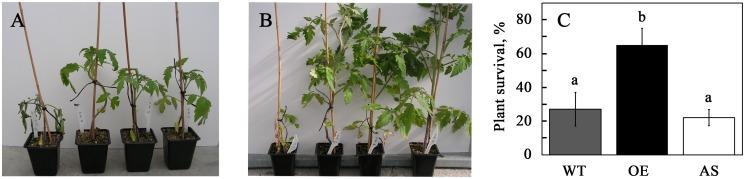
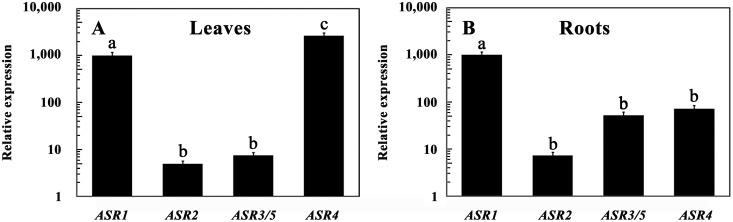
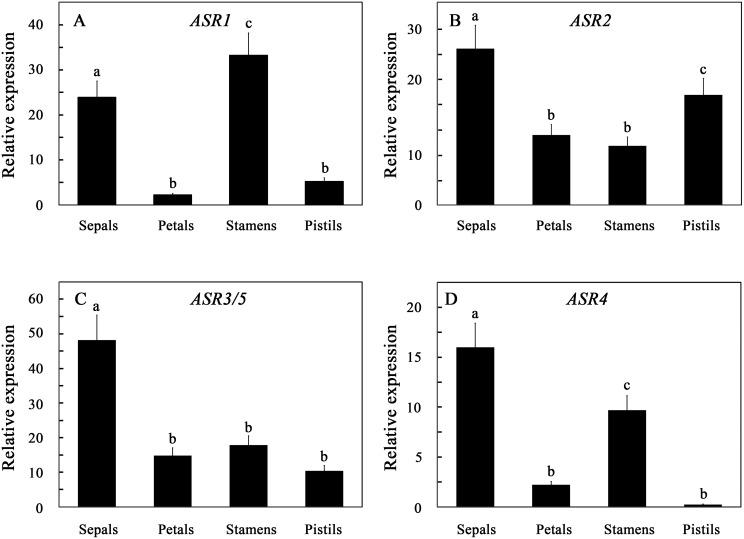
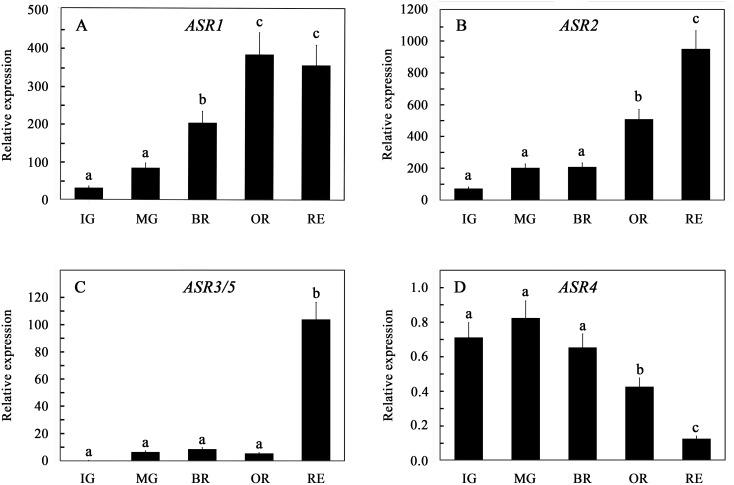
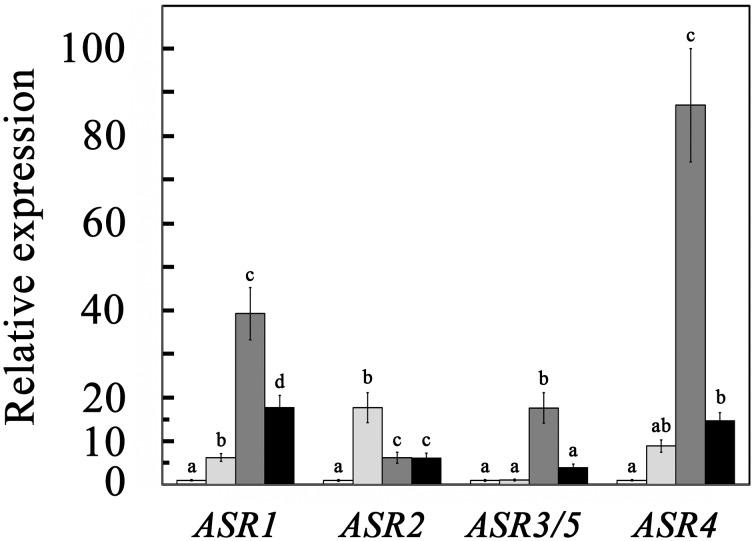
Tomato ABSCISIC ACID RIPENING 1 (ASR1) was the first cloned plant ASR gene. ASR orthologs were then cloned from a large number of monocot, dicot and gymnosperm plants, where they are mostly involved in response to abiotic (drought and salinity) stress and fruit ripening. The tomato genome encodes five ASR genes: ASR1, 2, 3 and 5 encode low-molecular-weight proteins (ca. 110 amino acid residues each), whereas ASR4 encodes a 297-residue polypeptide. Information on the expression of the tomato ASR gene family is scarce. We used quantitative RT-PCR to assay the expression of this gene family in plant development and in response to salt and osmotic stresses. ASR1 and ASR4 were the main expressed genes in all tested organs and conditions, whereas ASR2 and ASR3/5 expression was two to three orders of magnitude lower (with the exception of cotyledons). ASR1 is expressed in all plant tissues tested whereas ASR4 expression is limited to photosynthetic organs and stamens. Essentially, ASR1 accounted for most of ASR gene expression in roots, stems and fruits at all developmental stages, whereas ASR4 was the major gene expressed in cotyledons and young and fully developed leaves. Both ASR1 and ASR4 were expressed in flower organs, with ASR1 expression dominating in stamens and pistils, ASR4 in sepals and petals. Steady-state levels of ASR1 and ASR4 were upregulated in plant vegetative organs following exposure to salt stress, osmotic stress or the plant abiotic stress hormone abscisic acid (ABA). Tomato plants overexpressing ASR1 displayed enhanced survival rates under conditions of water stress, whereas ASR1-antisense plants displayed marginal hypersensitivity to water withholding.
番茄脱落酸成熟蛋白1(ASR1)是首个被克隆的植物ASR基因。随后,从大量单子叶植物、双子叶植物和裸子植物中克隆出了ASR直系同源基因,这些基因大多参与对非生物(干旱和盐胁迫)胁迫的响应以及果实成熟过程。番茄基因组编码5个ASR基因:ASR1、2、3和5编码低分子量蛋白(每个约含110个氨基酸残基),而ASR4编码一个含297个残基的多肽。关于番茄ASR基因家族表达的信息很少。我们使用定量逆转录PCR来检测该基因家族在植物发育过程中以及对盐胁迫和渗透胁迫的响应中的表达情况。ASR1和ASR4是在所有测试器官和条件下的主要表达基因,而ASR2和ASR3/5的表达量则低两到三个数量级(子叶除外)。ASR1在所有测试的植物组织中均有表达,而ASR4的表达仅限于光合器官和雄蕊。从本质上讲,在所有发育阶段,ASR1在根、茎和果实中的ASR基因表达中占大部分,而ASR4是在子叶以及幼叶和成熟叶中表达的主要基因。ASR1和ASR4在花器官中均有表达,ASR1在雄蕊和雌蕊中表达占主导,ASR4在萼片和花瓣中表达占主导。在植物营养器官中,暴露于盐胁迫、渗透胁迫或植物非生物胁迫激素脱落酸(ABA)后,ASR1和ASR4的稳态水平上调。过表达ASR1的番茄植株在水分胁迫条件下显示出更高的存活率,而ASR1反义植株对水分亏缺表现出轻微的超敏反应。

 Zotero 插件