
CANDLES,一种用于监测细胞培养中 GPCR 诱导的 cAMP 生成的测定法。
CANDLES, an assay for monitoring GPCR induced cAMP generation in cell cultures.
机构信息
Department of Physiology, Institute of Biomedicine, University of Turku, Turku, Finland.
Turku Centre for Biotechnology, University of Turku and Åbo Akademi University, BioCity, Turku, Finland.
出版信息
Cell Commun Signal. 2014 Nov 4;12:70. doi: 10.1186/s12964-014-0070-x.
BACKGROUND
G protein-coupled receptors (GPCRs) represent a physiologically and pharmacologically important family of receptors that upon coupling to GαS stimulate cAMP production catalyzed by adenylyl cyclase. Thus, developing assays to monitor cAMP production is crucial to screen for ligands in studies of GPCR signaling. Primary cell cultures represent a more robust model than cell lines to study GPCR signaling since they physiologically resemble the parent tissue. Current cAMP assays have two fundamental limitations: 1) absence of cAMP kinetics as competition-based assays require cell lysis and measure only a single time-point, and 2) high variation with separate samples needed to measure consecutive time points. The utility of real-time cAMP biosensors is also limited in primary cell cultures due to their poor transfection efficiency, variable expression levels and inability to select stable clones. We therefore, decided to develop an assay that can measure cAMP not only at a single time-point but the entire cAMP kinetics after GPCR activation in untransfected primary cells.
RESULTS
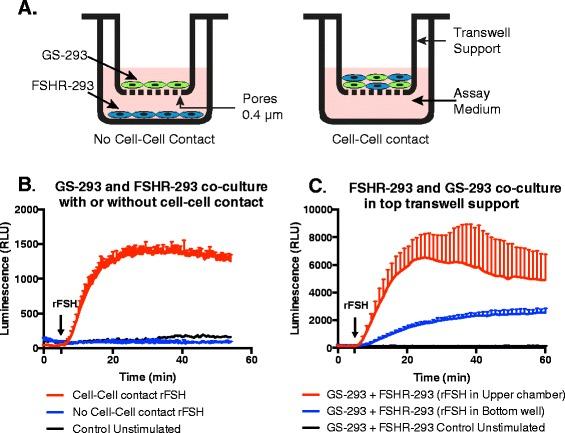
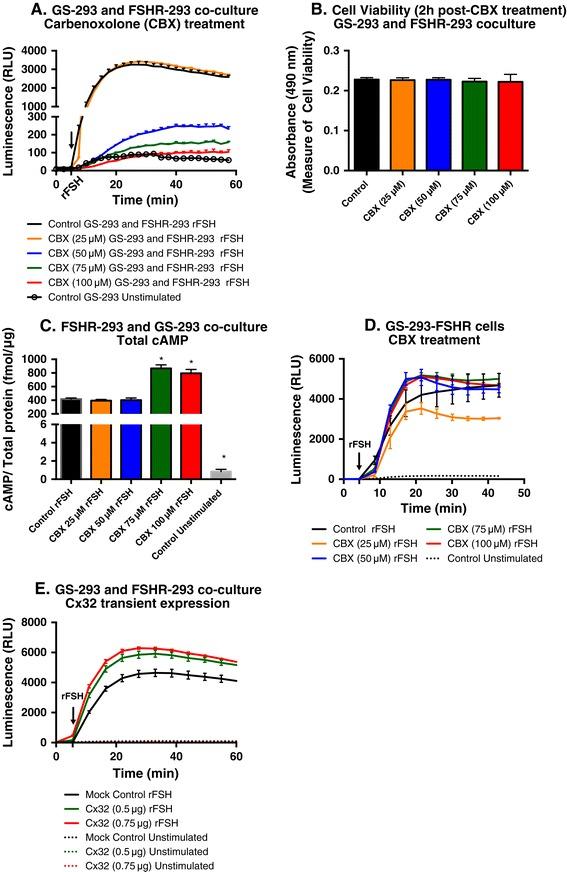
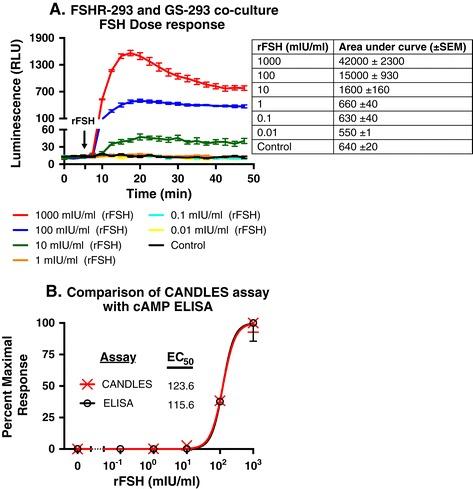
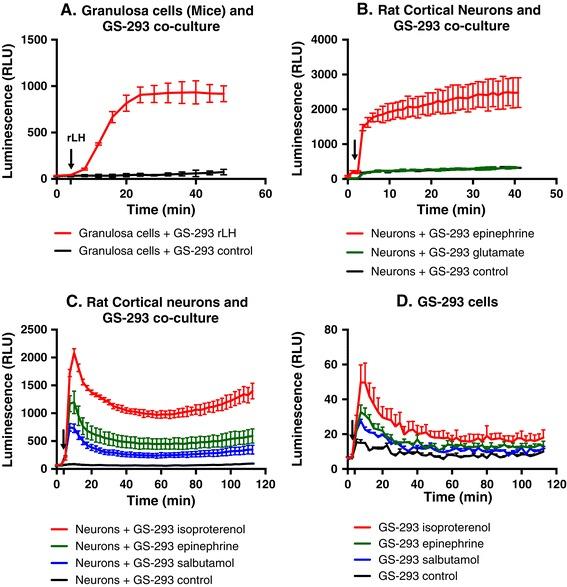
CANDLES (Cyclic AMP iNdirect Detection by Light Emission from Sensor cells) assay for monitoring cAMP kinetics in cell cultures, particularly in primary cultures was developed. The assay requires co-culturing of primary cells with sensor cells that stably express a luminescent cAMP sensor. Upon GPCR activation in primary cells, cAMP is transferred to sensor cells via gap junction channels, thereby evoking a luminescent read-out. GPCR activation using primary cultures of rat cortical neurons and mouse granulosa cells was measured. Kinetic responses of different agonists to adrenergic receptors were also compared using rat cortical neurons. The assay optimization was done by varying sensor-test cell ratio, using phosphodiesterase inhibitors and testing cell-cell contact requirement.
CONCLUSIONS
Here we present CANDLES assay based on co-culturing test cells with cAMP-detecting sensor cells. This co-culture setup allows kinetic measurements, eliminates primary cell transfections and reduces variability. A variety of cell types (rat cortical neurons, mouse granulosa cells and established cell lines) and receptors (adrenergic, follicle stimulating hormone and luteinizing hormone/chorionic gonadotropin receptors) were tested for use with CANDLES. The assay is best applied while comparing cAMP generation curves upon different drug treatments to untransfected primary cells.
背景
G 蛋白偶联受体(GPCRs)是一类具有重要生理和药理学意义的受体家族,它们与 GαS 偶联后可刺激腺苷酸环化酶催化的 cAMP 产生。因此,开发监测 cAMP 产生的测定方法对于研究 GPCR 信号传导中的配体筛选至关重要。与细胞系相比,原代细胞培养更能代表生理状态,是研究 GPCR 信号传导的更稳健模型,因为它们在生理上与母组织相似。目前的 cAMP 测定法有两个基本限制:1)缺乏 cAMP 动力学,因为基于竞争的测定法需要细胞裂解,并且仅测量单个时间点;2)高变异性,需要单独的样本来测量连续的时间点。由于转染效率低、表达水平变化和无法选择稳定的克隆,实时 cAMP 生物传感器的应用也受到限制。因此,我们决定开发一种测定法,不仅可以在单个时间点测量 cAMP,还可以在未转染的原代细胞中测量 GPCR 激活后的整个 cAMP 动力学。
结果
开发了一种用于监测细胞培养物中 cAMP 动力学的 CANDLES(通过传感器细胞的发光间接检测环磷酸腺苷)测定法,特别是在原代培养物中。该测定法需要将原代细胞与稳定表达发光 cAMP 传感器的传感器细胞共培养。在原代细胞中 GPCR 被激活后,cAMP 通过间隙连接通道转移到传感器细胞,从而引发发光读数。使用大鼠皮质神经元和小鼠颗粒细胞的原代培养物测量 GPCR 激活。还使用大鼠皮质神经元比较了不同激动剂对肾上腺素能受体的动力学反应。通过改变传感器-测试细胞比例、使用磷酸二酯酶抑制剂和测试细胞-细胞接触要求来优化测定法。
结论
这里我们提出了一种基于共培养测试细胞与 cAMP 检测传感器细胞的 CANDLES 测定法。这种共培养设置允许进行动力学测量,消除了原代细胞的转染并减少了变异性。各种细胞类型(大鼠皮质神经元、小鼠颗粒细胞和已建立的细胞系)和受体(肾上腺素能、卵泡刺激素和黄体生成素/绒毛膜促性腺激素受体)都经过了 CANDLES 的测试。该测定法最适用于比较不同药物处理对未转染原代细胞的 cAMP 生成曲线。


 Zotero 插件