
对铜绿假单胞菌孤儿群体感应调节因子QscR的一种不断演变的观点。
An evolving perspective on the Pseudomonas aeruginosa orphan quorum sensing regulator QscR.
作者信息
Chugani Sudha, Greenberg Everett P
机构信息
Department of Microbiology, University of Washington Seattle, WA, USA.
出版信息
Front Cell Infect Microbiol. 2014 Oct 28;4:152. doi: 10.3389/fcimb.2014.00152. eCollection 2014.
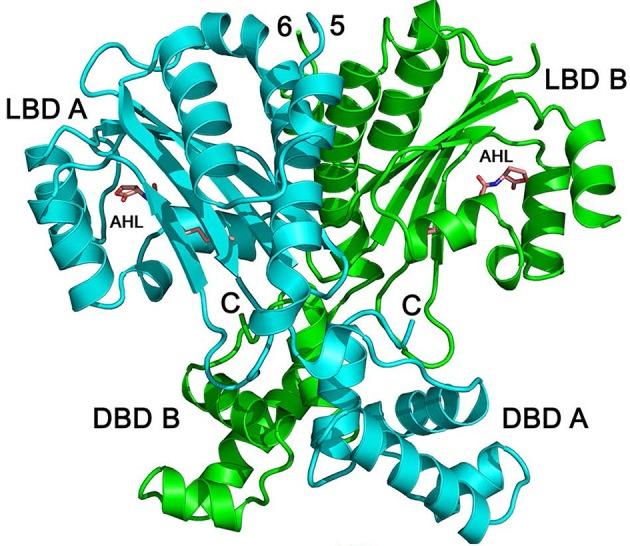
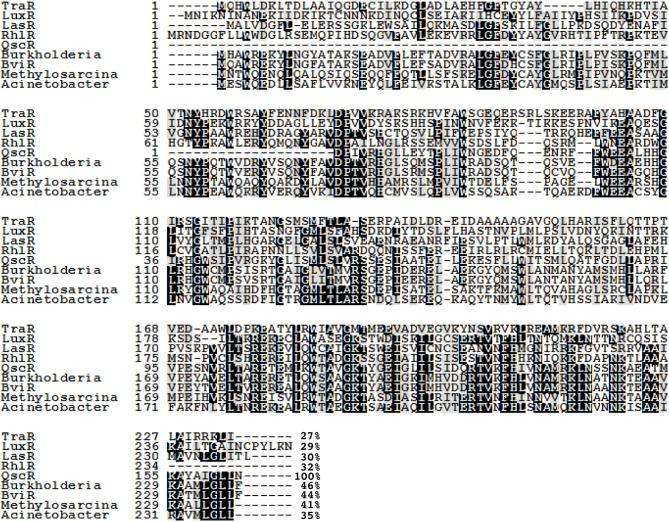
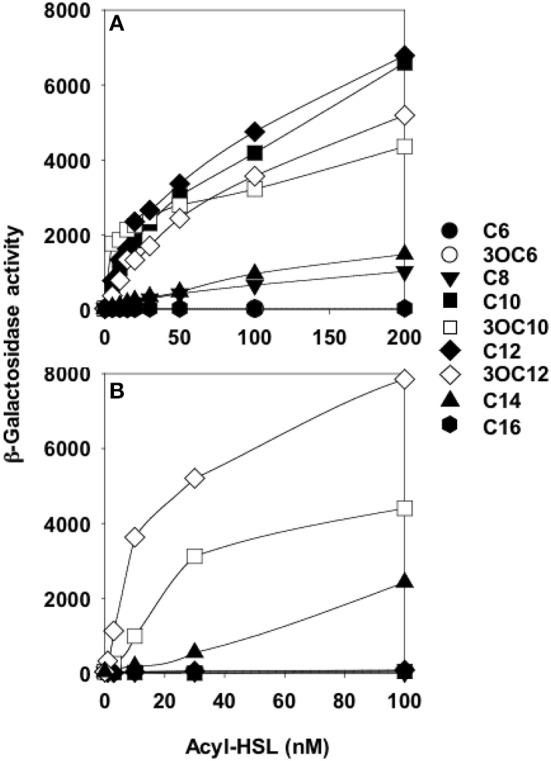
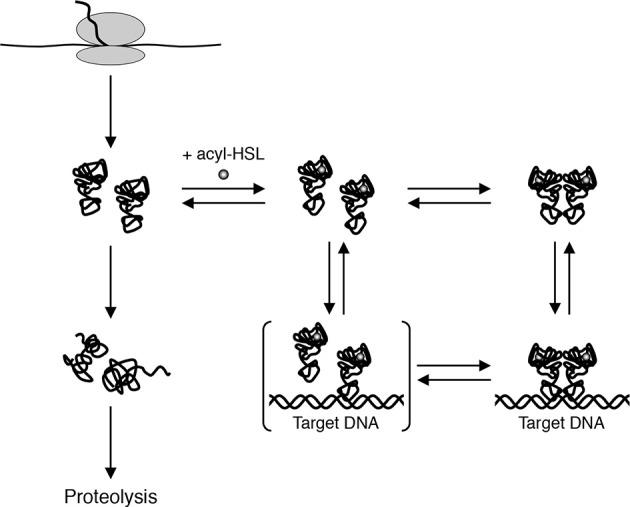
Many Proteobacteria govern responses to changes in cell density by using acyl-homoserine lactone (AHL) quorum-sensing (QS) signaling. Similar to the LuxI-LuxR system described in Vibrio fischeri, a minimal AHL QS circuit comprises a pair of genes, a luxI-type synthase gene encoding an enzyme that synthesizes an AHL and a luxR-type AHL-responsive transcription regulator gene. In most bacteria that utilize AHL QS, cognate luxI and luxR homologs are found in proximity to each other on the chromosome. However, a number of recent reports have identified luxR homologs that are not linked to luxI homologs; in some cases luxR homologs have been identified in bacteria that have no luxI homologs. A luxR homolog without a linked luxI homologs is termed an orphan or solo. One of the first reports of an orphan was on QscR in Pseudomonas aeruginosa. The qscR gene was revealed by whole genome sequencing and has been studied in some detail. P. aeruginosa encodes two AHL synthases and three AHL responsive receptors, LasI-LasR form a cognate synthase-receptor pair as do RhlI-RhlR. QscR lacks a linked synthase and responds to the LasI-generated AHL. QS regulation of gene expression in P. aeruginosa employs multiple signals and occurs in the context of other interconnected regulatory circuits that control diverse physiological functions. QscR affects virulence of P. aeruginosa, and although it shows sensitivity to the LasI-generated AHL, 3-oxo-dodecanoylhomoserine lactone, it's specificity is relaxed compared to LasR and can respond equally well to several AHLs. QscR controls a set of genes that overlaps the set regulated by LasR. QscR is comparatively easy to purify and study in vitro, and has become a model for understanding the biochemistry of LuxR homologs. In fact there is a crystal structure of QscR bound to the LasI-generated AHL. Here, we review the current state of research concerning QscR and highlight recent advances in our understanding of its structure and biochemistry.
许多变形菌通过使用酰基高丝氨酸内酯(AHL)群体感应(QS)信号来调控对细胞密度变化的反应。与费氏弧菌中描述的LuxI-LuxR系统类似,一个最小的AHL QS回路由一对基因组成,一个luxI型合酶基因编码一种合成AHL的酶,以及一个luxR型AHL响应转录调节基因。在大多数利用AHL QS的细菌中,同源的luxI和luxR同源物在染色体上彼此相邻。然而,最近的一些报道发现了与luxI同源物不相关的luxR同源物;在某些情况下,在没有luxI同源物的细菌中也发现了luxR同源物。没有与luxI同源物相连的luxR同源物被称为孤儿或单独的(孤儿LuxR)。关于孤儿LuxR的最早报道之一是关于铜绿假单胞菌中的QscR。qscR基因通过全基因组测序被发现,并已得到了一些详细研究。铜绿假单胞菌编码两种AHL合酶和三种AHL响应受体,LasI-LasR形成一对同源的合酶-受体对,RhlI-RhlR也是如此。QscR没有相连的合酶,并对LasI产生的AHL作出反应。铜绿假单胞菌中基因表达的QS调控使用多种信号,并且发生在控制多种生理功能的其他相互关联的调控回路的背景下。QscR影响铜绿假单胞菌的毒力,尽管它对LasI产生的AHL(3-氧代十二烷酰高丝氨酸内酯)敏感,但其特异性与LasR相比有所放宽,并且对几种AHL的反应同样良好。QscR控制一组与LasR调控的基因重叠的基因。QscR相对容易在体外纯化和研究,并且已成为理解LuxR同源物生物化学的模型。实际上,存在与LasI产生的AHL结合的QscR的晶体结构。在这里,我们综述了关于QscR的当前研究状况,并强调了我们对其结构和生物化学理解的最新进展。
 Zotero 插件