
睡美人:生殖滞育如何影响黑腹果蝇的激素信号传导、新陈代谢、免疫反应和体细胞维持。
The sleeping beauty: how reproductive diapause affects hormone signaling, metabolism, immune response and somatic maintenance in Drosophila melanogaster.
作者信息
Kubrak Olga I, Kučerová Lucie, Theopold Ulrich, Nässel Dick R
机构信息
Department of Zoology, Stockholm University, S-106 91 Stockholm, Sweden.
Department of Molecular Biosciences, Wenner-Gren Institute, Stockholm University, Stockholm, Sweden.
出版信息
PLoS One. 2014 Nov 13;9(11):e113051. doi: 10.1371/journal.pone.0113051. eCollection 2014.
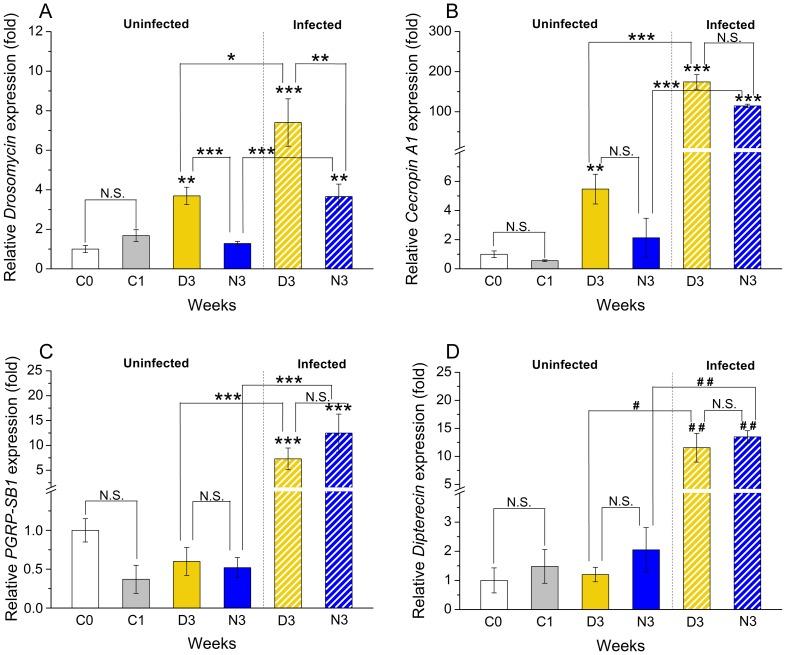
Some organisms can adapt to seasonal and other environmental challenges by entering a state of dormancy, diapause. Thus, insects exposed to decreased temperature and short photoperiod enter a state of arrested development, lowered metabolism, and increased stress resistance. Drosophila melanogaster females can enter a shallow reproductive diapause in the adult stage, which drastically reduces organismal senescence, but little is known about the physiology and endocrinology associated with this dormancy, and the genes involved in its regulation. We induced diapause in D. melanogaster and monitored effects over 12 weeks on dynamics of ovary development, carbohydrate and lipid metabolism, as well as expression of genes involved in endocrine signaling, metabolism and innate immunity. During diapause food intake diminishes drastically, but circulating and stored carbohydrates and lipids are elevated. Gene transcripts of glucagon- and insulin-like peptides increase, and expression of several target genes of these peptides also change. Four key genes in innate immunity can be induced by infection in diapausing flies, and two of these, drosomycin and cecropin A1, are upregulated by diapause independently of infection. Diapausing flies display very low mortality, extended lifespan and decreased aging of the intestinal epithelium. Many phenotypes induced by diapause are reversed after one week of recovery from diapause conditions. Furthermore, mutant flies lacking specific insulin-like peptides (dilp5 and dilp2-3) display increased diapause incidence. Our study provides a first comprehensive characterization of reproductive diapause in D. melanogaster, and evidence that glucagon- and insulin-like signaling are among the key regulators of the altered physiology during this dormancy.
一些生物体可以通过进入休眠状态(滞育)来适应季节性和其他环境挑战。因此,暴露于低温和短光周期下的昆虫会进入发育停滞、新陈代谢降低和抗逆性增强的状态。黑腹果蝇雌性成虫可进入一种浅度的生殖滞育状态,这能大幅降低机体衰老,但人们对与这种休眠相关的生理学和内分泌学以及参与其调控的基因知之甚少。我们诱导黑腹果蝇进入滞育状态,并在12周内监测其对卵巢发育动态、碳水化合物和脂质代谢以及参与内分泌信号传导、代谢和先天免疫的基因表达的影响。在滞育期间,食物摄入量大幅减少,但循环和储存的碳水化合物及脂质水平升高。胰高血糖素样肽和胰岛素样肽的基因转录本增加,这些肽的几个靶基因的表达也发生变化。先天免疫中的四个关键基因可在滞育果蝇受到感染时被诱导,其中两个基因,即果蝇抗菌肽和天蚕素A1,在滞育时独立于感染而上调。滞育果蝇的死亡率极低,寿命延长,肠上皮细胞衰老减缓。滞育诱导的许多表型在从滞育状态恢复一周后会逆转。此外,缺乏特定胰岛素样肽(dilp5和dilp2 - 3)的突变果蝇滞育发生率增加。我们的研究首次全面描述了黑腹果蝇的生殖滞育,并证明胰高血糖素样信号和胰岛素样信号是这种休眠期间生理变化的关键调节因子之一。


 Zotero 插件