
STIM1和STIM2在非洲爪蟾卵母细胞瞬时内向(Tin)电流产生及成熟过程中的不同作用。
Differential role of STIM1 and STIM2 during transient inward (T in) current generation and the maturation process in the Xenopus oocyte.
作者信息
Serrano-Flores Barbara, Garay Edith, Vázquez-Cuevas Francisco G, Arellano Rogelio O
出版信息
BMC Physiol. 2014 Nov 15;14:9. doi: 10.1186/s12899-014-0009-x.
BACKGROUND
The Xenopus oocyte is a useful cell model to study Ca2+ homeostasis and cell cycle regulation, two highly interrelated processes. Here, we used antisense oligonucleotides to investigate the role in the oocyte of stromal interaction molecule (STIM) proteins that are fundamental elements of the store-operated calcium-entry (SOCE) phenomenon, as they are both sensors for Ca2+ concentration in the intracellular reservoirs as well as activators of the membrane channels that allow Ca2+ influx.
RESULTS
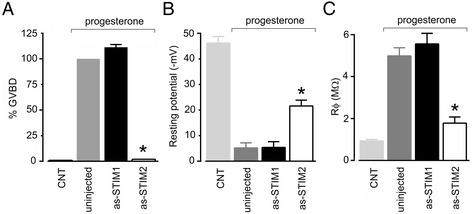
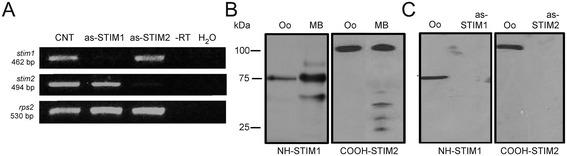
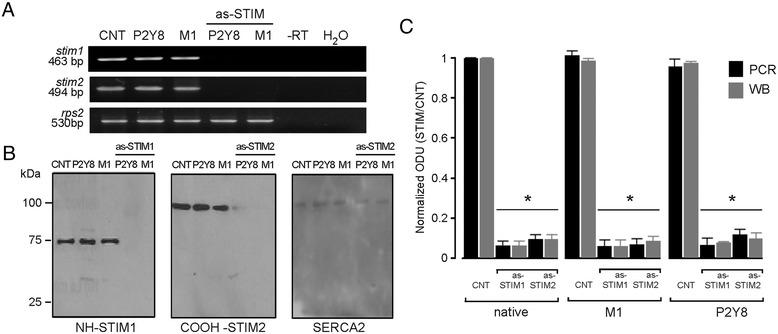
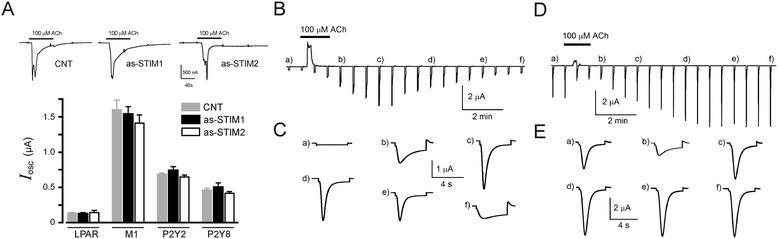
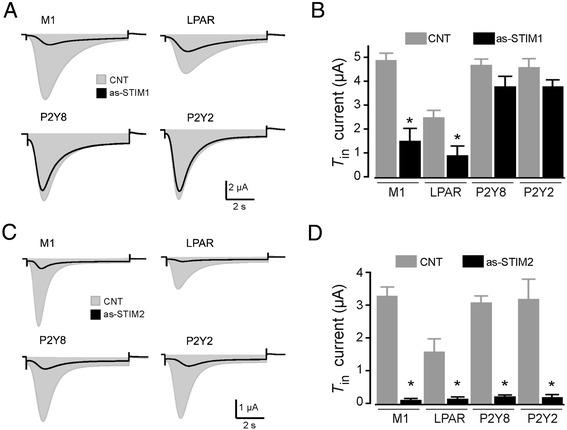
Endogenous STIM1 and STIM2 expression was demonstrated, and their synthesis was knocked down 48-72 h after injecting oocytes with specific antisense sequences. Selective elimination of their mRNA and protein expression was confirmed by PCR and Western blot analysis, and we then evaluated the effect of their absence on two endogenous responses: the opening of SOC channels elicited by G protein-coupled receptor (GPCR)-activated Ca2+ release, and the process of maturation stimulated by progesterone. Activation of SOC channels was monitored electrically by measuring the T in response, a Ca2+-influx-dependent Cl- current, while maturation was assessed by germinal vesicle breakdown (GVBD) scoring and electrophysiology.
CONCLUSIONS
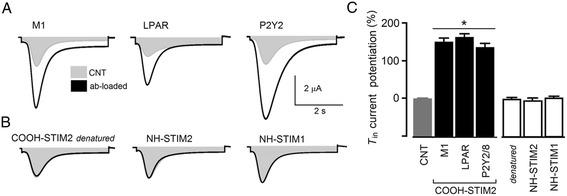
It was found that STIM2, but not STIM1, was essential in both responses, and T in currents and GVBD were strongly reduced or eliminated in cells devoid of STIM2; STIM1 knockdown had no effect on the maturation process, but it reduced the T in response by 15 to 70%. Thus, the endogenous SOCE response in Xenopus oocytes depended mainly on STIM2, and its expression was necessary for entry into meiosis induced by progesterone.
背景
非洲爪蟾卵母细胞是研究钙离子稳态和细胞周期调控这两个高度相关过程的有用细胞模型。在此,我们使用反义寡核苷酸来研究基质相互作用分子(STIM)蛋白在卵母细胞中的作用,STIM蛋白是储存式钙内流(SOCE)现象的基本要素,因为它们既是细胞内储存库中钙离子浓度的传感器,也是允许钙离子内流的膜通道的激活剂。
结果
证实了内源性STIM1和STIM2的表达,在用特定反义序列注射卵母细胞后48 - 72小时,它们的合成被敲低。通过PCR和蛋白质印迹分析确认了它们的mRNA和蛋白质表达的选择性消除,然后我们评估了它们缺失对两种内源性反应的影响:由G蛋白偶联受体(GPCR)激活的钙释放引发的SOC通道开放,以及孕酮刺激的成熟过程。通过测量T型电流(一种依赖钙离子内流的氯离子电流)来电监测SOC通道的激活,而通过生发泡破裂(GVBD)评分和电生理学评估成熟情况。
结论
发现STIM2而非STIM1在这两种反应中都是必不可少的,在缺乏STIM2的细胞中,T型电流和GVBD显著降低或消除;STIM1敲低对成熟过程没有影响,但它使T型电流反应降低了15%至70%。因此,非洲爪蟾卵母细胞中的内源性SOCE反应主要依赖于STIM2,其表达是孕酮诱导进入减数分裂所必需的。
 Zotero 插件