
马杜霉素抑制成肌细胞的增殖并诱导其凋亡。
Maduramicin inhibits proliferation and induces apoptosis in myoblast cells.
作者信息
Chen Xin, Gu Ying, Singh Karnika, Shang Chaowei, Barzegar Mansoureh, Jiang Shanxiang, Huang Shile
机构信息
Laboratory of Veterinary Pharmacology and Toxicology, College of Veterinary Medicine, Nanjing Agricultural University, Nanjing, Jiangsu Province, P. R. China; Department of Biochemistry and Molecular Biology, Louisiana State University Health Sciences Center, Shreveport, Louisiana, United States of America.
Department of Biochemistry and Molecular Biology, Louisiana State University Health Sciences Center, Shreveport, Louisiana, United States of America.
出版信息
PLoS One. 2014 Dec 22;9(12):e115652. doi: 10.1371/journal.pone.0115652. eCollection 2014.
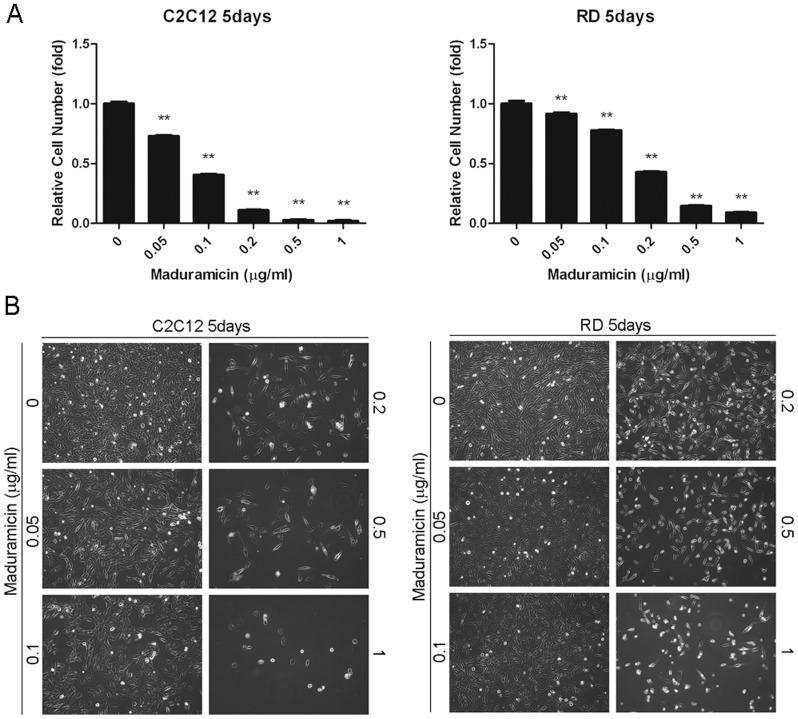
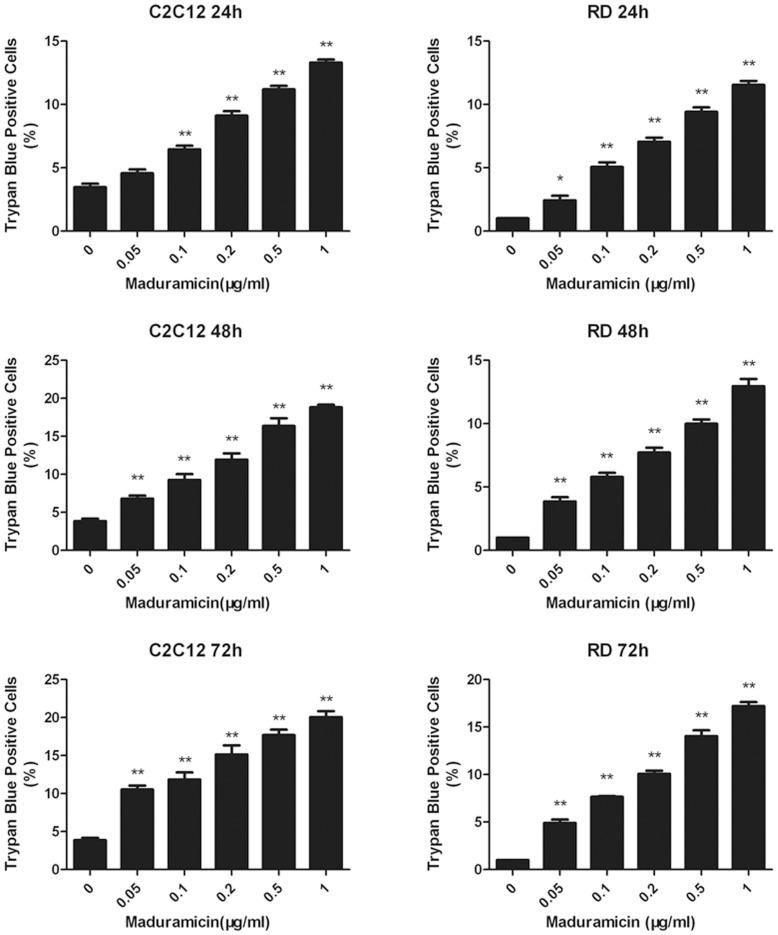
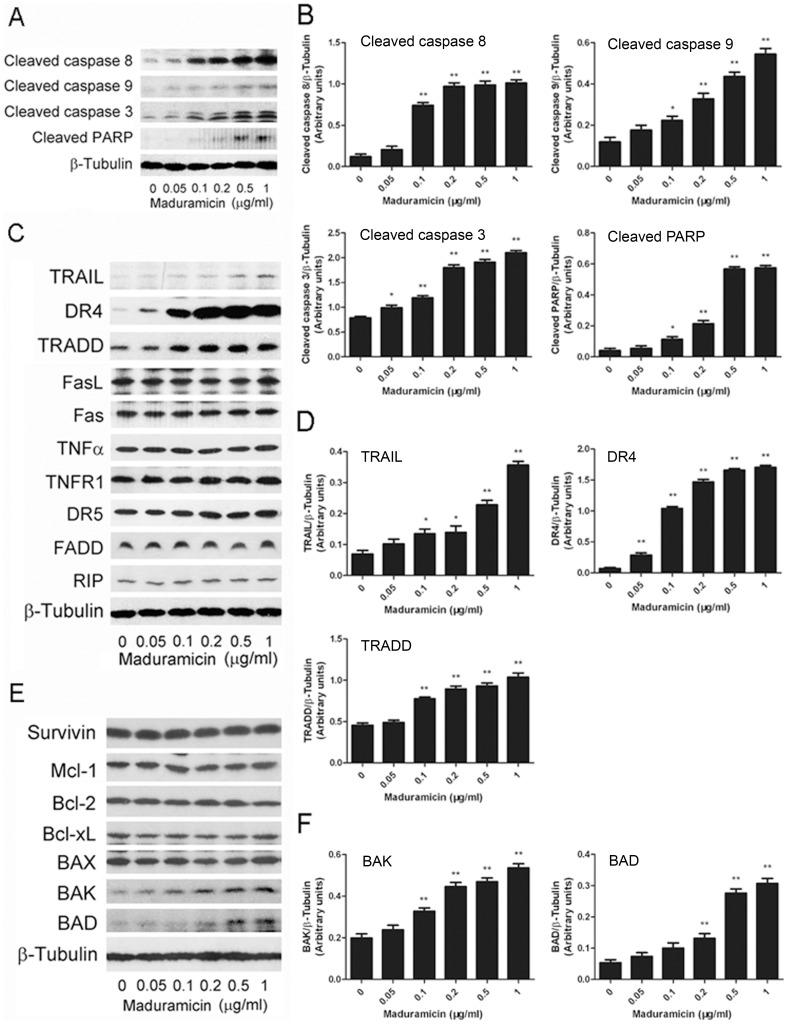
Maduramicin, a polyether ionophore antibiotic derived from the bacterium Actinomadura yumaensis, is currently used as a feed additive against coccidiosis in poultry worldwide. It has been clinically observed that maduramicin can cause skeletal muscle and heart cell damage, resulting in skeletal muscle degeneration, heart failure, and even death in animals and humans, if improperly used. However, the mechanism of its toxic action in myoblasts is not well understood. Using mouse myoblasts (C2C12) and human rhabdomyosarcoma (RD and Rh30) cells as an experimental model for myoblasts, here we found that maduramicin inhibited cell proliferation and induced cell death in a concentration-dependent manner. Further studies revealed that maduramicin induced accumulation of the cells at G0/G1 phase of the cell cycle, and induced apoptosis in the cells. Concurrently, maduramicin downregulated protein expression of cyclin D1, cyclin-dependent kinases (CDK4 and CDK6), and CDC25A, and upregulated expression of the CDK inhibitors (p21Cip1 and p27Kip1), resulting in decreased phosphorylation of Rb. Maduramicin also induced expression of BAK, BAD, DR4, TRADD and TRAIL, leading to activation of caspases 8, 9 and 3 as well as cleavage of poly ADP ribose polymerase (PARP). Taken together, our results suggest that maduramicin executes its toxicity in myoblasts at least by inhibiting cell proliferation and inducing apoptotic cell death.
马杜霉素是一种从尤马马杜拉放线菌中提取的聚醚离子载体抗生素,目前在全球范围内用作家禽抗球虫病的饲料添加剂。临床观察发现,如果使用不当,马杜霉素会导致骨骼肌和心脏细胞损伤,进而导致动物和人类出现骨骼肌退化、心力衰竭甚至死亡。然而,其在成肌细胞中的毒性作用机制尚不清楚。我们以小鼠成肌细胞(C2C12)和人横纹肌肉瘤(RD和Rh30)细胞作为成肌细胞的实验模型,发现马杜霉素以浓度依赖的方式抑制细胞增殖并诱导细胞死亡。进一步研究表明,马杜霉素诱导细胞在细胞周期的G0/G1期积累,并诱导细胞凋亡。同时,马杜霉素下调细胞周期蛋白D1、细胞周期蛋白依赖性激酶(CDK4和CDK6)以及细胞周期蛋白磷酸酶25A(CDC25A)的蛋白表达,并上调细胞周期蛋白依赖性激酶抑制剂(p21Cip1和p27Kip1)的表达,导致视网膜母细胞瘤蛋白(Rb)磷酸化减少。马杜霉素还诱导促凋亡蛋白BAK、BAD、死亡受体4(DR4)、肿瘤坏死因子受体相关死亡结构域蛋白(TRADD)和肿瘤坏死因子相关凋亡诱导配体(TRAIL)的表达,导致半胱天冬酶8、9和3激活以及聚ADP核糖聚合酶(PARP)裂解。综上所述,我们的结果表明,马杜霉素至少通过抑制细胞增殖和诱导凋亡性细胞死亡在成肌细胞中发挥其毒性作用。




 Zotero 插件