
一种针对75岁及以上老年人初级保健的衰弱评估工具:基于纵向人群队列研究“欧洲健康、老龄化与退休调查”(SHARE-FI75+)的结果
A Frailty Instrument for primary care for those aged 75 years or more: findings from the Survey of Health, Ageing and Retirement in Europe, a longitudinal population-based cohort study (SHARE-FI75+).
作者信息
Romero-Ortuno Roman, Soraghan Christopher
机构信息
Department of Medicine for the Elderly (DME), Addenbrooke's Hospital, Cambridge University Hospitals NHS Foundation Trust, Cambridge, UK Clinical Gerontology Unit, Department of Public Health and Primary Care, University of Cambridge, Addenbrooke's Hospital, Cambridge, UK.
Department of Medical Physics and Bioengineering, St. James's Hospital, Dublin, Ireland Mercer's Institute for Successful Ageing, St. James's Hospital, Dublin, Ireland.
出版信息
BMJ Open. 2014 Dec 23;4(12):e006645. doi: 10.1136/bmjopen-2014-006645.
OBJECTIVE
To create and validate a frailty assessment tool for community-dwelling adults aged ≥75 years.
DESIGN
Longitudinal, population-based study.
SETTING
The Survey of Health, Ageing and Retirement in Europe (SHARE).
PARTICIPANTS
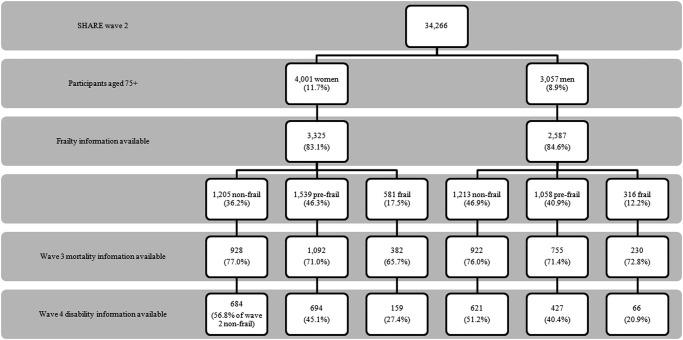
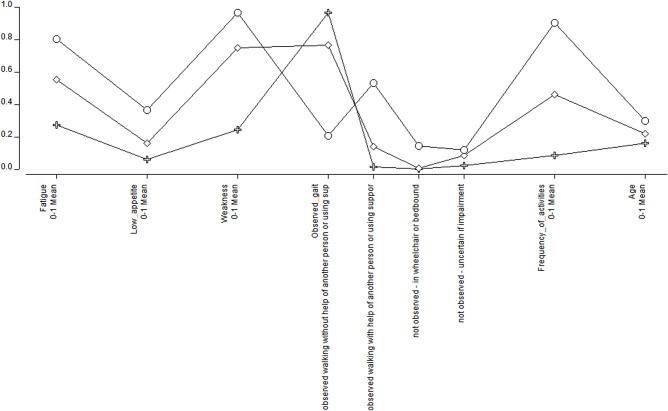
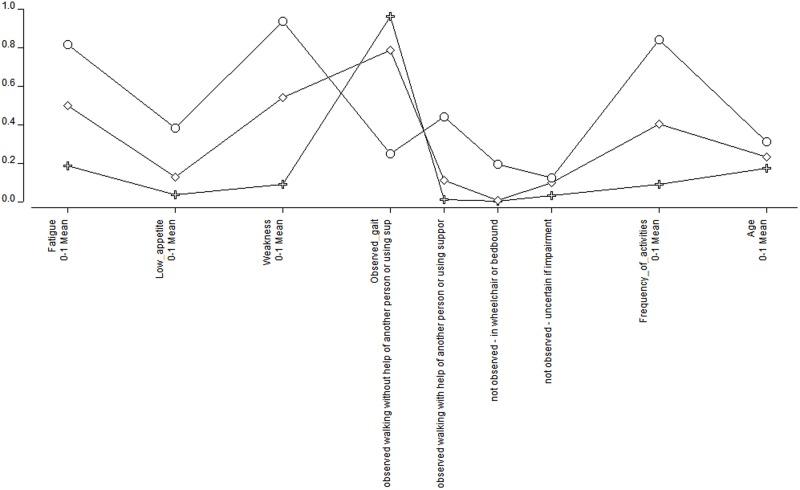
4001 women and 3057 men aged ≥75 years from the second wave of SHARE. 3325 women and 2587 men had complete information for the frailty indicators: fatigue, low appetite, weakness, observed gait (walking without help, walking with help, chairbound/bedbound, unobserved) and low physical activity.
MAIN OUTCOME MEASURES
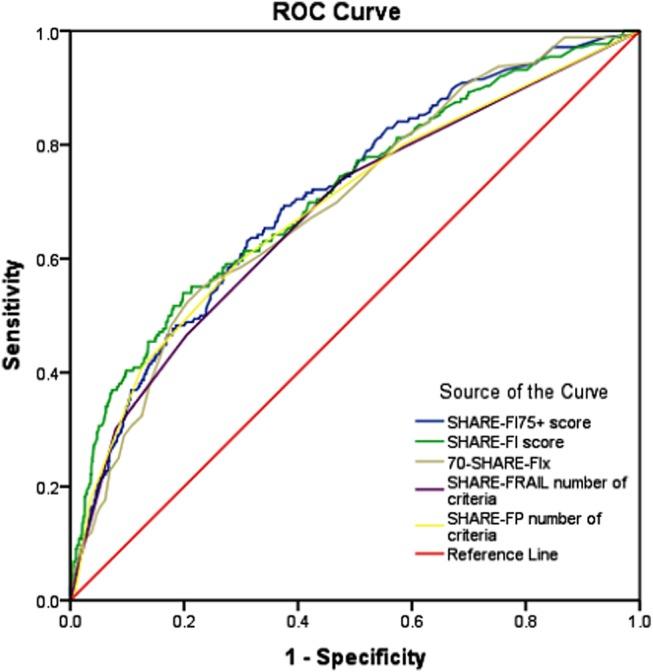
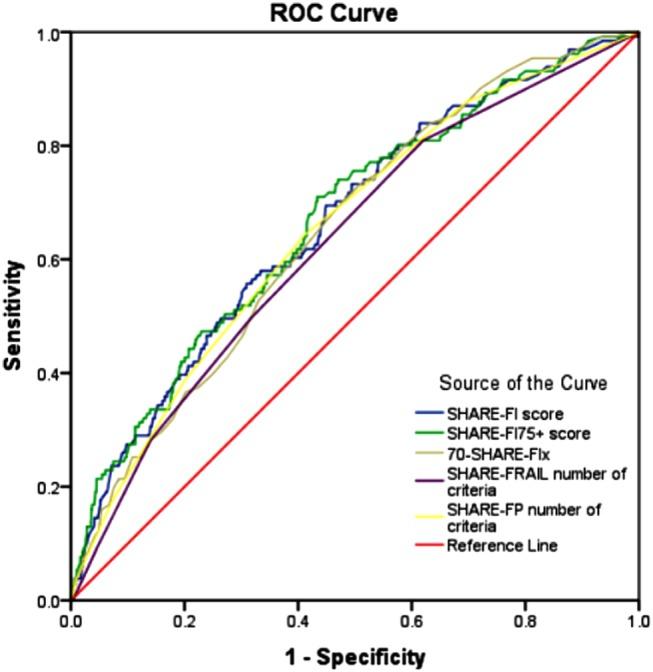
The internal validity of the frailty indicators was tested with latent class analysis, by modelling an underlying variable with three ordered categories. The predictive validity of the frailty classification was tested against 2-year mortality and 4-year disability. The mortality prediction of SHARE-FI75+ was compared with that of previously operationalised frailty scales in SHARE (SHARE-FI, 70-item index, phenotype, FRAIL).
RESULTS
In both genders, all frailty indicators significantly aggregated into a three-category ordinal latent variable. After adjusting for baseline age, comorbidity and basic activities of daily living (BADL) disability, the frail had an OR for 2-year mortality of 2.2 (95% CI 1.2 to 3.8) in women and 4.2 (2.6 to 6.8) in men. The mortality prediction of SHARE-FI75+ was similar to that of the other SHARE frailty scales. By wave 4, 49% of frail women (78 of 159) had at least one more limitation with BADL (compared with 18% of non-frail, 125 of 684; p<0.001); in men, these proportions were 39% (26 of 66) and 18% (110 of 621), respectively (p<0.001). A calculator is supplied for point-of-care use, which automatically replicates the frailty classification for any given measurements.
CONCLUSIONS
SHARE-FI75+ could help frailty case finding in primary care and provide a focus for personalised community interventions. Further validation in trials and clinical programmes is needed.
目的
创建并验证一种适用于75岁及以上社区居住成年人的衰弱评估工具。
设计
基于人群的纵向研究。
背景
欧洲健康、老龄化与退休调查(SHARE)。
参与者
来自SHARE第二轮调查的4001名年龄≥75岁的女性和3057名年龄≥75岁的男性。3325名女性和2587名男性拥有关于衰弱指标的完整信息,这些指标包括疲劳、食欲减退、虚弱、观察到的步态(无需帮助行走、需帮助行走、依赖轮椅/卧床、未观察到)以及低体力活动。
主要观察指标
通过对一个具有三个有序类别的潜在变量进行建模,采用潜在类别分析来检验衰弱指标的内部效度。针对2年死亡率和4年残疾情况检验衰弱分类的预测效度。将SHARE-FI75+的死亡率预测与SHARE中先前使用的衰弱量表(SHARE-FI,70项指标、表型、FRAIL)的死亡率预测进行比较。
结果
在男性和女性中,所有衰弱指标均显著聚合成一个具有三个类别的有序潜在变量。在调整了基线年龄、合并症和日常生活基本活动(BADL)残疾情况后,衰弱女性2年死亡率的比值比为2.2(95%置信区间1.2至3.8),衰弱男性为4.2(2.6至6.8)。SHARE-FI75+的死亡率预测与其他SHARE衰弱量表相似。到第4轮时,49%的衰弱女性(159人中的78人)在BADL方面至少又出现了一项功能受限(相比之下,非衰弱女性中这一比例为18%,684人中的125人;p<0.001);在男性中,这些比例分别为39%(66人中的26人)和18%(621人中的110人)(p<0.001)。提供了一个供即时医疗使用的计算器,可根据任何给定测量值自动重复进行衰弱分类。
结论
SHARE-FI75+有助于在初级保健中发现衰弱病例,并为个性化社区干预提供重点。需要在试验和临床项目中进行进一步验证。
 Zotero 插件