
脂肪来源的基质细胞在压缩状态下保护椎间盘细胞:对干细胞再生椎间盘治疗的启示。
Adipose-derived stromal cells protect intervertebral disc cells in compression: implications for stem cell regenerative disc therapy.
作者信息
Sun Zhen, Luo Beier, Liu Zhi-Heng, Samartzis Dino, Liu Zhongyang, Gao Bo, Huang Liangliang, Luo Zhuo-Jing
机构信息
1. Department of Orthopedics, Xijing Hospital, Fourth Military Medical University, West Changle Road, Xi'an, 710032, China;
2. Department of Orthopedics, Changhai Hospital, The Second Military Medical University, Shanghai, 200433, China;
出版信息
Int J Biol Sci. 2015 Jan 1;11(2):133-43. doi: 10.7150/ijbs.10598. eCollection 2015.
INTRODUCTION
Abnormal biomechanics plays a role in intervertebral disc degeneration. Adipose-derived stromal cells (ADSCs) have been implicated in disc integrity; however, their role in the setting of mechanical stimuli upon the disc's nucleus pulposus (NP) remains unknown. As such, the present study aimed to evaluate the influence of ADSCs upon NP cells in compressive load culture.
METHODS
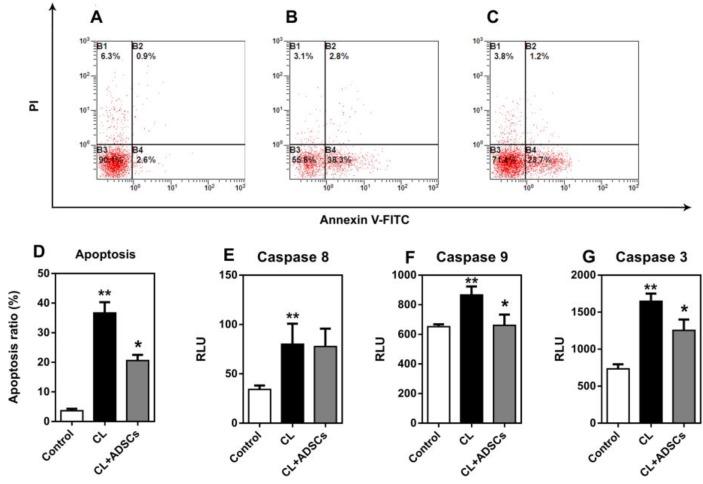
Human NP cells were cultured in compressive load at 3.0MPa for 48 hours with or without ADSCs co-culture (the ratio was 50:50). We used flow cytometry, live/dead staining and scanning electron microscopy (SEM) to evaluate cell death, and determined the expression of specific apoptotic pathways by characterizing the expression of activated caspases-3, -8 and -9. We further used real-time (RT-) PCR and immunostaining to determine the expression of the extracellular matrix (ECM), mediators of matrix degradation (e.g. MMPs, TIMPs and ADAMTSs), pro-inflammatory factors and NP cell phenotype markers.
RESULTS
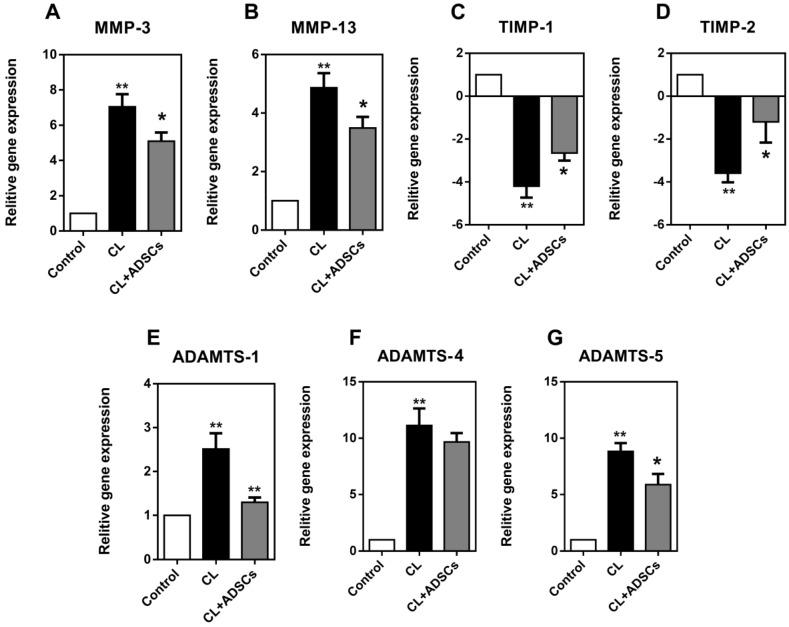
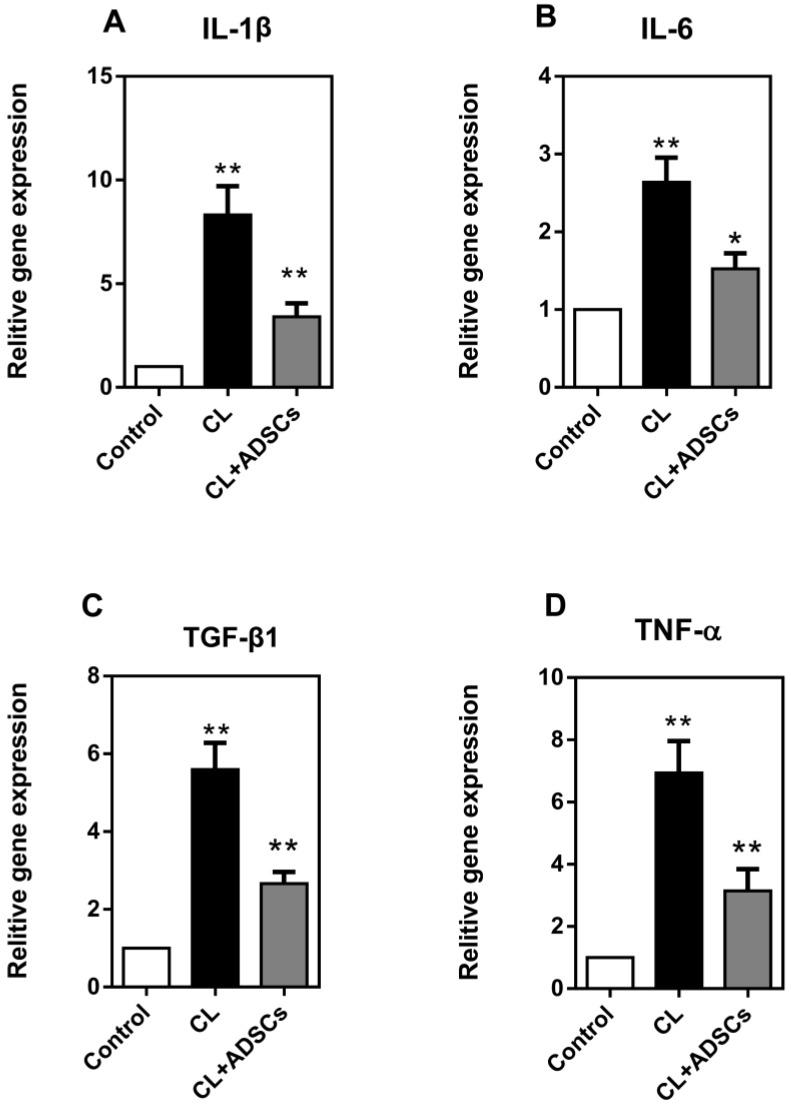
ADSCs inhibited human NP cell apoptosis via suppression of activated caspase-9 and caspase-3. Furthermore, ADSCs protected NP cells from the degradative effects of compressive load by significantly up-regulating the expression of ECM genes (SOX9, COL2A1 and ACAN), tissue inhibitors of metalloproteinases (TIMPs) genes (TIMP-1 and TIMP-2) and cytokeratin 8 (CK8) protein expression. Alternatively, ADSCs showed protective effect by inhibiting compressive load mediated increase of matrix metalloproteinases (MMPs; MMP-3 and MMP-13), disintegrin and metalloproteinase with thrombospondin motifs (ADAMTSs; ADAMTS-1 and 5), and pro-inflammatory factors (IL-1beta, IL-6, TGF-beta1 and TNF-alpha).
CONCLUSIONS
Our study is the first in vitro study assessing the impact of ADSCs on NP cells in an un-physiological mechanical stimulation culture environment. Our study noted that ADSCs protect compressive load induced NP cell death and degradation by inhibition of activated caspase-9 and -3 activity; regulating ECM and modulator genes, suppressing pro-inflammatory factors and preserving CK8. Consequently, the protective impact of ADSCs found in this study provides an essential understanding and expands our knowledge as to the utility of ADSCs therapy for intervertebral disc regeneration.
引言
异常生物力学在椎间盘退变中起作用。脂肪来源的基质细胞(ADSCs)与椎间盘完整性有关;然而,它们在椎间盘髓核(NP)受到机械刺激时所起的作用仍不清楚。因此,本研究旨在评估ADSCs在压缩负荷培养中对NP细胞的影响。
方法
将人NP细胞在3.0MPa的压缩负荷下培养48小时,有无ADSCs共培养(比例为50:50)。我们使用流式细胞术、活/死染色和扫描电子显微镜(SEM)评估细胞死亡,并通过检测活化的半胱天冬酶-3、-8和-9的表达来确定特定凋亡途径的表达。我们进一步使用实时(RT-)PCR和免疫染色来确定细胞外基质(ECM)、基质降解介质(如MMPs、TIMPs和ADAMTSs)、促炎因子和NP细胞表型标志物的表达。
结果
ADSCs通过抑制活化的半胱天冬酶-9和半胱天冬酶-3来抑制人NP细胞凋亡。此外,ADSCs通过显著上调ECM基因(SOX9、COL2A1和ACAN)、金属蛋白酶组织抑制剂(TIMPs)基因(TIMP-1和TIMP-2)的表达以及细胞角蛋白8(CK8)蛋白表达,保护NP细胞免受压缩负荷的降解作用。另外,ADSCs通过抑制压缩负荷介导的基质金属蛋白酶(MMPs;MMP-3和MMP-13)、含血小板反应蛋白基序的解聚素和金属蛋白酶(ADAMTSs;ADAMTS-1和5)以及促炎因子(IL-1β、IL-6、TGF-β1和TNF-α)的增加而显示出保护作用。
结论
我们的研究是第一项在非生理性机械刺激培养环境中评估ADSCs对NP细胞影响的体外研究。我们的研究指出,ADSCs通过抑制活化的半胱天冬酶-9和-3活性、调节ECM和调节基因、抑制促炎因子以及保留CK8来保护压缩负荷诱导的NP细胞死亡和降解。因此,本研究中发现的ADSCs的保护作用为ADSCs治疗椎间盘再生的效用提供了重要理解并扩展了我们的知识。




 Zotero 插件