
患有和未患有终末期肾病个体的金黄色葡萄球菌菌血症风险及预后:一项基于丹麦人群的队列研究。
Risk and prognosis of Staphylococcus aureus bacteremia among individuals with and without end-stage renal disease: a Danish, population-based cohort study.
作者信息
Nielsen Lise H, Jensen-Fangel Søren, Benfield Thomas, Skov Robert, Jespersen Bente, Larsen Anders R, Østergaard Lars, Støvring Henrik, Schønheyder Henrik C, Søgaard Ole S
机构信息
Department of Infectious Diseases, Aarhus University Hospital, Brendstrupgaardvej 100, 8200, Aarhus N, Denmark.
Department of Infectious Diseases, Hvidovre Hospital, University of Copenhagen, Copenhagen, Denmark.
出版信息
BMC Infect Dis. 2015 Jan 8;15:6. doi: 10.1186/s12879-014-0740-8.
BACKGROUND
Staphylococcus aureus is a leading cause of bloodstream infections among hemodialysis patients and of exit-site infections among peritoneal dialysis patients. However, the risk and prognosis of Staphylococcus aureus bacteremia among end-stage renal disease patients have not been delineated.
METHODS
In this Danish nationwide, population-based cohort study patients with end-stage renal disease and matched population controls were observed from end-stage renal disease diagnosis/sampling until first episode of Staphylococcus aureus bacteremia, death, or end of study period. Staphylococcus aureus positive blood cultures, hospitalization, comorbidity, and case fatality were obtained from nationwide microbiological, clinical, and administrative databases. Incidence rates and risk factors were assessed by regression analysis.
RESULTS
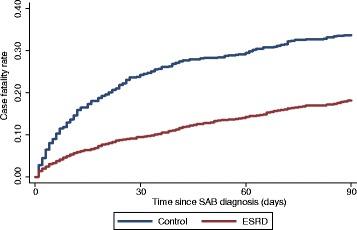
The incidence rate of Staphylococcus aureus bacteremia was very high for end-stage renal disease patients (35.7 per 1,000 person-years; 95% CI, 33.8-37.6) compared to population controls (0.5 per 1,000 person-years; 95% CI, 0.5-0.6), yielding a relative risk of 65.1 (95% CI, 59.6-71.2) which fell to 28.6 (95% CI, 23.3-35.3) after adjustment for sex, age, and comorbidity. After stratification for type of renal replacement therapy, we found the highest incidence rate of Staphylococcus aureus bacteremia among hemodialysis patients (46.3 per 1,000 person-years) compared to peritoneal dialysis patients (22.0 per 1,000 person-years) and renal transplant recipients (8.9 per 1,000 person-years). In persons with Staphylococcus aureus bacteremia, ninety-day case fatality was 18.2% (95% CI, 16.2%-20.3%) for end-stage renal disease patients and 33.7% (95% CI, 30.3-37.3) for population controls.
CONCLUSIONS
Patients with end-stage renal disease, and hemodialysis patients in particular, have greatly increased risk of Staphylococcus aureus bacteremia compared to population controls. Future challenges will be to develop strategies to reduce Staphylococcus aureus bacteremia-related morbidity and death in this high-risk population.
背景
金黄色葡萄球菌是血液透析患者血流感染以及腹膜透析患者出口部位感染的主要原因。然而,终末期肾病患者中金黄色葡萄球菌菌血症的风险和预后尚未明确。
方法
在这项丹麦全国性的基于人群的队列研究中,对终末期肾病患者及匹配的人群对照从终末期肾病诊断/采样开始,直至首次发生金黄色葡萄球菌菌血症、死亡或研究期结束进行观察。金黄色葡萄球菌血培养阳性、住院情况、合并症及病死率数据来自全国性的微生物学、临床及行政数据库。通过回归分析评估发病率及危险因素。
结果
与人群对照(每1000人年0.5例;95%可信区间,0.5 - 0.6)相比,终末期肾病患者金黄色葡萄球菌菌血症的发病率非常高(每1000人年35.7例;95%可信区间,33.8 - 37.6),相对风险为65.1(95%可信区间,59.6 - 71.2),在对性别、年龄和合并症进行调整后降至28.6(95%可信区间,23.3 - 35.3)。在按肾脏替代治疗类型分层后,我们发现血液透析患者中金黄色葡萄球菌菌血症的发病率最高(每1000人年46.3例),其次是腹膜透析患者(每1000人年22.0例)和肾移植受者(每1000人年8.9例)。在发生金黄色葡萄球菌菌血症的患者中,终末期肾病患者的90天病死率为18.2%(95%可信区间,16.2% - 20.3%),人群对照为33.7%(95%可信区间,30.3 - 37.3)。
结论
与人群对照相比,终末期肾病患者,尤其是血液透析患者,发生金黄色葡萄球菌菌血症的风险大幅增加。未来的挑战将是制定策略以降低这一高危人群中与金黄色葡萄球菌菌血症相关的发病率和死亡率。

 Zotero 插件