
18F-氟代脱氧葡萄糖正电子发射断层扫描(FDG-PET)对伊马替尼的代谢反应与KIT基因第11外显子突变相关,并可预测黏膜黑色素瘤患者的预后。
Metabolic response by FDG-PET to imatinib correlates with exon 11 KIT mutation and predicts outcome in patients with mucosal melanoma.
作者信息
Zukotynski Katherine, Yap Jeffrey T, Giobbie-Hurder Anita, Weber Jeffrey, Gonzalez Rene, Gajewski Thomas F, O'Day Steven, Kim Kevin, Hodi F Stephen, Van den Abbeele Annick D
出版信息
Cancer Imaging. 2014 Nov 12;14(1):30. doi: 10.1186/s40644-014-0030-0.
BACKGROUND
In patients with metastatic melanoma and KIT amplifications and/or mutations, therapy with imatinib mesylate may prolong survival. 18F-labeled 2-fluoro-2-deoxy-D-glucose (18F-FDG) PET/CT may be used to assess metabolic response. We investigated associations of metabolic response, mutational status, progression-free survival and overall survival in this population.
METHODS
Baseline and 4-week follow-up 18F-FDG-PET/CT were evaluated in 17 patients with metastatic melanoma and KIT amplifications and/or mutations treated with imatinib in a multicenter phase II clinical trial. The maximum standardized uptake values (SUVmax) were measured in up to 10 lesions on each scan. Metabolic response was classified using modified EORTC criteria. Each patient had a diagnostic CT or MR at baseline, after 6 weeks of therapy and then at intervals of 2 months and anatomic response was classified using RECIST 1.0. Median follow-up was 9.8 months.
RESULTS
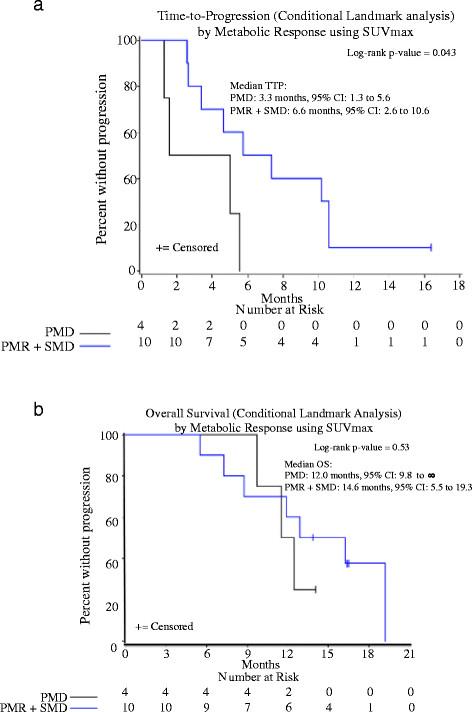
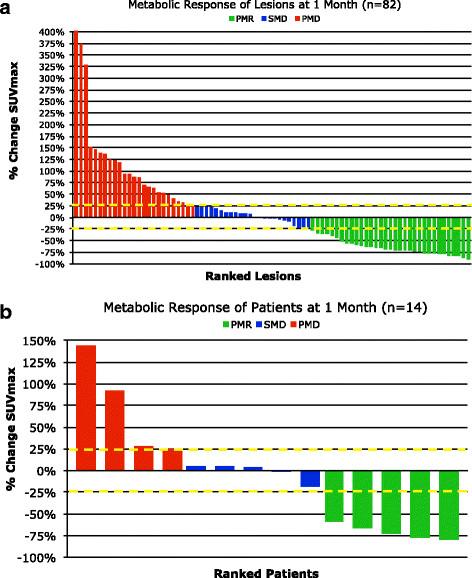
Partial metabolic response (PMR), stable metabolic disease (SMD) and progressive metabolic disease (PMD) was seen in 5 (29%), 5 (29%), and 7 (41%) patients respectively. Five patients (29%) had a KIT mutation in exon 11, four of whom (80%) had PMR while 1 (20%) had SMD. Twelve patients (71%) did not have a KIT mutation in exon 11, and only 1 (8%) had PMR, 4 (33%) had SMD and 7 (58%) had PMD. There was agreement of metabolic and anatomic classification in 12 of 17 patients (71%). Four of 17 patients (24%) had PR on both metabolic and anatomic imaging and all had a KIT mutation in exon 11. Survival of patients with PMD was lower than with SMD or PMR.
CONCLUSIONS
Metabolic response by 18F-FDG-PET/CT is associated with mutational status in metastatic melanoma patients treated with imatinib. 18F-FDG-PET/CT may be a predictor of outcome, although a larger study is needed to verify this.
CLINICAL TRIAL REGISTRATION
NCT00424515.
背景
在伴有KIT基因扩增和/或突变的转移性黑色素瘤患者中,甲磺酸伊马替尼治疗可能会延长生存期。18F标记的2-氟-2-脱氧-D-葡萄糖(18F-FDG)PET/CT可用于评估代谢反应。我们研究了该人群中代谢反应、突变状态、无进展生存期和总生存期之间的关联。
方法
在一项多中心II期临床试验中,对17例接受伊马替尼治疗的伴有KIT基因扩增和/或突变的转移性黑色素瘤患者的基线和4周随访时的18F-FDG-PET/CT进行了评估。在每次扫描中,对多达10个病灶测量最大标准化摄取值(SUVmax)。使用改良的欧洲癌症研究与治疗组织(EORTC)标准对代谢反应进行分类。每位患者在基线、治疗6周后以及随后每隔2个月进行一次诊断性CT或MR检查,并使用实体瘤疗效评价标准(RECIST)1.0对解剖学反应进行分类。中位随访时间为9.8个月。
结果
分别有5例(29%)、5例(29%)和7例(41%)患者出现部分代谢反应(PMR)、代谢稳定疾病(SMD)和进行性代谢疾病(PMD)。5例(29%)患者在第11外显子有KIT突变,其中4例(80%)有PMR,1例(20%)有SMD。12例(71%)患者在第11外显子没有KIT突变,只有1例(8%)有PMR,4例(33%)有SMD,7例(58%)有PMD。17例患者中有12例(71%)代谢和解剖学分类一致。17例患者中有4例(24%)在代谢和解剖学成像上均有部分缓解(PR),且均在第11外显子有KIT突变。PMD患者的生存期低于SMD或PMR患者。
结论
18F-FDG-PET/CT的代谢反应与接受伊马替尼治疗的转移性黑色素瘤患者的突变状态相关。18F-FDG-PET/CT可能是预后的一个预测指标,尽管需要更大规模的研究来证实这一点。
临床试验注册
NCT00424515。

 Zotero 插件