
将记忆功能磁共振成像应用于临床:颞叶癫痫中七种记忆功能磁共振成像协议的比较
Bringing memory fMRI to the clinic: comparison of seven memory fMRI protocols in temporal lobe epilepsy.
作者信息
Towgood Karren, Barker Gareth J, Caceres Alejandro, Crum William R, Elwes Robert D C, Costafreda Sergi G, Mehta Mitul A, Morris Robin G, von Oertzen Tim J, Richardson Mark P
机构信息
Department of Basic and Clinical Neuroscience, Institute of Psychiatry, Psychology and Neuroscience, King's College London, London, United Kingdom.
出版信息
Hum Brain Mapp. 2015 Apr;36(4):1595-608. doi: 10.1002/hbm.22726. Epub 2015 Mar 2.
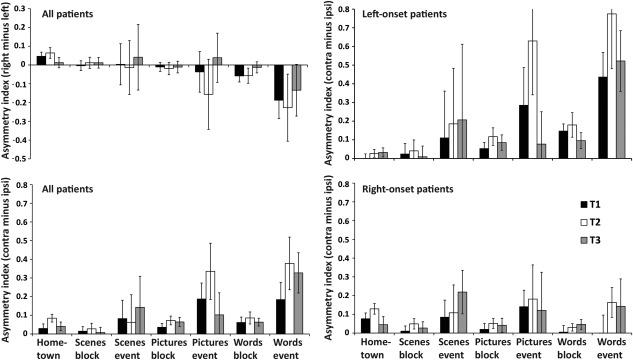
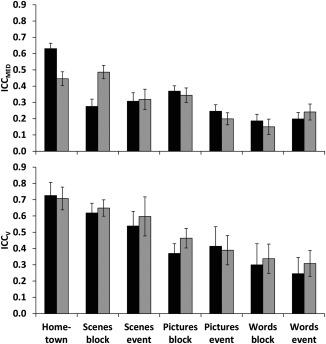
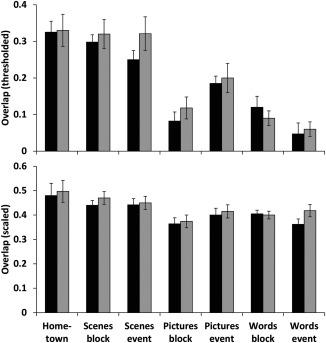
fMRI is increasingly implemented in the clinic to assess memory function. There are multiple approaches to memory fMRI, but limited data on advantages and reliability of different methods. Here, we compared effect size, activation lateralisation, and between-sessions reliability of seven memory fMRI protocols: Hometown Walking (block design), Scene encoding (block design and event-related design), Picture encoding (block and event-related), and Word encoding (block and event-related). All protocols were performed on three occasions in 16 patients with temporal lobe epilepsy (TLE). Group T-maps showed activity bilaterally in medial temporal lobe for all protocols. Using ANOVA, there was an interaction between hemisphere and seizure-onset lateralisation (P = 0.009) and between hemisphere, protocol and seizure-onset lateralisation (P = 0.002), showing that the distribution of memory-related activity between left and right temporal lobes differed between protocols and between patients with left-onset and right-onset seizures. Using voxelwise intraclass Correlation Coefficient, between-sessions reliability was best for Hometown and Scenes (block and event). The between-sessions spatial overlap of activated voxels was also greatest for Hometown and Scenes. Lateralisation of activity between hemispheres was most reliable for Scenes (block and event) and Words (event). Using receiver operating characteristic analysis to explore the ability of each fMRI protocol to classify patients as left-onset or right-onset TLE, only the Words (event) protocol achieved a significantly above-chance classification of patients at all three sessions. We conclude that Words (event) protocol shows the best combination of between-sessions reliability of the distribution of activity between hemispheres and reliable ability to distinguish between left-onset and right-onset patients.
功能磁共振成像(fMRI)在临床上越来越多地用于评估记忆功能。记忆fMRI有多种方法,但关于不同方法的优势和可靠性的数据有限。在这里,我们比较了七种记忆fMRI方案的效应大小、激活偏侧化和不同扫描间的可靠性:家乡行走(组块设计)、场景编码(组块设计和事件相关设计)、图片编码(组块和事件相关)以及单词编码(组块和事件相关)。所有方案均在16例颞叶癫痫(TLE)患者中进行了三次扫描。组T图显示所有方案在内侧颞叶均有双侧活动。使用方差分析,半球与癫痫发作起始偏侧化之间存在交互作用(P = 0.009),半球、方案与癫痫发作起始偏侧化之间也存在交互作用(P = 0.002),表明不同方案之间以及左发作和右发作癫痫患者之间,左右颞叶之间与记忆相关活动的分布存在差异。使用体素内类相关系数,家乡和场景(组块和事件)方案在不同扫描间的可靠性最佳。激活体素的不同扫描间空间重叠在家乡和场景方案中也最大。半球间活动的偏侧化在场景(组块和事件)和单词(事件)方案中最可靠。使用受试者工作特征分析来探索每个fMRI方案将患者分类为左发作或右发作TLE的能力,只有单词(事件)方案在所有三次扫描中对患者的分类均显著高于随机水平。我们得出结论,单词(事件)方案在半球间活动分布的不同扫描间可靠性以及区分左发作和右发作患者的可靠能力方面表现出最佳组合。
 Zotero 插件