
塞拉利昂埃博拉病毒传播的时间变化及其对控制要求的影响:一项实时建模研究
Temporal Changes in Ebola Transmission in Sierra Leone and Implications for Control Requirements: a Real-time Modelling Study.
作者信息
Camacho Anton, Kucharski Adam, Aki-Sawyerr Yvonne, White Mark A, Flasche Stefan, Baguelin Marc, Pollington Timothy, Carney Julia R, Glover Rebecca, Smout Elizabeth, Tiffany Amanda, Edmunds W John, Funk Sebastian
机构信息
Department of Infectious Disease Epidemiology, London School of Hygiene & Tropical Medicine, London, UK.
Quality Assurance Team, UK-Med Ebola Response Team; IDEA, London, UK.
出版信息
PLoS Curr. 2015 Feb 10;7:ecurrents.outbreaks.406ae55e83ec0b5193e30856b9235ed2. doi: 10.1371/currents.outbreaks.406ae55e83ec0b5193e30856b9235ed2.
BACKGROUND
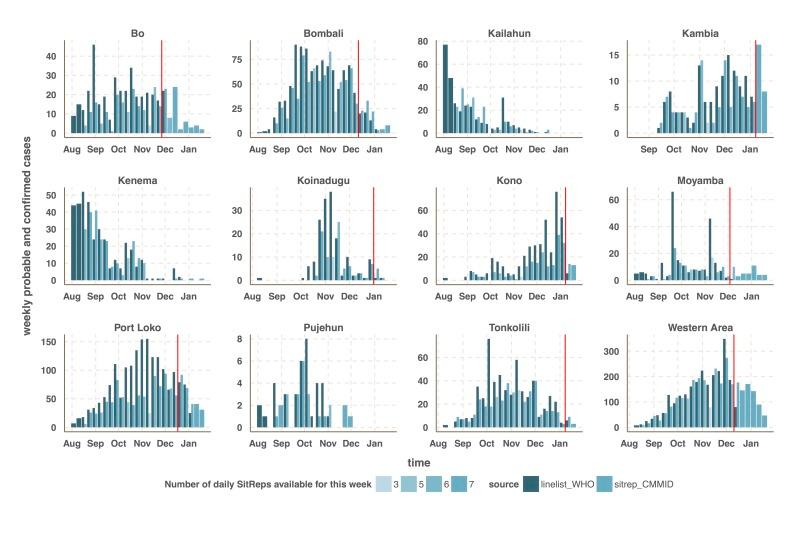
Between August and November 2014, the incidence of Ebola virus disease (EVD) rose dramatically in several districts of Sierra Leone. As a result, the number of cases exceeded the capacity of Ebola holding and treatment centres. During December, additional beds were introduced, and incidence declined in many areas. We aimed to measure patterns of transmission in different regions, and evaluate whether bed capacity is now sufficient to meet future demand.
METHODS
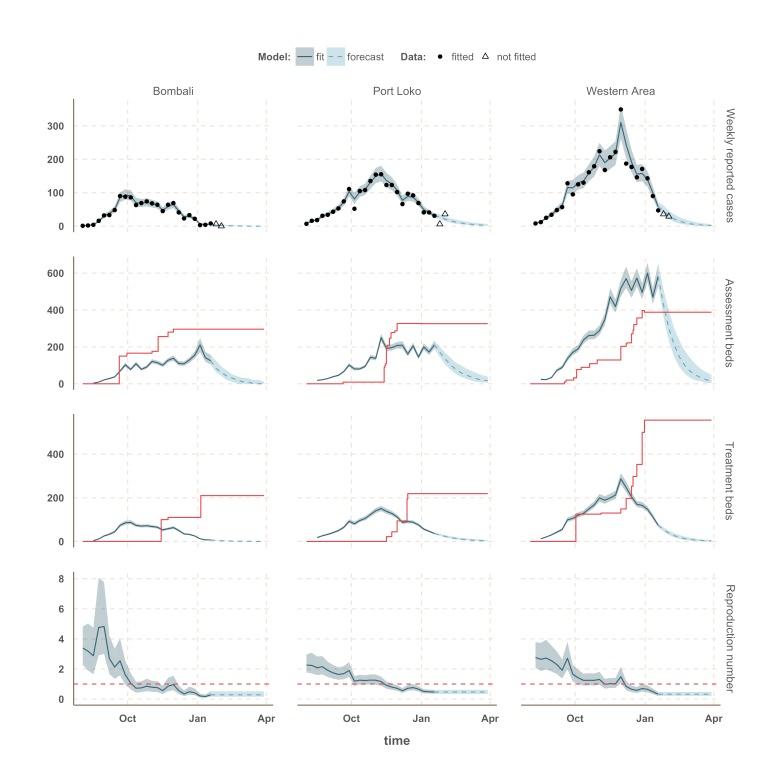
We used a mathematical model of EVD infection to estimate how the extent of transmission in the nine worst affected districts of Sierra Leone changed between 10th August 2014 and 18th January 2015. Using the model, we forecast the number of cases that could occur until the end of March 2015, and compared bed requirements with expected future capacity.
RESULTS
We found that the reproduction number, R, defined as the average number of secondary cases generated by a typical infectious individual, declined between August and December in all districts. We estimated that R was near the crucial control threshold value of 1 in December. We further estimated that bed capacity has lagged behind demand between August and December for most districts, but as a consequence of the decline in transmission, control measures caught up with the epidemic in early 2015.
CONCLUSIONS
EVD incidence has exhibited substantial temporal and geographical variation in Sierra Leone, but our results suggest that the epidemic may have now peaked in Sierra Leone, and that current bed capacity appears to be sufficient to keep the epidemic under-control in most districts.
背景
2014年8月至11月期间,埃博拉病毒病(EVD)在塞拉利昂的几个地区发病率急剧上升。结果,病例数超过了埃博拉隔离和治疗中心的收治能力。12月期间,增设了床位,许多地区发病率下降。我们旨在衡量不同地区的传播模式,并评估当前床位容量是否足以满足未来需求。
方法
我们使用埃博拉病毒病感染的数学模型,估计2014年8月10日至2015年1月18日期间塞拉利昂受影响最严重的9个地区的传播程度如何变化。利用该模型,我们预测了到2015年3月底可能出现的病例数,并将床位需求与预期的未来容量进行了比较。
结果
我们发现,基本再生数R(定义为典型感染个体产生的二代病例的平均数量)在8月至12月期间在所有地区均有所下降。我们估计12月时R接近关键控制阈值1。我们进一步估计,8月至12月期间大多数地区的床位容量滞后于需求,但由于传播率下降,控制措施在2015年初赶上了疫情。
结论
埃博拉病毒病发病率在塞拉利昂呈现出显著的时间和地理差异,但我们的结果表明,塞拉利昂疫情可能现已达到峰值,目前的床位容量似乎足以在大多数地区控制疫情。




 Zotero 插件