
通过有机和光氧化还原催化的烯丙基 sp(3) C-H 键的直接芳基化反应。
The direct arylation of allylic sp(3) C-H bonds via organic and photoredox catalysis.
机构信息
Merck Center for Catalysis at Princeton University, Princeton, New Jersey 08544, USA.
出版信息
Nature. 2015 Mar 5;519(7541):74-7. doi: 10.1038/nature14255.
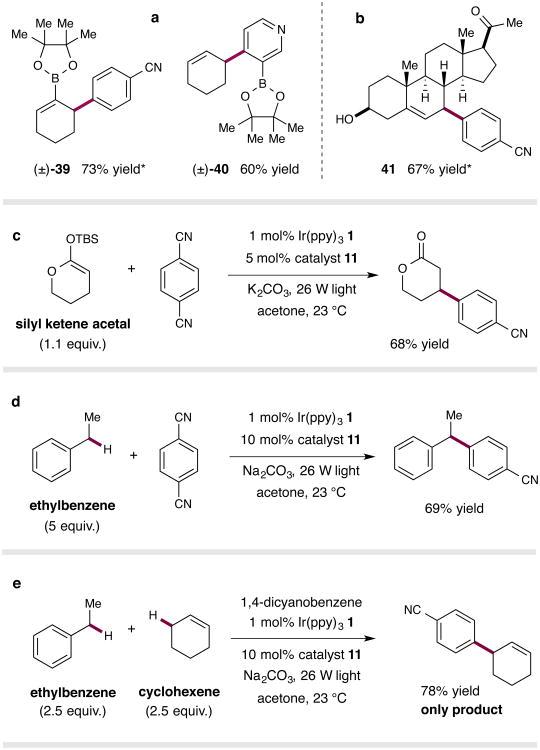
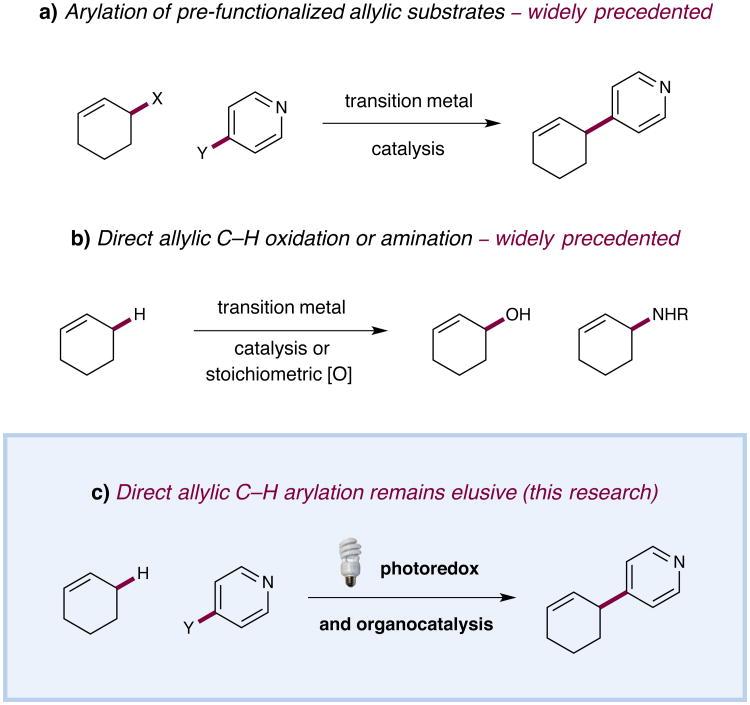
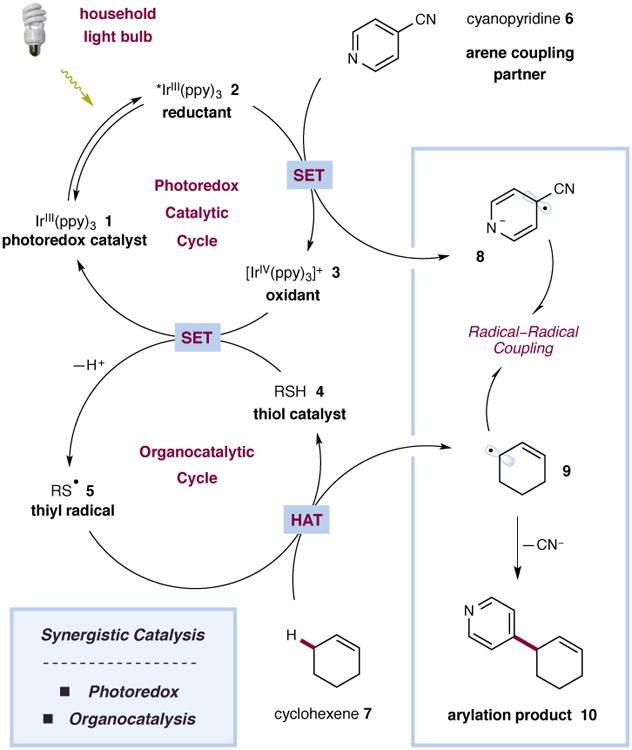
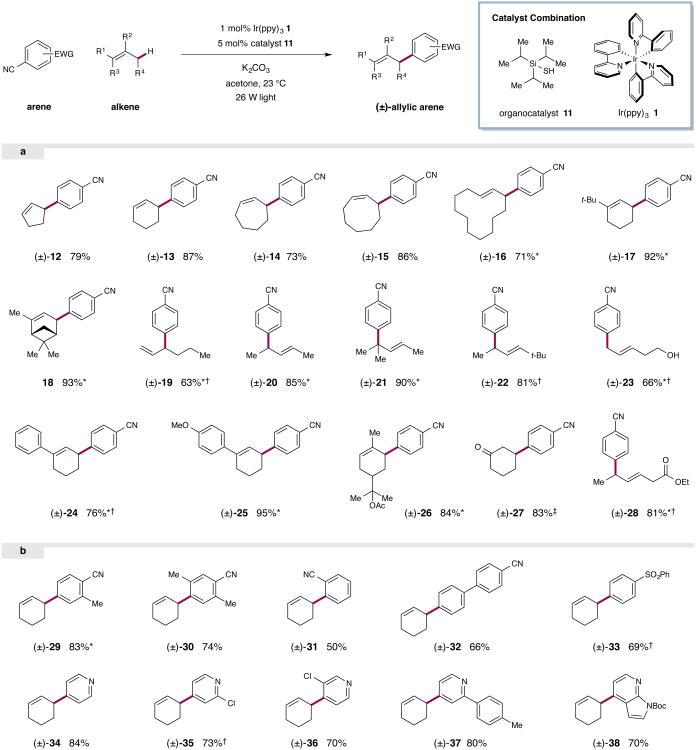
The direct functionalization of unactivated sp(3) C-H bonds is still one of the most challenging problems facing synthetic organic chemists. The appeal of such transformations derives from their capacity to facilitate the construction of complex organic molecules via the coupling of simple and otherwise inert building blocks, without introducing extraneous functional groups. Despite notable recent efforts, the establishment of general and mild strategies for the engagement of sp(3) C-H bonds in C-C bond forming reactions has proved difficult. Within this context, the discovery of chemical transformations that are able to directly functionalize allylic methyl, methylene and methine carbons in a catalytic manner is a priority. Although protocols for direct oxidation and amination of allylic C-H bonds (that is, C-H bonds where an adjacent carbon is involved in a C = C bond) have become widely established, the engagement of allylic substrates in C-C bond forming reactions has thus far required the use of pre-functionalized coupling partners. In particular, the direct arylation of non-functionalized allylic systems would enable access to a series of known pharmacophores (molecular features responsible for a drug's action), though a general solution to this long-standing challenge remains elusive. Here we report the use of both photoredox and organic catalysis to accomplish a mild, broadly effective direct allylic C-H arylation. This C-C bond forming reaction readily accommodates a broad range of alkene and electron-deficient arene reactants, and has been used in the direct arylation of benzylic C-H bonds.
未活化的 sp(3) C-H 键的直接官能化仍然是合成有机化学家面临的最具挑战性的问题之一。这种转化的吸引力源于它们能够通过简单的、否则惰性的构建块的偶联来构建复杂的有机分子,而无需引入额外的官能团。尽管最近做出了显著的努力,但建立用于 sp(3) C-H 键在 C-C 键形成反应中参与的通用和温和的策略仍然很困难。在这种情况下,发现能够以催化方式直接官能化烯丙基甲基、亚甲基和次甲基碳的化学转化是当务之急。尽管直接氧化和烯丙基 C-H 键(即相邻碳原子参与 C = C 键的 C-H 键)的胺化的方案已经得到广泛确立,但迄今为止,烯丙基底物在 C-C 键形成反应中的参与需要使用预官能化的偶联伙伴。特别是,非官能化的烯丙基体系的直接芳基化将能够获得一系列已知的药效团(负责药物作用的分子特征),尽管这个长期存在的挑战的通用解决方案仍然难以捉摸。在这里,我们报告了使用光氧化还原和有机催化来实现温和、广泛有效的直接烯丙基 C-H 芳基化。这种 C-C 键形成反应很容易适应广泛的烯烃和缺电子芳族反应物的范围,并已用于苄基 C-H 键的直接芳基化。
 Zotero 插件