
生命之树揭示了类似时钟的物种形成和多样化。
Tree of life reveals clock-like speciation and diversification.
作者信息
Hedges S Blair, Marin Julie, Suleski Michael, Paymer Madeline, Kumar Sudhir
机构信息
Center for Biodiversity, Temple University Institute for Genomics and Evolutionary Medicine, Temple University Department of Biology, Temple University
Center for Biodiversity, Temple University Institute for Genomics and Evolutionary Medicine, Temple University Department of Biology, Temple University.
出版信息
Mol Biol Evol. 2015 Apr;32(4):835-45. doi: 10.1093/molbev/msv037. Epub 2015 Mar 3.
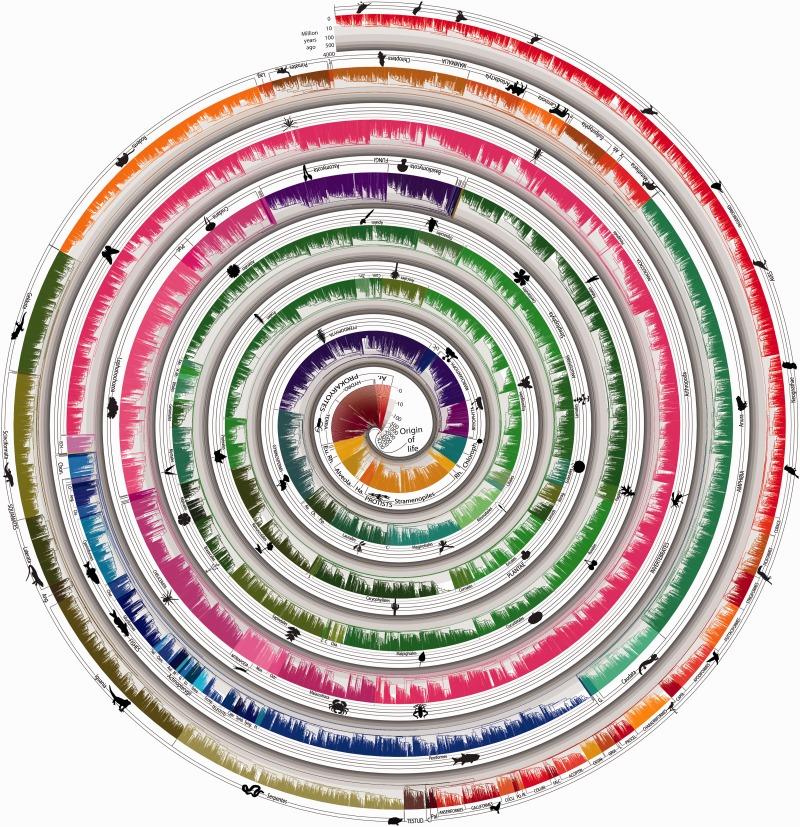
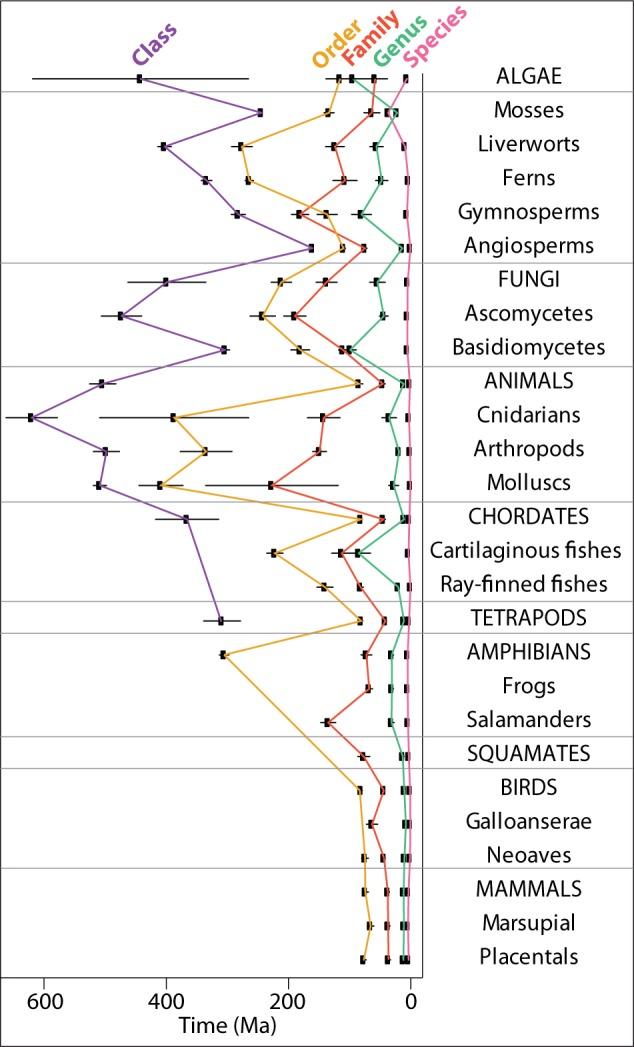
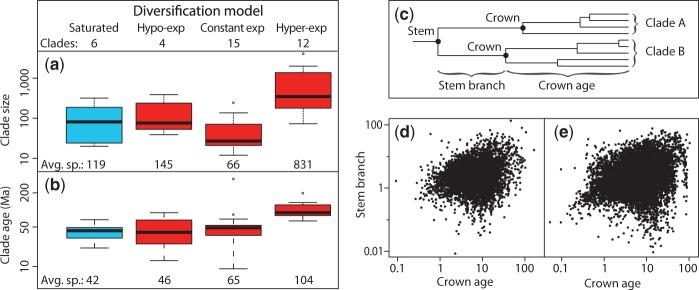
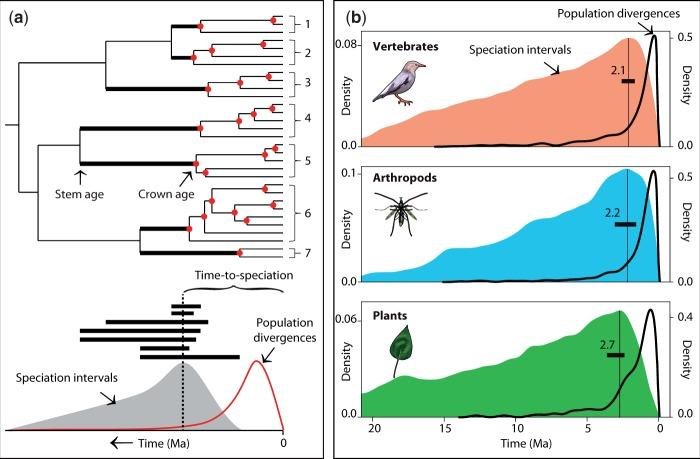
Genomic data are rapidly resolving the tree of living species calibrated to time, the timetree of life, which will provide a framework for research in diverse fields of science. Previous analyses of taxonomically restricted timetrees have found a decline in the rate of diversification in many groups of organisms, often attributed to ecological interactions among species. Here, we have synthesized a global timetree of life from 2,274 studies representing 50,632 species and examined the pattern and rate of diversification as well as the timing of speciation. We found that species diversity has been mostly expanding overall and in many smaller groups of species, and that the rate of diversification in eukaryotes has been mostly constant. We also identified, and avoided, potential biases that may have influenced previous analyses of diversification including low levels of taxon sampling, small clade size, and the inclusion of stem branches in clade analyses. We found consistency in time-to-speciation among plants and animals, ∼2 My, as measured by intervals of crown and stem species times. Together, this clock-like change at different levels suggests that speciation and diversification are processes dominated by random events and that adaptive change is largely a separate process.
基因组数据正在迅速解析校准到时间的现存物种树,即生命时间树,它将为不同科学领域的研究提供一个框架。先前对分类学受限的时间树的分析发现,许多生物类群的多样化速率下降,这通常归因于物种间的生态相互作用。在这里,我们从代表50632个物种的2274项研究中综合出一个全球生命时间树,并研究了多样化的模式和速率以及物种形成的时间。我们发现,总体而言以及在许多较小的物种组中,物种多样性大多在扩大,并且真核生物的多样化速率大多保持恒定。我们还识别并避免了可能影响先前多样化分析的潜在偏差,包括分类单元采样水平低、小分支大小以及在分支分析中纳入干群分支。我们发现,通过冠群和干群物种时间间隔衡量,动植物之间的物种形成时间具有一致性,约为200万年。不同层面上这种类似时钟的变化共同表明,物种形成和多样化是由随机事件主导的过程,而适应性变化在很大程度上是一个独立的过程。

 Zotero 插件