
野生大豆种质中根系结构相关基因的遗传变异,是改良栽培大豆的潜在资源。
Genetic variants in root architecture-related genes in a Glycine soja accession, a potential resource to improve cultivated soybean.
作者信息
Prince Silvas J, Song Li, Qiu Dan, Maldonado Dos Santos Joao V, Chai Chenglin, Joshi Trupti, Patil Gunvant, Valliyodan Babu, Vuong Tri D, Murphy Mackensie, Krampis Konstantinos, Tucker Dominic M, Biyashev Ruslan, Dorrance Anne E, Maroof M A Saghai, Xu Dong, Shannon J Grover, Nguyen Henry T
机构信息
National Center for Soybean Biotechnology and Division of Plant Sciences, University of Missouri, Columbia, MO, 65211, USA.
Christopher S. Bond Life Sciences Center, University of Missouri, Columbia, MO, 65211, USA.
出版信息
BMC Genomics. 2015 Feb 25;16(1):132. doi: 10.1186/s12864-015-1334-6.
BACKGROUND
Root system architecture is important for water acquisition and nutrient acquisition for all crops. In soybean breeding programs, wild soybean alleles have been used successfully to enhance yield and seed composition traits, but have never been investigated to improve root system architecture. Therefore, in this study, high-density single-feature polymorphic markers and simple sequence repeats were used to map quantitative trait loci (QTLs) governing root system architecture in an inter-specific soybean mapping population developed from a cross between Glycine max and Glycine soja.
RESULTS
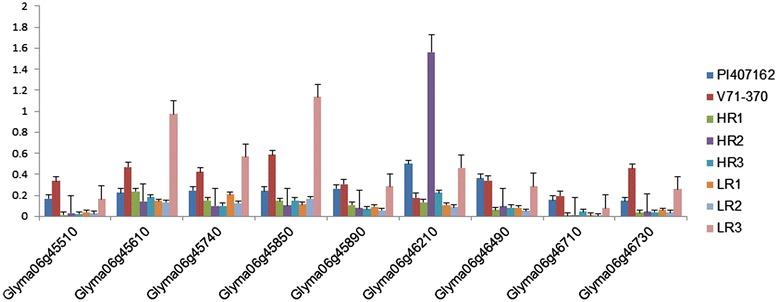
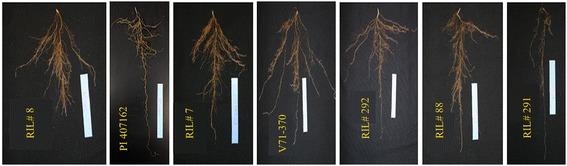
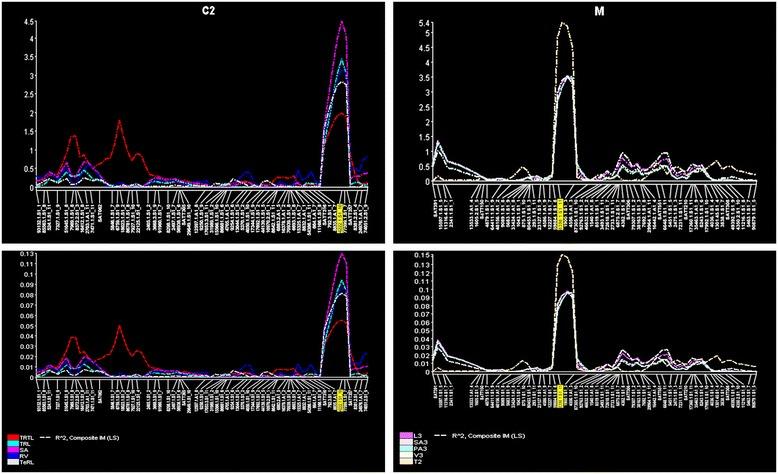
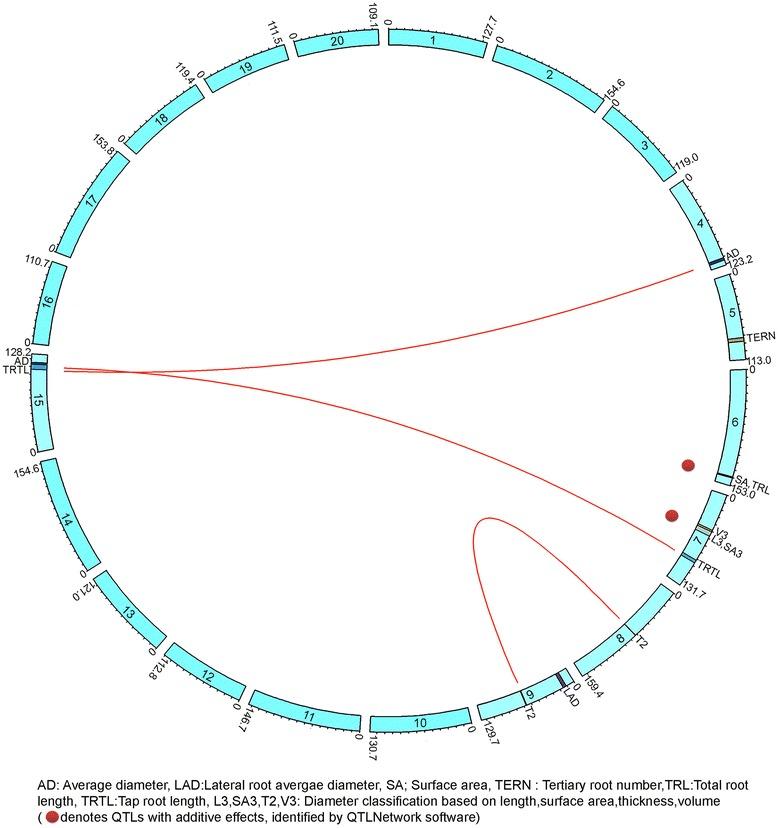
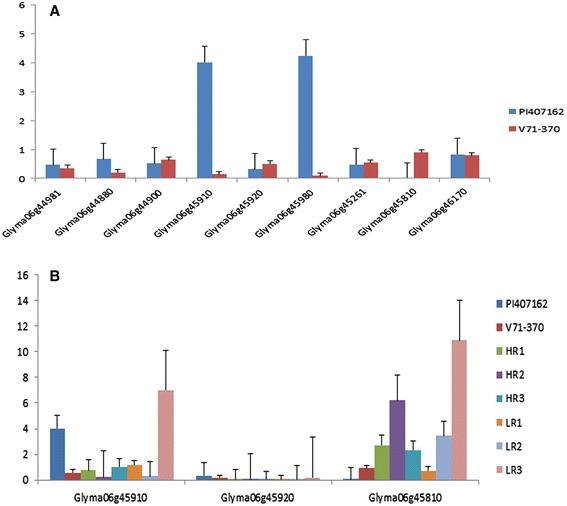
Wild and cultivated soybean both contributed alleles towards significant additive large effect QTLs on chromosome 6 and 7 for a longer total root length and root distribution, respectively. Epistatic effect QTLs were also identified for taproot length, average diameter, and root distribution. These root traits will influence the water and nutrient uptake in soybean. Two cell division-related genes (D type cyclin and auxin efflux carrier protein) with insertion/deletion variations might contribute to the shorter root phenotypes observed in G. soja compared with cultivated soybean. Based on the location of the QTLs and sequence information from a second G. soja accession, three genes (slow anion channel associated 1 like, Auxin responsive NEDD8-activating complex and peroxidase), each with a non-synonymous single nucleotide polymorphism mutation were identified, which may also contribute to changes in root architecture in the cultivated soybean. In addition, Apoptosis inhibitor 5-like on chromosome 7 and slow anion channel associated 1-like on chromosome 15 had epistatic interactions for taproot length QTLs in soybean.
CONCLUSION
Rare alleles from a G. soja accession are expected to enhance our understanding of the genetic components involved in root architecture traits, and could be combined to improve root system and drought adaptation in soybean.
背景
根系结构对所有作物获取水分和养分都很重要。在大豆育种计划中,野生大豆等位基因已成功用于提高产量和种子成分性状,但从未被研究用于改善根系结构。因此,在本研究中,利用高密度单特征多态性标记和简单序列重复来定位在由栽培大豆(Glycine max)和野生大豆(Glycine soja)杂交产生的种间大豆作图群体中控制根系结构的数量性状位点(QTL)。
结果
野生大豆和栽培大豆分别为6号和7号染色体上总根长更长和根分布更广的显著加性大效应QTL贡献了等位基因。还鉴定出了主根长度、平均直径和根分布的上位性效应QTL。这些根系性状将影响大豆对水分和养分的吸收。两个具有插入/缺失变异的细胞分裂相关基因(D型细胞周期蛋白和生长素外流载体蛋白)可能导致野生大豆与栽培大豆相比根系表型更短。基于QTL的位置和另一个野生大豆种质的序列信息,鉴定出三个基因(慢阴离子通道相关蛋白1样、生长素响应型NEDD8激活复合物和过氧化物酶),每个基因都有一个非同义单核苷酸多态性突变,这也可能导致栽培大豆根系结构的变化。此外,7号染色体上的凋亡抑制因子5样和15号染色体上的慢阴离子通道相关蛋白1样在大豆主根长度QTL上存在上位性相互作用。
结论
野生大豆种质中的稀有等位基因有望增进我们对根系结构性状相关遗传成分的理解,并可用于改良大豆根系系统和干旱适应性。



 Zotero 插件