
通过抑制非同源末端连接提高CRISPR-Cas9精确基因组编辑的效率
Increasing the efficiency of precise genome editing with CRISPR-Cas9 by inhibition of nonhomologous end joining.
作者信息
Maruyama Takeshi, Dougan Stephanie K, Truttmann Matthias C, Bilate Angelina M, Ingram Jessica R, Ploegh Hidde L
机构信息
Whitehead Institute for Biomedical Research, Cambridge, Massachusetts, USA.
1] Whitehead Institute for Biomedical Research, Cambridge, Massachusetts, USA. [2] Department of Biology, Massachusetts Institute of Technology, Cambridge, Massachusetts, USA.
出版信息
Nat Biotechnol. 2015 May;33(5):538-42. doi: 10.1038/nbt.3190. Epub 2015 Mar 23.
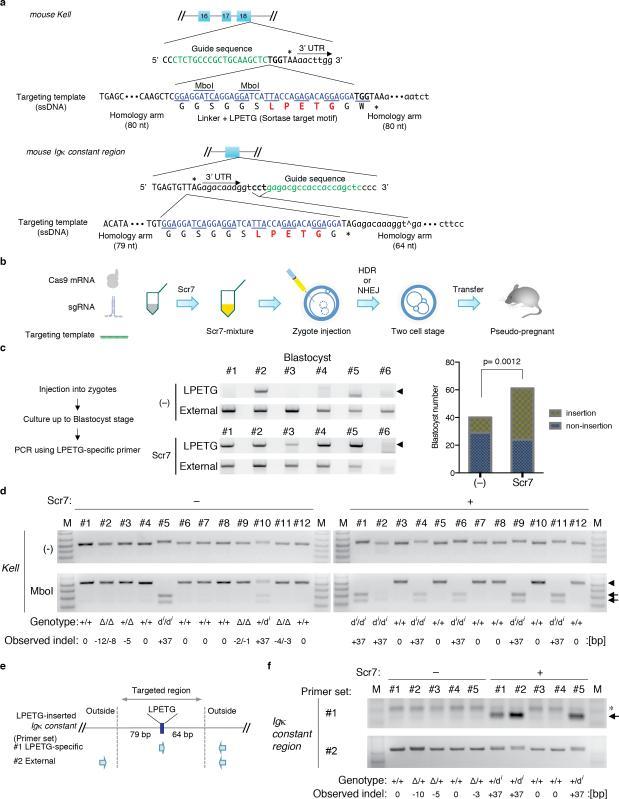
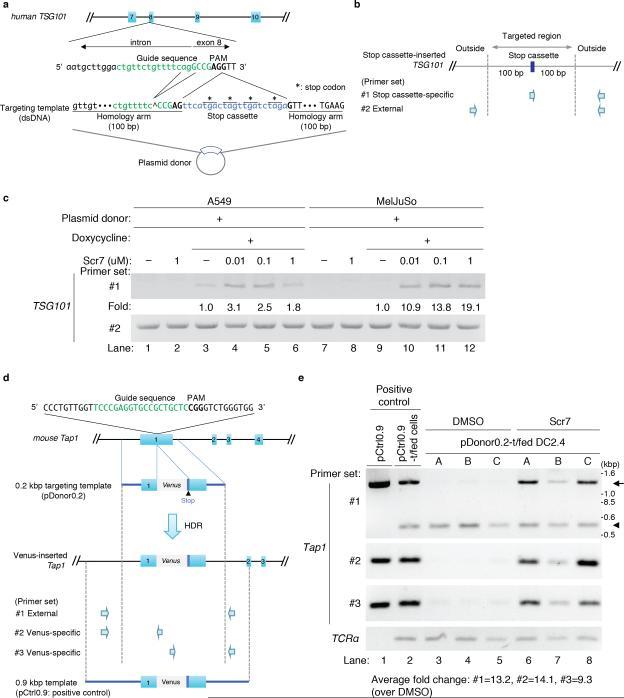
Methods to introduce targeted double-strand breaks (DSBs) into DNA enable precise genome editing by increasing the rate at which externally supplied DNA fragments are incorporated into the genome through homologous recombination. The efficiency of these methods is limited by nonhomologous end joining (NHEJ), an alternative DNA repair pathway that competes with homology-directed repair (HDR). To promote HDR at the expense of NHEJ, we targeted DNA ligase IV, a key enzyme in the NHEJ pathway, using the inhibitor Scr7. Scr7 treatment increased the efficiency of HDR-mediated genome editing, using Cas9 in mammalian cell lines and in mice for all four genes examined, up to 19-fold. This approach should be applicable to other customizable endonucleases, such as zinc finger nucleases and transcription activator-like effector nucleases, and to nonmammalian cells with sufficiently conserved mechanisms of NHEJ and HDR.
将靶向双链断裂(DSB)引入DNA的方法,可通过提高外源供应的DNA片段通过同源重组整合到基因组中的速率,实现精确的基因组编辑。这些方法的效率受到非同源末端连接(NHEJ)的限制,NHEJ是一种与同源定向修复(HDR)竞争的替代性DNA修复途径。为了以牺牲NHEJ为代价促进HDR,我们使用抑制剂Scr7靶向DNA连接酶IV,这是NHEJ途径中的一种关键酶。在所有检测的四个基因中,Scr7处理提高了哺乳动物细胞系和小鼠中使用Cas9的HDR介导的基因组编辑效率,提高了19倍。这种方法应该适用于其他可定制的核酸内切酶,如锌指核酸酶和转录激活因子样效应物核酸酶,以及具有足够保守的NHEJ和HDR机制的非哺乳动物细胞。
 Zotero 插件