
进食高脂肪食物会降低青少年和成年雄性大鼠的多巴胺清除率,但会选择性增强青少年时期可卡因的运动刺激作用。
Eating high fat chow decreases dopamine clearance in adolescent and adult male rats but selectively enhances the locomotor stimulating effects of cocaine in adolescents.
机构信息
Departments of Pharmacology (Drs Baladi, Daws, and France), Psychiatry (Dr France), and Physiology (Ms. Horton, Mr. Owens, and Dr. Daws), University of Texas Health Science Center at San Antonio, San Antonio, Texas.
Departments of Pharmacology (Drs Baladi, Daws, and France), Psychiatry (Dr France), and Physiology (Ms. Horton, Mr. Owens, and Dr. Daws), University of Texas Health Science Center at San Antonio, San Antonio, Texas
出版信息
Int J Neuropsychopharmacol. 2015 Mar 24;18(7):pyv024. doi: 10.1093/ijnp/pyv024.
BACKGROUND
Feeding conditions can influence dopamine neurotransmission and impact behavioral and neurochemical effects of drugs acting on dopamine systems. This study examined whether eating high fat chow alters the locomotor effects of cocaine and dopamine transporter activity in adolescent (postnatal day 25) and adult (postnatal day 75) male Sprague-Dawley rats.
METHODS
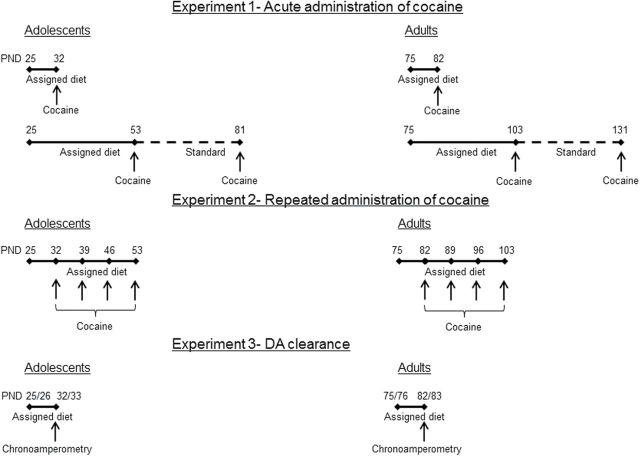
Dose-response curves for cocaine-induced locomotor activity were generated in rats with free access to either standard or high fat chow or restricted access to high fat chow (body weight matched to rats eating standard chow).
RESULTS
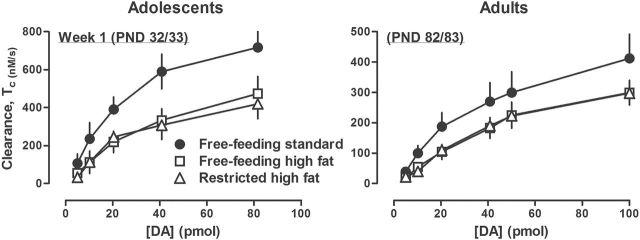
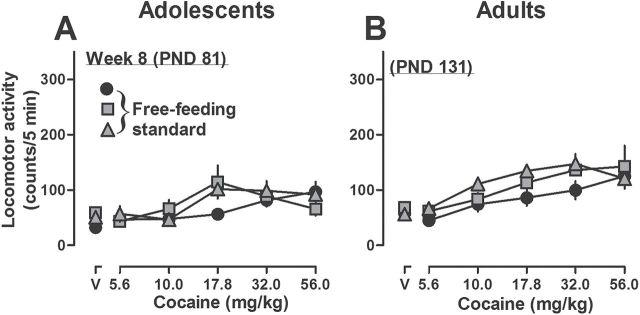
Compared with eating standard chow, eating high fat chow increased the sensitivity of adolescent, but not adult, rats to the acute effects of cocaine. When tested once per week, sensitization to the locomotor effects of cocaine was enhanced in adolescent rats eating high fat chow compared with adolescent rats eating standard chow. Sensitization to cocaine was not different among feeding conditions in adults. When adolescent rats that previously ate high fat chow ate standard chow, sensitivity to cocaine returned to normal. As measured by chronoamperometry, dopamine clearance rate in striatum was decreased in both adolescent and adult rats eating high fat chow compared with age-matched rats eating standard chow.
CONCLUSIONS
These results suggest that high fat diet-induced reductions in dopamine clearance rate do not always correspond to increased sensitivity to the locomotor effects of cocaine, suggesting that mechanisms other than dopamine transporter might play a role. Moreover, in adolescent but not adult rats, eating high fat chow increases sensitivity to cocaine and enhances the sensitization that develops to cocaine.
背景
喂养条件会影响多巴胺神经传递,并影响作用于多巴胺系统的药物的行为和神经化学效应。本研究探讨了高脂饮食是否会改变可卡因对青少年(出生后 25 天)和成年(出生后 75 天)雄性 Sprague-Dawley 大鼠的运动效应和多巴胺转运体活性。
方法
在自由进食标准或高脂饲料或限制进食高脂饲料(体重与进食标准饲料的大鼠匹配)的大鼠中生成可卡因诱导的运动活性的剂量-反应曲线。
结果
与进食标准饲料相比,进食高脂饲料增加了青少年大鼠而非成年大鼠对可卡因急性作用的敏感性。每周测试一次时,与进食标准饲料的青少年大鼠相比,进食高脂饲料的青少年大鼠对可卡因的运动效应的敏感性增强。在成年大鼠中,不同喂养条件下对可卡因的敏感性没有差异。当先前进食高脂饲料的青少年大鼠进食标准饲料时,对可卡因的敏感性恢复正常。通过 chronoamperometry 测量,与进食标准饲料的同龄大鼠相比,进食高脂饲料的青少年和成年大鼠的纹状体多巴胺清除率降低。
结论
这些结果表明,高脂肪饮食引起的多巴胺清除率降低并不总是与对可卡因运动效应的敏感性增加相对应,表明除了多巴胺转运体之外,其他机制可能起作用。此外,在青少年但不是成年大鼠中,进食高脂饲料会增加对可卡因的敏感性,并增强对可卡因的敏感性发展。




 Zotero 插件