
用于抗体生产的市售CHO细胞培养基的基准测试。
Benchmarking of commercially available CHO cell culture media for antibody production.
作者信息
Reinhart David, Damjanovic Lukas, Kaisermayer Christian, Kunert Renate
机构信息
Vienna Institute of BioTechnology, Department of Biotechnology, University of Natural Resources and Life Sciences,Vienna, Muthgasse 11, 1190, Vienna, Austria,
出版信息
Appl Microbiol Biotechnol. 2015 Jun;99(11):4645-57. doi: 10.1007/s00253-015-6514-4. Epub 2015 Apr 7.
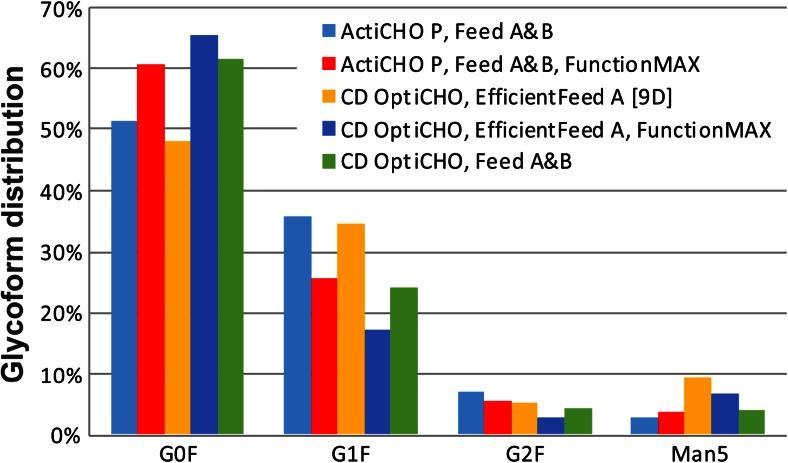
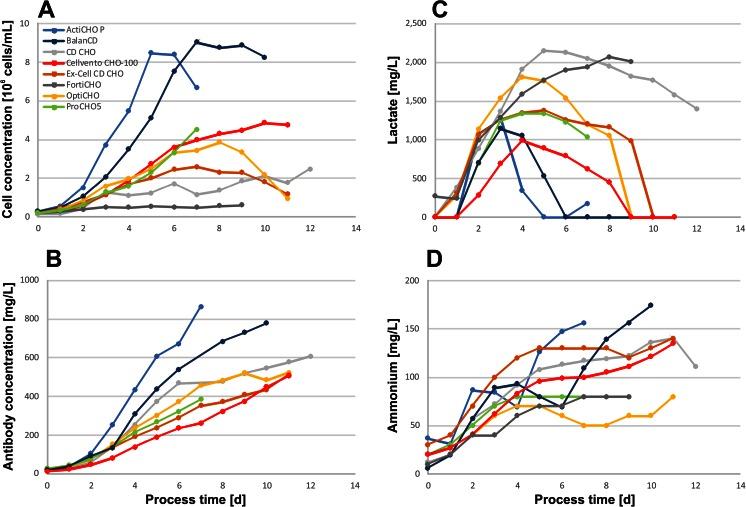
In this study, eight commercially available, chemically defined Chinese hamster ovary (CHO) cell culture media from different vendors were evaluated in batch culture using an IgG-producing CHO DG44 cell line as a model. Medium adaptation revealed that the occurrence of even small aggregates might be a good indicator of cell growth performance in subsequent high cell density cultures. Batch experiments confirmed that the culture medium has a significant impact on bioprocess performance, but high amino acid concentrations alone were not sufficient to ensure superior cell growth and high antibody production. However, some key amino acids that were limiting in most media could be identified. Unbalanced glucose and amino acids led to high cell-specific lactate and ammonium production rates. In some media, persistently high glucose concentrations probably induced the suppression of respiration and oxidative phosphorylation, known as Crabtree effect, which resulted in high cell-specific glycolysis rates along with a continuous and high lactate production. In additional experiments, two of the eight basal media were supplemented with feeds from two different manufacturers in six combinations, in order to understand the combined impact of media and feeds on cell metabolism in a CHO fed-batch process. Cell growth, nutrient consumption and metabolite production rates, antibody production, and IgG quality were evaluated in detail. Concentrated feed supplements boosted cell concentrations almost threefold and antibody titers up to sevenfold. Depending on the fed-batch strategy, fourfold higher peak cell concentrations and eightfold increased IgG titers (up to 5.8 g/L) were achieved. The glycolytic flux was remarkably similar among the fed-batches; however, substantially different specific lactate production rates were observed in the different media and feed combinations. Further analysis revealed that in addition to the feed additives, the basal medium can make a considerable contribution to the ammonium metabolism of the cells. The glycosylation of the recombinant antibody was influenced by the selection of basal medium and feeds. Differences of up to 50 % in the monogalacto-fucosylated (G1F) and high mannose fraction of the IgG were observed.
在本研究中,以产生IgG的中国仓鼠卵巢(CHO)DG44细胞系为模型,在分批培养中对来自不同供应商的8种市售化学限定型CHO细胞培养基进行了评估。培养基适应性研究表明,即使是少量聚集体的出现也可能是后续高细胞密度培养中细胞生长性能的良好指标。分批实验证实,培养基对生物过程性能有显著影响,但仅高氨基酸浓度不足以确保优异的细胞生长和高抗体产量。然而,可以确定大多数培养基中存在限制作用的一些关键氨基酸。葡萄糖和氨基酸的不平衡导致细胞特异性乳酸和铵的高产率。在某些培养基中,持续高葡萄糖浓度可能诱导了呼吸和氧化磷酸化的抑制,即所谓的Crabtree效应,这导致细胞特异性糖酵解速率升高以及持续高乳酸产量。在额外的实验中,将8种基础培养基中的两种与来自两个不同制造商的补料以六种组合进行补充,以了解培养基和补料对CHO补料分批培养过程中细胞代谢的综合影响。详细评估了细胞生长、营养物质消耗和代谢产物产率、抗体产生以及IgG质量。浓缩补料补充剂使细胞浓度提高了近三倍,抗体滴度提高了七倍。根据补料分批策略,实现了四倍更高的峰值细胞浓度和八倍增加的IgG滴度(高达5.8 g/L)。补料分批培养之间的糖酵解通量非常相似;然而,在不同的培养基和补料组合中观察到了显著不同的细胞特异性乳酸产率。进一步分析表明,除了补料添加剂外,基础培养基对细胞的铵代谢也有相当大的贡献。重组抗体的糖基化受基础培养基和补料选择的影响。观察到IgG的单半乳糖岩藻糖基化(G1F)和高甘露糖部分的差异高达50%。

 Zotero 插件