
BRAF 突变型黑色素瘤中卓越应答者的下一代测序:对敏感性和耐药性的影响
Next generation sequencing of exceptional responders with BRAF-mutant melanoma: implications for sensitivity and resistance.
作者信息
Wheler Jennifer, Yelensky Roman, Falchook Gerald, Kim Kevin B, Hwu Patrick, Tsimberidou Apostolia M, Stephens Philip J, Hong David, Cronin Maureen T, Kurzrock Razelle
机构信息
Department of Investigational Cancer Therapeutics - a Phase I Clinical Trials Program, Unit 455, The University of Texas MD Anderson Cancer Center, 1515 Holcombe Blvd, Houston, TX, 77030, USA.
Foundation Medicine, 150 Second Street, Cambridge, MA, 02141, USA.
出版信息
BMC Cancer. 2015 Feb 18;15:61. doi: 10.1186/s12885-015-1029-z.
BACKGROUND
Patients with BRAF mutation-positive advanced melanoma respond well to matched therapy with BRAF or MEK inhibitors, but often quickly develop resistance.
METHODS
Tumor tissue from ten patients with advanced BRAF mutation-positive melanoma who achieved partial response (PR) or complete response (CR) on BRAF and/or MEK inhibitors was analyzed using next generation sequencing (NGS) assay. Genomic libraries were captured for 3230 exons in 182 cancer-related genes plus 37 introns from 14 genes often rearranged in cancer and sequenced to average median depth of 734X with 99% of bases covered >100X.
RESULTS
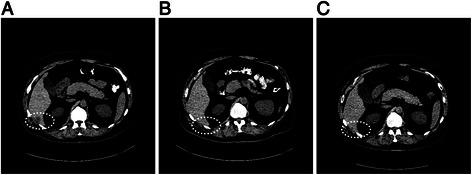
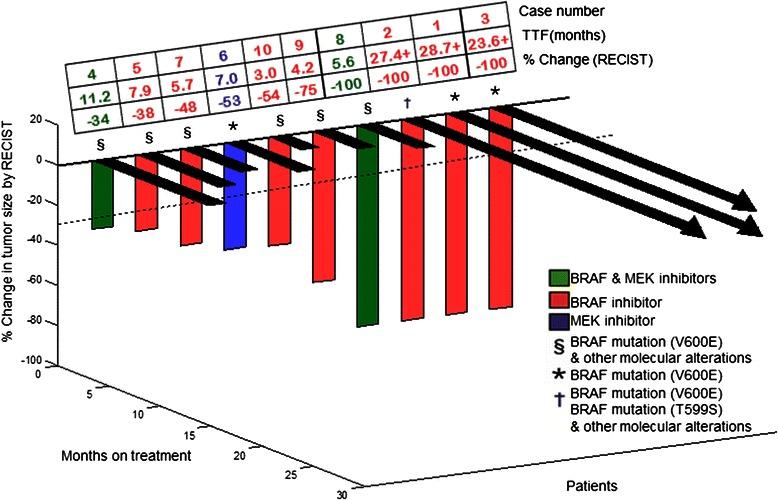
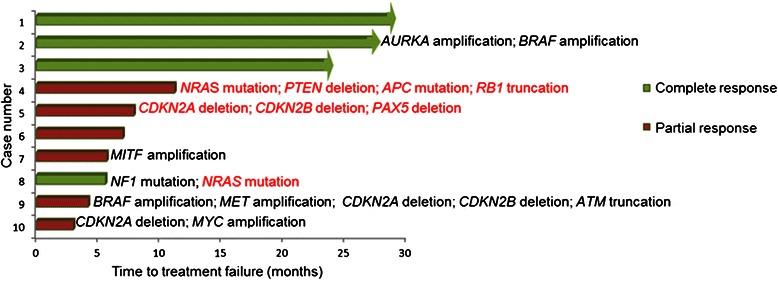
Three of the ten patients (median number of prior therapies = 2) attained prolonged CR (duration = 23.6+ to 28.7+ months); seven patients achieved either a PR or a short-lived CR. One patient who achieved CR ongoing at 28.7+ months and had tissue available close to the time of initiating BRAF inhibitor therapy had only a BRAF mutation. Abnormalities in addition to BRAF mutation found in other patients included: mutations in NRAS, APC and NF1; amplifications in BRAF, aurora kinase A, MYC, MITF and MET; deletions in CDKN2A/B and PAX5; and, alterations in RB1 and ATM. Heterogeneity between patients and molecular evolution within patients was noted.
CONCLUSION
NGS identified potentially actionable DNA alterations that could account for resistance in patients with BRAF mutation-positive advanced melanoma who achieved a PR or CR but whose tumors later progressed. A subset of patients with advanced melanoma may harbor only a BRAF mutation and achieve a durable CR on BRAF pathway inhibitors.
背景
BRAF 突变阳性的晚期黑色素瘤患者对 BRAF 或 MEK 抑制剂的匹配治疗反应良好,但通常会迅速产生耐药性。
方法
使用下一代测序(NGS)分析对 10 例 BRAF 突变阳性晚期黑色素瘤患者的肿瘤组织进行分析,这些患者在 BRAF 和/或 MEK 抑制剂治疗后达到部分缓解(PR)或完全缓解(CR)。对 182 个癌症相关基因中的 3230 个外显子以及 14 个在癌症中常发生重排的基因的 37 个内含子进行基因组文库捕获,并测序至平均中位深度为 734X,99%的碱基覆盖度>100X。
结果
10 例患者中的 3 例(既往治疗的中位数=2)获得了长期 CR(持续时间=23.6+至 28.7+个月);7 例患者达到 PR 或短期 CR。1 例在 28.7+个月时仍处于 CR 状态且在开始 BRAF 抑制剂治疗时附近有可用组织的患者仅存在 BRAF 突变。在其他患者中除 BRAF 突变外发现的异常包括:NRAS、APC 和 NF1 突变;BRAF、极光激酶 A、MYC、MITF 和 MET 扩增;CDKN2A/B 和 PAX5 缺失;以及 RB1 和 ATM 改变。注意到患者之间的异质性和患者体内的分子进化。
结论
NGS鉴定出潜在的可操作的DNA改变,这些改变可能解释了在BRAF突变阳性晚期黑色素瘤患者中达到PR或CR但肿瘤随后进展的耐药性。一部分晚期黑色素瘤患者可能仅存在BRAF突变,并在BRAF通路抑制剂治疗下获得持久的CR。
 Zotero 插件