
甲氟喹对大鼠两种急性模型诱发的全身强直阵挛性癫痫发作的抗惊厥作用。
Anticonvulsant effects of mefloquine on generalized tonic-clonic seizures induced by two acute models in rats.
作者信息
Franco-Pérez Javier, Ballesteros-Zebadúa Paola, Manjarrez-Marmolejo Joaquín
机构信息
Laboratory of Physiology of Reticular Formation, National Institute of Neurology and Neurosurgery, M.V.S, Insurgentes Sur 3877, Col. La Fama, C.P. 14269, Mexico, DF, Mexico.
Laboratory of Medical Physics, National Institute of Neurology and Neurosurgery, M.V.S, Mexico, DF, Mexico.
出版信息
BMC Neurosci. 2015 Mar 1;16:7. doi: 10.1186/s12868-015-0145-7.
BACKGROUND
Mefloquine can cross the blood-brain barrier and block the gap junction intercellular communication in the brain. Enhanced electrical coupling mediated by gap junctions is an underlying mechanism involved in the generation and maintenance of seizures. For this reason, the aim of this study was to analyze the effects of the systemic administration of mefloquine on tonic-clonic seizures induced by two acute models such as pentylenetetrazole and maximal electroshock.
RESULTS
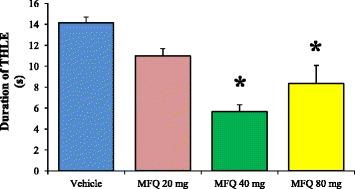
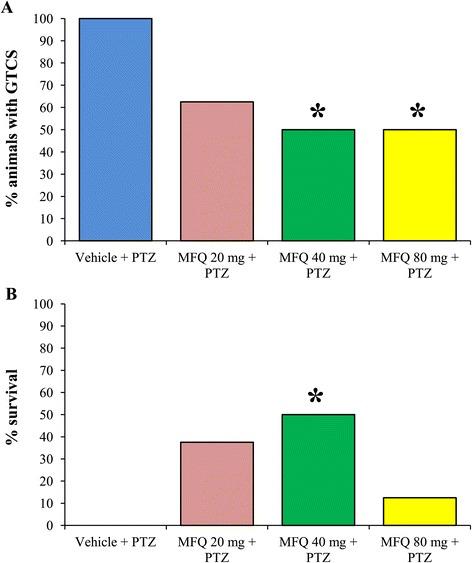
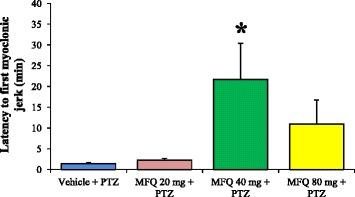
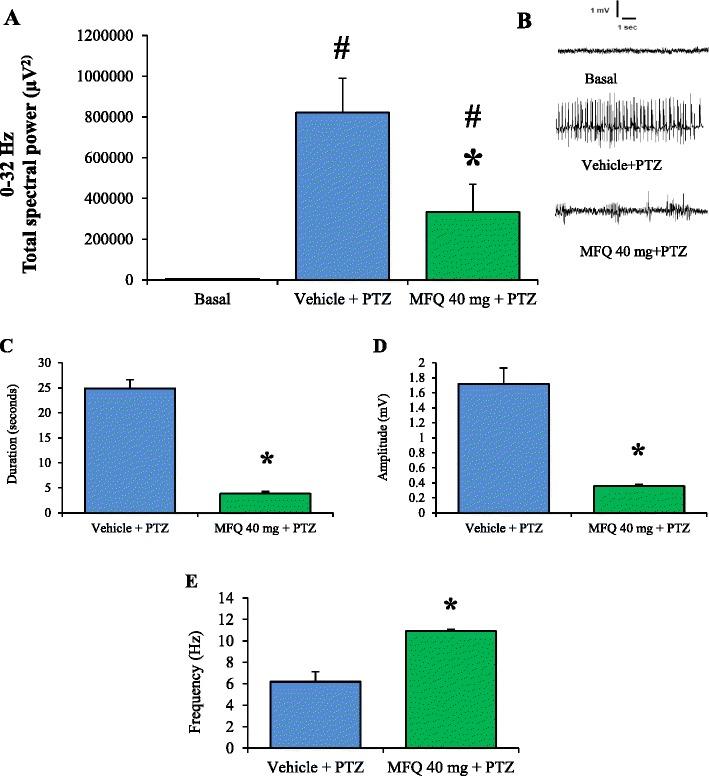
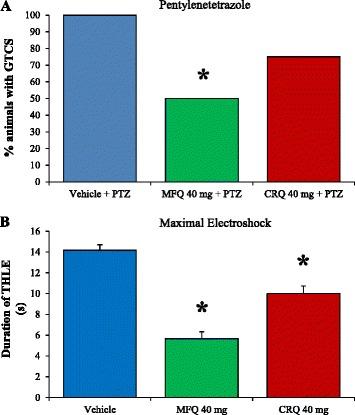
All the control rats presented generalized tonic-clonic seizures after the administration of pentylenetetrazole. However, the incidence of seizures induced by pentylenetetrazole significantly decreased in the groups administered systematically with 40 and 80 mg/kg of mefloquine. In the control group, none of the rats survived after the generalized tonic-clonic seizures induced by pentylenetetrazole, but survival was improved by mefloquine. Besides, mefloquine significantly modified the total spectral power as well as the duration, amplitude and frequency of the epileptiform activity induced by pentylenetetrazole. For the maximal electroshock model, mefloquine did not change the occurrence of tonic hindlimb extension. However, this gap junction blocker significantly decreased the duration of the tonic hindlimb extension induced by the acute electroshock.
CONCLUSIONS
These data suggest that mefloquine at low doses might be eliciting some anticonvulsant effects when is systemically administered to rats.
背景
甲氟喹可穿过血脑屏障并阻断大脑中的缝隙连接细胞间通讯。由缝隙连接介导的增强电耦合是癫痫发作产生和维持的潜在机制。因此,本研究的目的是分析全身给予甲氟喹对由戊四氮和最大电休克这两种急性模型诱导的强直阵挛性发作的影响。
结果
所有对照大鼠在给予戊四氮后均出现全身性强直阵挛性发作。然而,在全身给予40和80mg/kg甲氟喹的组中,戊四氮诱导的癫痫发作发生率显著降低。在对照组中,戊四氮诱导的全身性强直阵挛性发作后没有大鼠存活,但甲氟喹提高了存活率。此外,甲氟喹显著改变了戊四氮诱导的癫痫样活动的总频谱功率以及持续时间、幅度和频率。对于最大电休克模型,甲氟喹没有改变强直性后肢伸展的发生率。然而,这种缝隙连接阻滞剂显著缩短了急性电休克诱导的强直性后肢伸展的持续时间。
结论
这些数据表明,低剂量甲氟喹全身给药时可能对大鼠产生一些抗惊厥作用。
 Zotero 插件