
耐甲氧西林金黄色葡萄球菌对人角质形成细胞的适应性
Methicillin-resistant Staphylococcus aureus adaptation to human keratinocytes.
作者信息
Soong Grace, Paulino Franklin, Wachtel Sarah, Parker Dane, Wickersham Matthew, Zhang Dongni, Brown Armand, Lauren Christine, Dowd Margaret, West Emily, Horst Basil, Planet Paul, Prince Alice
机构信息
Department of Pediatrics, College of Physicians & Surgeons, Columbia University, New York, New York, USA.
Department of Dermatology, College of Physicians & Surgeons, Columbia University, New York, New York, USA.
出版信息
mBio. 2015 Apr 21;6(2):e00289-15. doi: 10.1128/mBio.00289-15.
UNLABELLED
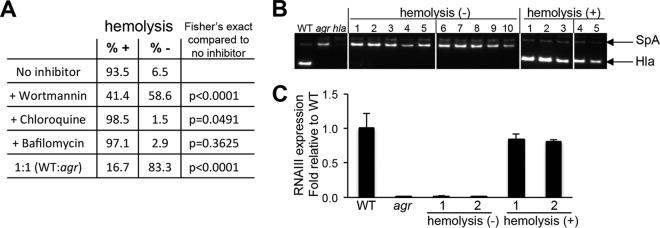
Skin is the most common site of Staphylococcus aureus infection. While most of these infections are self-limited, recurrent infections are common. Keratinocytes and recruited immune cells participate in skin defense against infection. We postulated that S. aureus is able to adapt to the milieu within human keratinocytes to avoid keratinocyte-mediated clearance. From a collection of S. aureus isolated from chronically infected patients with atopic dermatitis, we noted 22% had an agr mutant-like phenotype. Using several models of human skin infection, we demonstrate that toxin-deficient, agr mutants of methicillin-resistant S. aureus (MRSA) USA300 are able to persist within keratinocytes by stimulating autophagy and evading caspase-1 and inflammasome activation. MRSA infection induced keratinocyte autophagy, as evidenced by galectin-8 and LC3 accumulation. Autophagy promoted the degradation of inflammasome components and facilitated staphylococcal survival. The recovery of more than 58% agr or RNAIII mutants (P < 0.0001) of an inoculum of wild-type (WT) MRSA from within wortmannin-treated keratinocytes compared to control keratinocytes reflected the survival advantage for mutants no longer expressing agr-dependent toxins. Our results illustrate the dynamic interplay between S. aureus and keratinocytes that can result in the selection of mutants that have adapted specifically to evade keratinocyte-mediated clearance mechanisms.
IMPORTANCE
Human skin is a major site of staphylococcal infection, and keratinocytes actively participate in eradication of these pathogens. We demonstrate that methicillin-resistant Staphylococcus aureus (MRSA) is ingested by keratinocytes and activates caspase-1-mediated clearance through pyroptosis. Toxin-deficient MRSA mutants are selected within keratinocytes that fail to induce caspase-1 activity and keratinocyte-mediated clearance. These intracellular staphylococci induce autophagy that enhances their intracellular survival by diminishing inflammasome components. These findings suggest that S. aureus mutants, by exploiting autophagy, can persist within human keratinocytes.
未标注
皮肤是金黄色葡萄球菌感染最常见的部位。虽然大多数此类感染是自限性的,但反复感染很常见。角质形成细胞和募集的免疫细胞参与皮肤对感染的防御。我们推测金黄色葡萄球菌能够适应人角质形成细胞内的环境,以避免角质形成细胞介导的清除。从患有特应性皮炎的慢性感染患者分离出的金黄色葡萄球菌中,我们注意到22%具有类agr突变体表型。使用几种人类皮肤感染模型,我们证明耐甲氧西林金黄色葡萄球菌(MRSA)USA300的毒素缺陷型agr突变体能够通过刺激自噬并逃避半胱天冬酶-1和炎性小体激活而在角质形成细胞内持续存在。MRSA感染诱导角质形成细胞自噬,这通过半乳糖凝集素-8和LC3积累得以证明。自噬促进炎性小体成分的降解并促进葡萄球菌存活。与对照角质形成细胞相比,从渥曼青霉素处理的角质形成细胞内接种的野生型(WT)MRSA菌液中回收超过58%的agr或RNAIII突变体(P<0.0001),这反映了不再表达agr依赖性毒素的突变体的生存优势。我们的结果说明了金黄色葡萄球菌与角质形成细胞之间的动态相互作用,这可能导致选择出专门适应逃避角质形成细胞介导的清除机制的突变体。
重要性
人类皮肤是葡萄球菌感染的主要部位,角质形成细胞积极参与这些病原体的根除。我们证明耐甲氧西林金黄色葡萄球菌(MRSA)被角质形成细胞摄取,并通过焦亡激活半胱天冬酶-1介导的清除。毒素缺陷型MRSA突变体在未能诱导半胱天冬酶-1活性和角质形成细胞介导的清除的角质形成细胞内被选择出来。这些细胞内的葡萄球菌诱导自噬,通过减少炎性小体成分来增强其细胞内存活。这些发现表明金黄色葡萄球菌突变体通过利用自噬能够在人角质形成细胞内持续存在。


 Zotero 插件