
水蚤中的端粒酶活性与端粒长度
Telomerase activity and telomere length in Daphnia.
作者信息
Schumpert Charles, Nelson Jacob, Kim Eunsuk, Dudycha Jeffry L, Patel Rekha C
机构信息
Department of Biological Sciences, University of South Carolina, Columbia, South Carolina, United States of America.
出版信息
PLoS One. 2015 May 11;10(5):e0127196. doi: 10.1371/journal.pone.0127196. eCollection 2015.
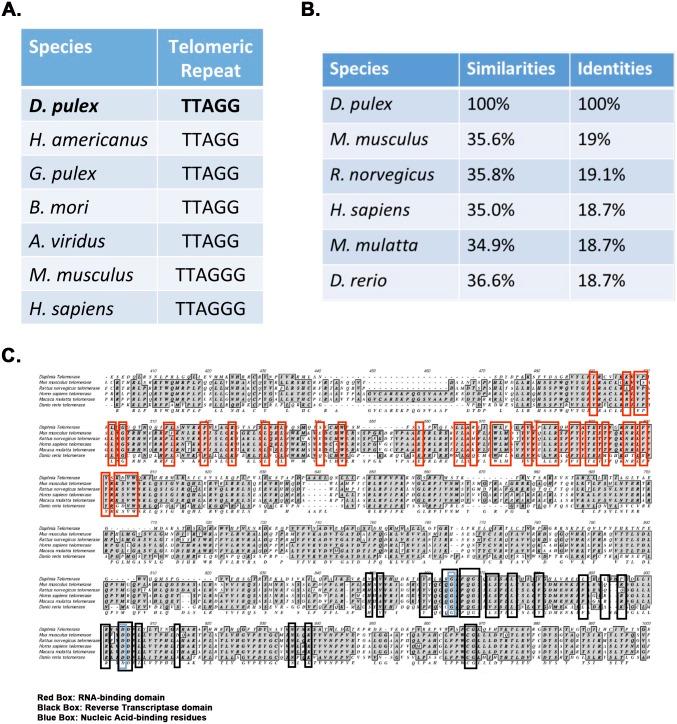
Telomeres, comprised of short repetitive sequences, are essential for genome stability and have been studied in relation to cellular senescence and aging. Telomerase, the enzyme that adds telomeric repeats to chromosome ends, is essential for maintaining the overall telomere length. A lack of telomerase activity in mammalian somatic cells results in progressive shortening of telomeres with each cellular replication event. Mammals exhibit high rates of cell proliferation during embryonic and juvenile stages but very little somatic cell proliferation occurs during adult and senescent stages. The telomere hypothesis of cellular aging states that telomeres serve as an internal mitotic clock and telomere length erosion leads to cellular senescence and eventual cell death. In this report, we have examined telomerase activity, processivity, and telomere length in Daphnia, an organism that grows continuously throughout its life. Similar to insects, Daphnia telomeric repeat sequence was determined to be TTAGG and telomerase products with five-nucleotide periodicity were generated in the telomerase activity assay. We investigated telomerase function and telomere lengths in two closely related ecotypes of Daphnia with divergent lifespans, short-lived D. pulex and long-lived D. pulicaria. Our results indicate that there is no age-dependent decline in telomere length, telomerase activity, or processivity in short-lived D. pulex. On the contrary, a significant age dependent decline in telomere length, telomerase activity and processivity is observed during life span in long-lived D. pulicaria. While providing the first report on characterization of Daphnia telomeres and telomerase activity, our results also indicate that mechanisms other than telomere shortening may be responsible for the strikingly short life span of D. pulex.
端粒由短重复序列组成,对基因组稳定性至关重要,并且已针对细胞衰老和老化进行了研究。端粒酶是一种向染色体末端添加端粒重复序列的酶,对于维持端粒的整体长度至关重要。哺乳动物体细胞中端粒酶活性的缺乏会导致随着每次细胞复制事件端粒逐渐缩短。哺乳动物在胚胎期和幼年期细胞增殖率很高,但在成年期和衰老期体细胞增殖很少发生。细胞衰老的端粒假说认为,端粒充当内部有丝分裂时钟,端粒长度的侵蚀导致细胞衰老并最终导致细胞死亡。在本报告中,我们研究了水蚤(一种终生持续生长的生物)的端粒酶活性、持续合成能力和端粒长度。与昆虫类似,水蚤的端粒重复序列被确定为TTAGG,并且在端粒酶活性测定中产生了具有五核苷酸周期性的端粒酶产物。我们研究了两种寿命不同的密切相关的水蚤生态型(短命的蚤状溞和长寿的大型溞)的端粒酶功能和端粒长度。我们的结果表明,短命的蚤状溞中端粒长度、端粒酶活性或持续合成能力没有随年龄下降。相反,在长寿的大型溞的生命周期中,观察到端粒长度、端粒酶活性和持续合成能力随年龄显著下降。在提供关于水蚤端粒和端粒酶活性特征的首份报告的同时,我们的结果还表明,除了端粒缩短之外的其他机制可能是蚤状溞寿命极短的原因。




 Zotero 插件