
一项队列研究表明,在老年初级保健患者中,抑郁症会增加心血管疾病的发病风险,且这种风险高于其他决定因素。
Depression increases the onset of cardiovascular disease over and above other determinants in older primary care patients, a cohort study.
作者信息
van Marwijk Harm W J, van der Kooy Koen G, Stehouwer Coen D A, Beekman Aartjan T F, van Hout Hein P J
机构信息
Department of General Practice and Elderly Care Medicine, EMGO+ Institute for Health and Health Care Research, VU University Medical Center, Amsterdam, The Netherlands.
Rotterdam Business School, P.O. box 2941, , 1000 SN, Rotterdam, The Netherlands.
出版信息
BMC Cardiovasc Disord. 2015 May 12;15:40. doi: 10.1186/s12872-015-0036-y.
BACKGROUND
To determine if major depressive disorder (MDD) in older primary care patients is an independent risk factor for cardiovascular events.
METHODS
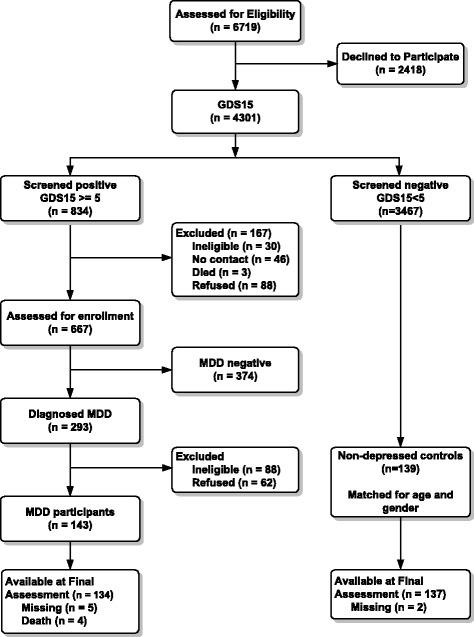
A cohort of 143 primary care patients with depression and 139 non-depressed controls without depression (both aged over 55 years, matched for age and gender) from the Netherlands was evaluated for 2 years. MDD was diagnosed according to DSM-IV-criteria. During the follow-up period, information was collected on physical health, depression status and behavioural risk factors. CVD end points were assessed with validated annual questionnaires and were crosschecked with medical records.
RESULTS
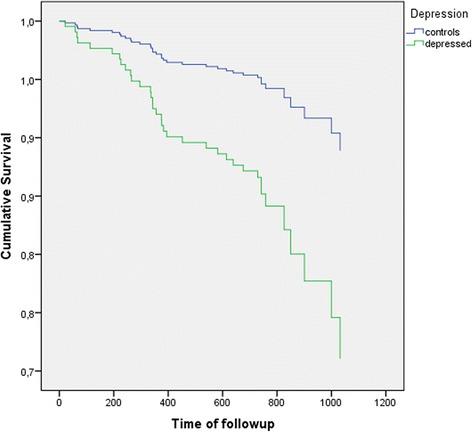
Thirty-four participants experienced a cardiovascular event, of which 71% were depressed: 27/134 with MDD (20.1%) and 9/137 controls (6.6%). MDD was associated with a hazard ratio of 2.83 (p value 0,004, 95% CI 1.32 to 6.05) for cardiovascular events. After adjustment for cardiovascular medication, the hazard ratio was 2.46 (95% CI 1.14 to 5.30).
CONCLUSIONS
In a 2-year follow-up period, baseline MDD increased the risk for CVD in older primary care patients compared with controls, over and above well-known cardiovascular risk factors.
背景
确定老年初级保健患者的重度抑郁症(MDD)是否为心血管事件的独立危险因素。
方法
对来自荷兰的143名患有抑郁症的初级保健患者和139名无抑郁症的非抑郁对照者(年龄均超过55岁,年龄和性别匹配)进行了为期2年的评估。根据《精神疾病诊断与统计手册》第四版标准诊断MDD。在随访期间,收集有关身体健康、抑郁状态和行为危险因素的信息。使用经过验证的年度问卷评估心血管疾病终点,并与病历进行交叉核对。
结果
34名参与者发生了心血管事件,其中71%为抑郁症患者:134名MDD患者中有27名(20.1%),137名对照者中有9名(6.6%)。MDD与心血管事件的风险比为2.83(p值0.004,95%置信区间1.32至6.05)。在调整心血管药物治疗后,风险比为2.46(95%置信区间1.14至5.30)。
结论
在2年的随访期内,与对照组相比,基线MDD增加了老年初级保健患者发生心血管疾病的风险,超过了已知的心血管危险因素。
 Zotero 插件