
胚胎和成年大鼠脉络丛中的流入机制:一项转录组研究。
Influx mechanisms in the embryonic and adult rat choroid plexus: a transcriptome study.
作者信息
Saunders Norman R, Dziegielewska Katarzyna M, Møllgård Kjeld, Habgood Mark D, Wakefield Matthew J, Lindsay Helen, Stratzielle Nathalie, Ghersi-Egea Jean-Francois, Liddelow Shane A
机构信息
Department of Pharmacology and Therapeutics, University of Melbourne Parkville, VIC, Australia.
Department of Cellular and Molecular Medicine, University of Copenhagen Copenhagen, Denmark.
出版信息
Front Neurosci. 2015 Apr 28;9:123. doi: 10.3389/fnins.2015.00123. eCollection 2015.
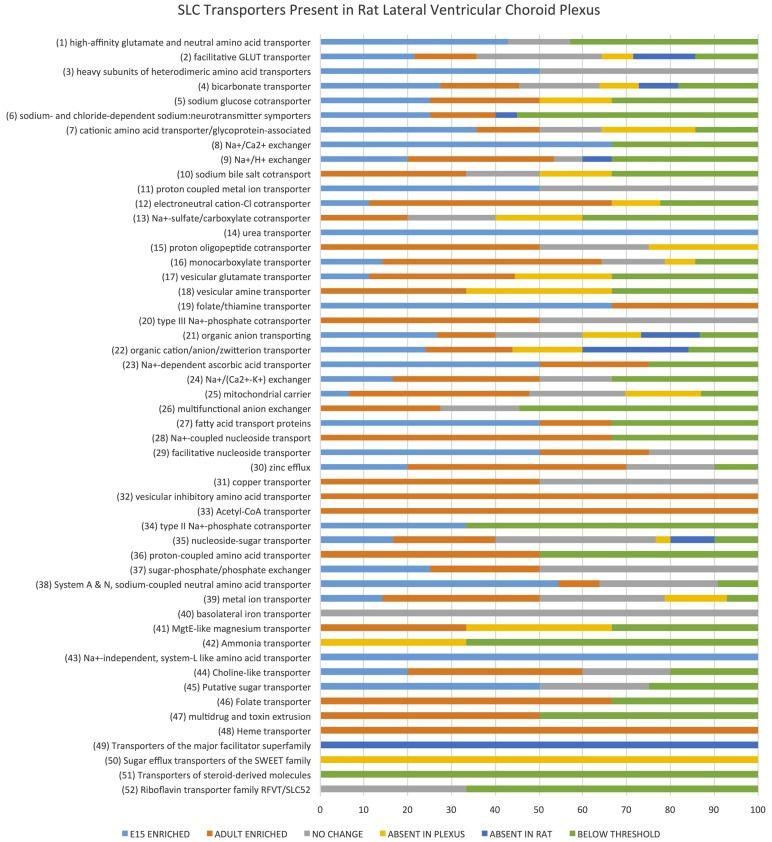
The transcriptome of embryonic and adult rat lateral ventricular choroid plexus, using a combination of RNA-Sequencing and microarray data, was analyzed by functional groups of influx transporters, particularly solute carrier (SLC) transporters. RNA-Seq was performed at embryonic day (E) 15 and adult with additional data obtained at intermediate ages from microarray analysis. The largest represented functional group in the embryo was amino acid transporters (twelve) with expression levels 2-98 times greater than in the adult. In contrast, in the adult only six amino acid transporters were up-regulated compared to the embryo and at more modest enrichment levels (<5-fold enrichment above E15). In E15 plexus five glucose transporters, in particular Glut-1, and only one monocarboxylate transporter were enriched compared to the adult, whereas only two glucose transporters but six monocarboxylate transporters in the adult plexus were expressed at higher levels than in embryos. These results are compared with earlier published physiological studies of amino acid and monocarboxylate transport in developing rodents. This comparison shows correlation of high expression of some transporters in the developing brain with higher amino acid transport activity reported previously. Data for divalent metal transporters are also considered. Immunohistochemistry of several transporters (e.g., Slc16a10, a thyroid hormone transporter) gene products was carried out to confirm translational activity and to define cellular distribution of the proteins. Overall the results show that there is substantial expression of numerous influx transporters in the embryonic choroid plexus, many at higher levels than in the adult. This, together with immunohistochemical evidence and data from published physiological transport studies suggests that the choroid plexus in embryonic brain plays a major role in supplying the developing brain with essential nutrients.
利用RNA测序和微阵列数据相结合的方法,对胚胎期和成年大鼠侧脑室脉络丛的转录组进行了分析,分析对象为流入转运体的功能组,特别是溶质载体(SLC)转运体。在胚胎期第15天(E15)和成年期进行了RNA测序,并从微阵列分析中获得了中间年龄阶段的额外数据。胚胎中表达最多的功能组是氨基酸转运体(12种),其表达水平比成年期高2 - 98倍。相比之下,成年期与胚胎期相比,只有6种氨基酸转运体上调,且富集水平较低(比E15高不到5倍)。与成年期相比,E15脉络丛中有5种葡萄糖转运体,特别是Glut - 1,以及只有1种单羧酸转运体富集,而成年脉络丛中只有2种葡萄糖转运体,但有6种单羧酸转运体的表达水平高于胚胎期。这些结果与早期发表的关于发育中啮齿动物氨基酸和单羧酸转运的生理学研究进行了比较。这种比较表明,发育中大脑中一些转运体的高表达与先前报道的较高氨基酸转运活性相关。还考虑了二价金属转运体的数据。对几种转运体(如甲状腺激素转运体Slc16a10)的基因产物进行了免疫组织化学分析,以确认翻译活性并确定蛋白质的细胞分布。总体结果表明,胚胎脉络丛中大量表达多种流入转运体,许多转运体的表达水平高于成年期。这与免疫组织化学证据以及已发表的生理转运研究数据一起表明,胚胎大脑中的脉络丛在为发育中的大脑提供必需营养物质方面发挥着重要作用。


 Zotero 插件