
复发率为多基因家族和双胞胎中自闭症谱系障碍的性别差异、家族遗传易感性提供了证据。
Recurrence rates provide evidence for sex-differential, familial genetic liability for autism spectrum disorders in multiplex families and twins.
作者信息
Werling Donna M, Geschwind Daniel H
机构信息
Semel Institute for Neuroscience and Human Behavior, David Geffen School of Medicine, University of California, Los Angeles, 760 Westwood Plaza, Los Angeles, CA 90095 USA.
Semel Institute for Neuroscience and Human Behavior, David Geffen School of Medicine, University of California, Los Angeles, 760 Westwood Plaza, Los Angeles, CA 90095 USA ; Neurogenetics Program and Department of Neurology, David Geffen School of Medicine, University of California, Los Angeles, 695 Charles E. Young Dr. South, Los Angeles, CA 90095 USA ; Center for Autism Research and Treatment, Semel Institute, David Geffen School of Medicine, University of California, Los Angeles, 760 Westwood Plaza, Los Angeles, CA 90095 USA ; Center for Neurobehavioral Genetics, Semel Institute, David Geffen School of Medicine, University of California, Los Angeles, 695 Charles E. Young Dr. South, Los Angeles, CA 90095 USA ; Department of Human Genetics, David Geffen School of Medicine, University of California, Los Angeles, 695 Charles E. Young Dr. South, Los Angeles, CA 90095 USA.
出版信息
Mol Autism. 2015 May 13;6:27. doi: 10.1186/s13229-015-0004-5. eCollection 2015.
BACKGROUND
Autism spectrum disorders (ASDs) are more prevalent in males, suggesting a multiple threshold liability model in which females are, on average, protected by sex-differential mechanisms. Under this model, autistic females are predicted to carry a more penetrant risk variant load than males and to share this greater genetic liability with their siblings. However, reported ASD recurrence rates have not demonstrated significantly increased risk to siblings of affected girls. Here, we characterize recurrence patterns in multiplex families from the Autism Genetics Resource Exchange (AGRE) to determine if risk in these families follows a female protective model.
METHODS
We assess recurrence rates and quantitative traits in full siblings from 1,120 multiplex nuclear families and concordance rates in 305 twin pairs from AGRE. We consider the first two affected children per family, and one randomly selected autistic twin per pair, as probands. We then compare recurrence rates and phenotypes between males and females and between twin pairs or families with at least one female proband (female-containing (FC)) versus those with only male probands (male-only (MO)).
RESULTS
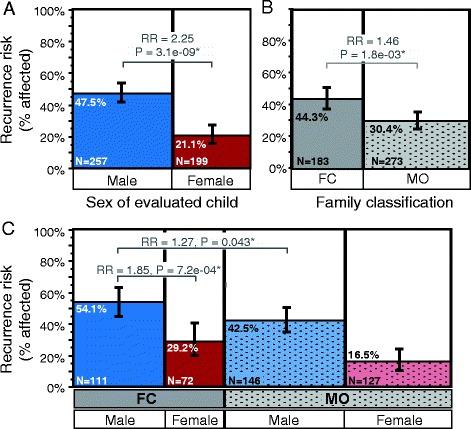
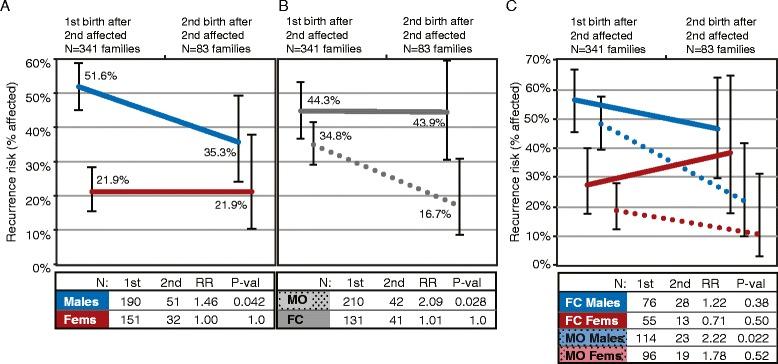
Among children born after two probands, we observe significantly higher recurrence in males (47.5%) than in females (21.1%; relative risk, RR = 2.25; adjusted P = 6.22e-08) and in siblings of female (44.3%) versus siblings of male probands (30.4%; RR = 1.46; adj. P = 0.036). This sex-differential recurrence is also robust in dizygotic twin pairs (males = 61.5%, females = 19.1%; RR = 3.23; adj. P = 7.66e-09). Additionally, we find a significant negative relationship between interbirth interval and ASD recurrence that is driven by children in MO families.
CONCLUSIONS
By classifying families as MO or FC using two probands instead of one, we observe significant recurrence rate differences between families harboring sex-differential familial liability. However, a significant sex difference in risk to children within FC families suggests that female protective mechanisms are still operative in families carrying high genetic risk loads. Furthermore, the male-specific relationship between shorter interbirth intervals and increased ASD risk is consistent with a potentially greater contribution from environmental factors in males versus higher genetic risk in affected females and their families. Understanding the mechanisms driving these sex-differential risk profiles will be useful for treatment development and prevention.
背景
自闭症谱系障碍(ASD)在男性中更为普遍,这表明存在一种多重阈值易感性模型,即平均而言,女性受到性别差异机制的保护。在该模型下,预计自闭症女性携带的风险变异负荷比男性更具渗透性,并且与其兄弟姐妹共享这种更高的遗传易感性。然而,报告的ASD复发率并未显示受影响女孩的兄弟姐妹的风险显著增加。在此,我们对来自自闭症遗传学资源交换库(AGRE)的多个家庭中的复发模式进行了特征分析,以确定这些家庭中的风险是否遵循女性保护模型。
方法
我们评估了1120个核心多重家庭中全同胞的复发率和定量性状,以及AGRE中305对双胞胎的一致性率。我们将每个家庭中前两个受影响的孩子以及每对双胞胎中随机选择的一名自闭症双胞胎作为先证者。然后,我们比较了男性和女性之间以及至少有一名女性先证者的双胞胎对或家庭(含女性(FC))与只有男性先证者的家庭(仅男性(MO))之间的复发率和表型。
结果
在两个先证者之后出生的孩子中,我们观察到男性的复发率(47.5%)显著高于女性(21.1%;相对风险,RR = 2.25;校正P = 6.22×10⁻⁸),女性先证者的兄弟姐妹的复发率(44.3%)高于男性先证者的兄弟姐妹(30.4%;RR = 1.46;校正P = 0.036)。这种性别差异复发在异卵双胞胎对中也很明显(男性 = 61.5%,女性 = 19.1%;RR = 3.23;校正P = 7.66×10⁻⁹)。此外,我们发现生育间隔与ASD复发之间存在显著的负相关关系,这是由MO家庭中的孩子驱动的。
结论
通过使用两个先证者而非一个将家庭分类为MO或FC,我们观察到具有性别差异家族易感性的家庭之间存在显著的复发率差异。然而,FC家庭中孩子的风险存在显著性别差异,这表明女性保护机制在携带高遗传风险负荷的家庭中仍然起作用。此外,较短生育间隔与ASD风险增加之间的男性特异性关系与男性环境因素的潜在更大贡献相一致,而受影响女性及其家庭的遗传风险更高。了解驱动这些性别差异风险特征的机制将有助于治疗开发和预防。


 Zotero 插件