
处于开放和关闭状态的IV型菌毛机器的结构。
Structure of a type IV pilus machinery in the open and closed state.
作者信息
Gold Vicki A M, Salzer Ralf, Averhoff Beate, Kühlbrandt Werner
机构信息
Department of Structural Biology, Max Planck Institute of Biophysics, Frankfurt am Main, Germany.
Molecular Microbiology and Bioenergetics, Institute of Molecular Biosciences, Goethe University Frankfurt, Frankfurt am Main, Germany.
出版信息
Elife. 2015 May 21;4:e07380. doi: 10.7554/eLife.07380.
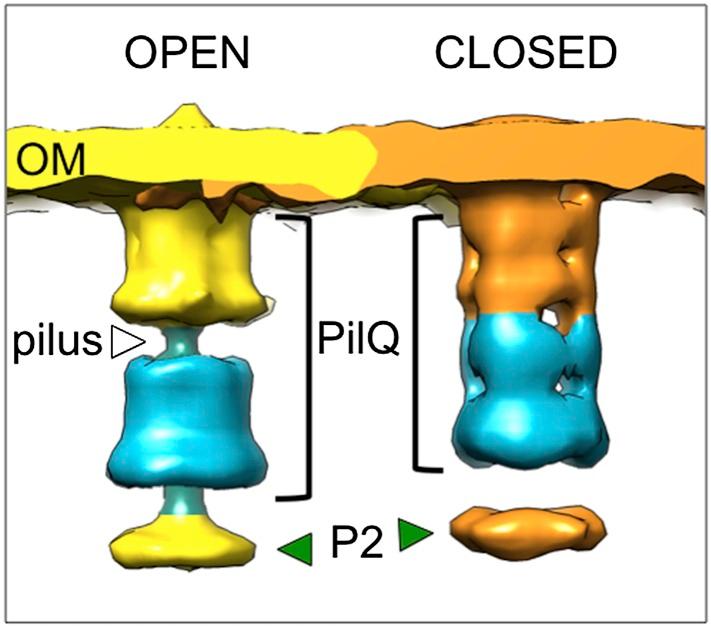
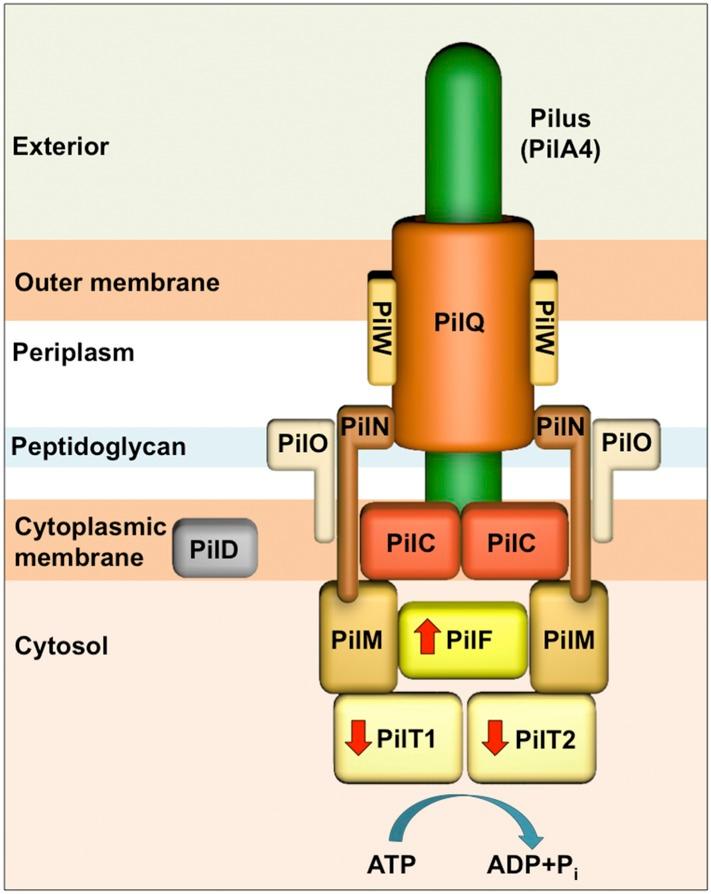
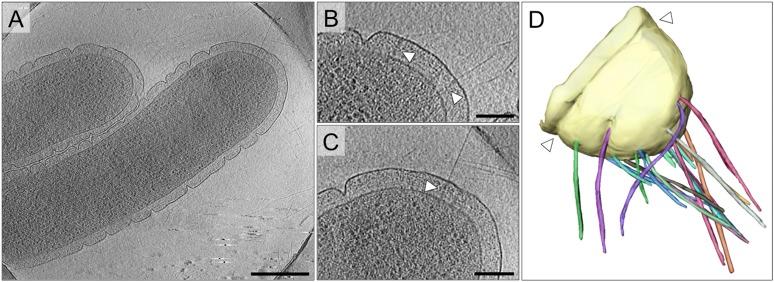
Proteins of the secretin family form large macromolecular complexes, which assemble in the outer membrane of Gram-negative bacteria. Secretins are major components of type II and III secretion systems and are linked to extrusion of type IV pili (T4P) and to DNA uptake. By electron cryo-tomography of whole Thermus thermophilus cells, we determined the in situ structure of a T4P molecular machine in the open and the closed state. Comparison reveals a major conformational change whereby the N-terminal domains of the central secretin PilQ shift by ~30 Å, and two periplasmic gates open to make way for pilus extrusion. Furthermore, we determine the structure of the assembled pilus.
促胰液素家族的蛋白质形成大型高分子复合物,这些复合物在革兰氏阴性菌的外膜中组装。促胰液素是II型和III型分泌系统的主要成分,与IV型菌毛(T4P)的挤出以及DNA摄取有关。通过对嗜热栖热菌全细胞进行电子冷冻断层扫描,我们确定了处于开放和关闭状态的T4P分子机器的原位结构。比较结果显示出一种主要的构象变化,即中央促胰液素PilQ的N端结构域移动了约30 Å,并且两个周质门打开,为菌毛挤出让路。此外,我们还确定了组装好的菌毛的结构。


 Zotero 插件