
不同种族伊朗人群中CYP2D6*10(C100T)、*4(G1846A)和*14(G1758A)等位基因的流行率。
Prevalence of the CYP2D6*10 (C100T), *4 (G1846A), and *14 (G1758A) alleles among Iranians of different ethnicities.
作者信息
Bagheri Ali, Kamalidehghan Behnam, Haghshenas Maryam, Azadfar Parisa, Akbari Leila, Sangtarash Mohammad Hossein, Vejdandoust Faramarz, Ahmadipour Fatemeh, Meng Goh Yong, Houshmand Massoud
机构信息
Department of Biology, University of Sistan and Baluchestan, Zahedan, Iran.
Department of Pharmacy, Faculty of Medicine, University of Malaya, Kuala Lumpur, Malaysia.
出版信息
Drug Des Devel Ther. 2015 May 13;9:2627-34. doi: 10.2147/DDDT.S79709. eCollection 2015.
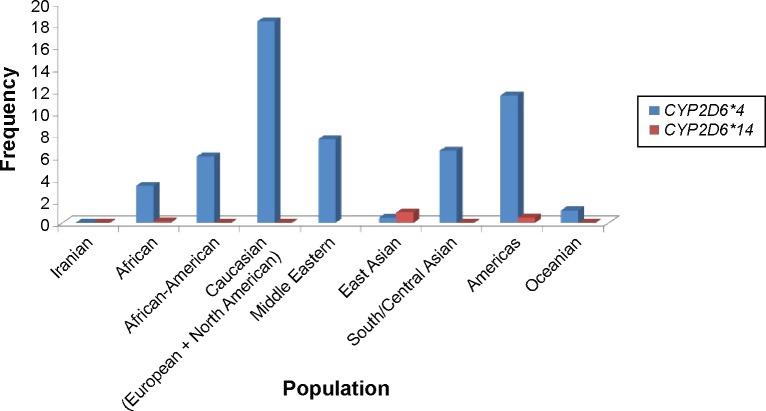
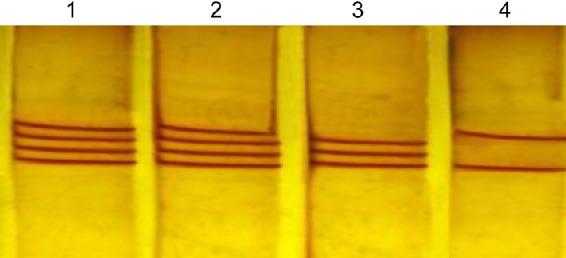
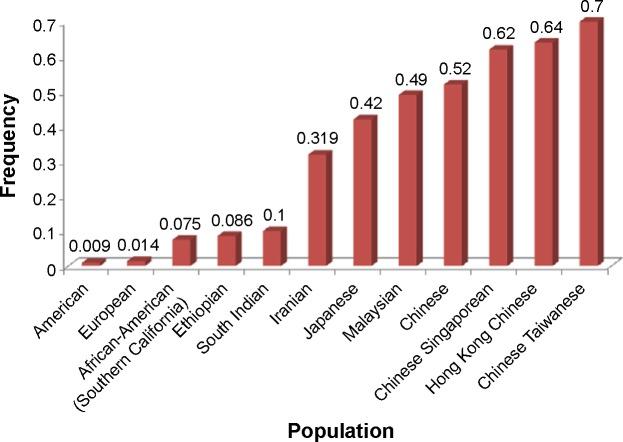
The presence of polymorphisms in the CYP2D6 gene may modulate enzyme level and activity, thereby affecting individual responses to pharmacological treatment. Here, we compared the prevalence of the CYP2D610, 4, and 14 alleles in an Iranian population of different ethnicities with those of other populations. Allele and genotype frequency distributions of CYP2D610 variants and predicted phenotypes including extensive metabolizers, intermediate metabolizers, and poor metabolizers were analysed in blood samples of 300 unrelated healthy individuals in an Iranian population using polymerase chain reaction (PCR)-restriction fragment length polymorphism, PCR-single-strand conformation polymorphism, and direct genomic DNA sequencing. The CYP2D64 (G1846A) and 14 (G1758A) allelic frequencies were not detected in different ethnicities, demonstrating the absence of a significant contribution of these alleles in Iranian populations. However, the T/T, C/T, and C/C genotype frequencies of the CYP2D610 allele were significantly different (P<0.01) in all Iranian ethnic groups. Additionally, the frequency of the homozygous T/T variant of the CYP2D610 allele was significantly high in the Lure (P<0.017) and low in the Kurd (P<0.002) ethnicities. The frequency of the T/T variant of the CYP2D610 allele in central Iran was the highest (P<0.001), while the south of Iran had the lowest frequency (P<0.001). The frequency of the C/T variant of the CYP2D610 allele was significantly a bit high (P<0.001) in females compare to males, while the frequencies of the T/T variant in females is similar to males, which are 24.4% and 24.3%, respectively. In contrast to absence of the CYP2D64 (G1846A) and 14 (G1758A) alleles in Iranian populations of different ethnicities, the prediction of the CYP2D610 allele is required in drug research and routine treatment, where the information would be helpful for clinicians to optimize therapy or identify persons at risk of adverse drug reactions before clinical trials. Approximately 39.3% of subjects (24.3% homozygous T/T CYP2D610 as poor metabolizers and 15% heterozygous C/T CYP2D6*10 as intermediate metabolizers) had this allele; therefore, the harmful effects of drugs are relatively common among Iranians.
CYP2D6基因多态性的存在可能会调节酶的水平和活性,从而影响个体对药物治疗的反应。在此,我们比较了不同种族的伊朗人群与其他人群中CYP2D610、4和14等位基因的流行情况。使用聚合酶链反应(PCR)-限制性片段长度多态性、PCR-单链构象多态性和直接基因组DNA测序,对伊朗人群中300名无亲缘关系的健康个体的血样进行分析,以确定CYP2D610变体的等位基因和基因型频率分布以及预测的表型,包括广泛代谢者、中间代谢者和慢代谢者。在不同种族中均未检测到CYP2D64(G1846A)和14(G1758A)等位基因频率,表明这些等位基因在伊朗人群中无显著贡献。然而,在所有伊朗种族群体中,CYP2D610等位基因的T/T、C/T和C/C基因型频率存在显著差异(P<0.01)。此外,CYP2D610等位基因纯合T/T变体的频率在卢尔族中显著较高(P<0.017),在库尔德族中较低(P<0.002)。CYP2D610等位基因的T/T变体在伊朗中部的频率最高(P<0.001),而在伊朗南部的频率最低(P<0.001)。CYP2D610等位基因的C/T变体在女性中的频率显著略高于男性(P<0.001),而女性中T/T变体的频率与男性相似,分别为24.4%和24.3%。与不同种族的伊朗人群中不存在CYP2D64(G1846A)和14(G1758A)等位基因不同,在药物研究和常规治疗中需要对CYP2D610等位基因进行预测,这些信息将有助于临床医生在临床试验前优化治疗或识别有药物不良反应风险的人群。约39.3%的受试者(24.3%为纯合T/T CYP2D610慢代谢者,15%为杂合C/T CYP2D6*10中间代谢者)携带该等位基因;因此,药物的有害影响在伊朗人中相对常见。



 Zotero 插件