
女性对不良胎儿妊娠结局风险的认知:一项大规模跨国调查。
Women's perception of risks of adverse fetal pregnancy outcomes: a large-scale multinational survey.
作者信息
Petersen Irene, McCrea Rachel L, Lupattelli Angela, Nordeng Hedvig
机构信息
Department of Primary Care and Population Health, UCL, London, UK.
Department of PharmacoEpidemiology and Drug Safety Research Group, School of Pharmacy, University of Oslo, Oslo, Norway.
出版信息
BMJ Open. 2015 Jun 1;5(6):e007390. doi: 10.1136/bmjopen-2014-007390.
OBJECTIVE
To determine pregnant women and new mothers' perception of risks in pregnancy.
DESIGN, SETTINGS AND PARTICIPANTS: This was a large-scale multinational survey including 9113 pregnant women and new mothers from 18 countries in Europe, North America and Australia.
MAIN OUTCOMES
Risk perception scores (0-10) for harmful effects to the fetus were derived for: (1) medicines (over-the-counter medicine and prescribed medicine), (2) food substances (eggs and blue veined cheese), (3) herbal substances (ginger and cranberries) (4) alcohol and tobacco, and (5) thalidomide.
RESULTS
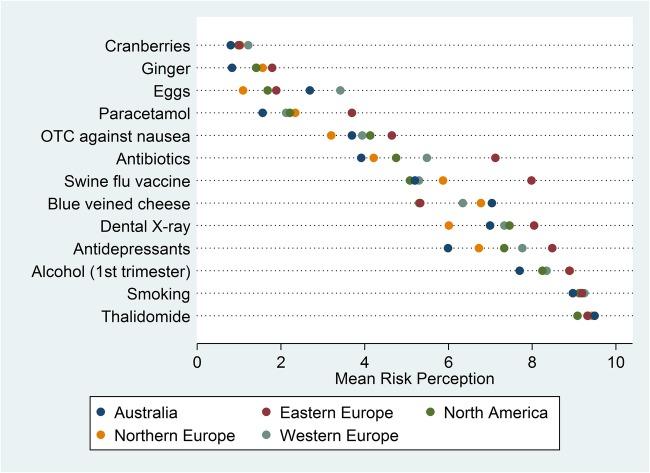
Overall, 80% (6453/8131) of women perceived the risk of giving birth to a child with a birth defect to be ≤ 5 of 100 births. The women rated cranberries and ginger least harmful (mean risk perception scores 1.1 and 1.5 of 10, respectively) and antidepressants, alcohol, smoking and thalidomide as most harmful (7.6, 8.6, 9.2 and 9.4 out of 10, respectively). The perception varied with age, level of education, pregnancy status, profession and geographical region. Noticeably, 70% had not heard about thalidomide, but of those who had (2692/9113), the risk perception scores were 0.4-0.5 points lower in women below 25 years compared to women aged 26-30 years.
CONCLUSIONS
In general, women perceived the risks of giving birth to a child with birth defects low, but there were substantial disparities between women's perceived risks and the actual risks when it comes to over-the-counter agents against nausea and prescribed medication. The study revealed that few women knew of thalidomide, suggesting that the general awareness among women of the teratogenic effects of thalidomide is declining, but it has left a general scepticism about safety of medication in pregnancy. This may have some severe consequences if women are left without medical treatments in pregnancy.
目的
确定孕妇和初为人母者对孕期风险的认知。
设计、研究背景与参与者:这是一项大规模跨国调查,涵盖来自欧洲、北美和澳大利亚18个国家的9113名孕妇和初为人母者。
主要结果
得出以下方面对胎儿有害影响的风险认知评分(0 - 10分):(1)药物(非处方药和处方药),(2)食物物质(鸡蛋和蓝纹奶酪),(3)草药物质(生姜和蔓越莓),(4)酒精和烟草,以及(5)沙利度胺。
结果
总体而言,80%(6453/8131)的女性认为生出有出生缺陷孩子的风险为每100次分娩中≤5例。女性将蔓越莓和生姜评为危害最小(平均风险认知评分分别为10分中的1.1分和1.5分),而抗抑郁药、酒精、吸烟和沙利度胺被评为危害最大(分别为10分中的7.6分、8.6分、9.2分和9.4分)。认知情况因年龄、教育程度、妊娠状态、职业和地理区域而异。值得注意的是,70%的人未听说过沙利度胺,但在听说过的人当中(2692/9113),25岁以下女性的风险认知评分比26 - 30岁女性低0.4 - 0.5分。
结论
总体而言,女性认为生出有出生缺陷孩子的风险较低,但在非处方抗恶心药物和处方药方面,女性的认知风险与实际风险存在显著差异。研究表明,很少有女性知道沙利度胺,这表明女性对沙利度胺致畸作用的总体认识在下降,但这也导致了对孕期用药安全性的普遍怀疑。如果孕期女性得不到治疗,这可能会产生一些严重后果。
 Zotero 插件