
piRNA介导的表观遗传沉默在黑腹果蝇转座元件群体动态中的作用
The Role of piRNA-Mediated Epigenetic Silencing in the Population Dynamics of Transposable Elements in Drosophila melanogaster.
作者信息
Lee Yuh Chwen G
机构信息
Department of Ecology and Evolution, University of Chicago. Chicago, Illinois, United States of America.
出版信息
PLoS Genet. 2015 Jun 4;11(6):e1005269. doi: 10.1371/journal.pgen.1005269. eCollection 2015 Jun.
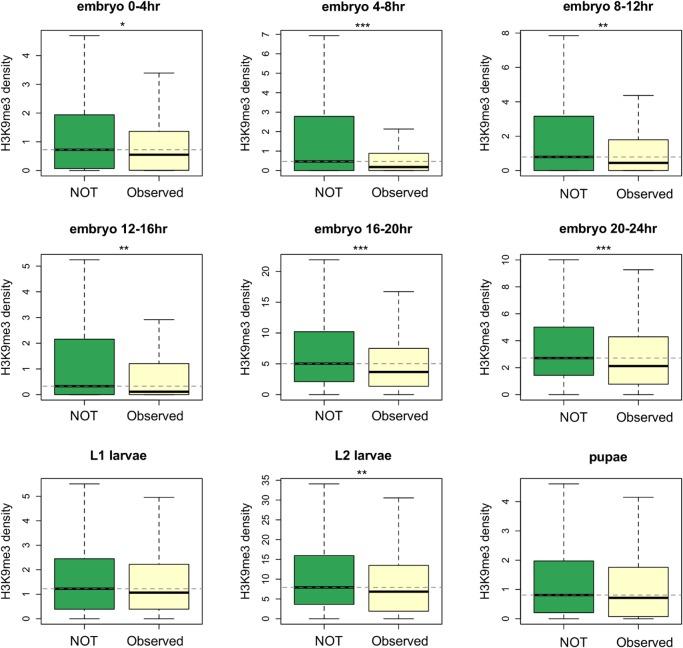
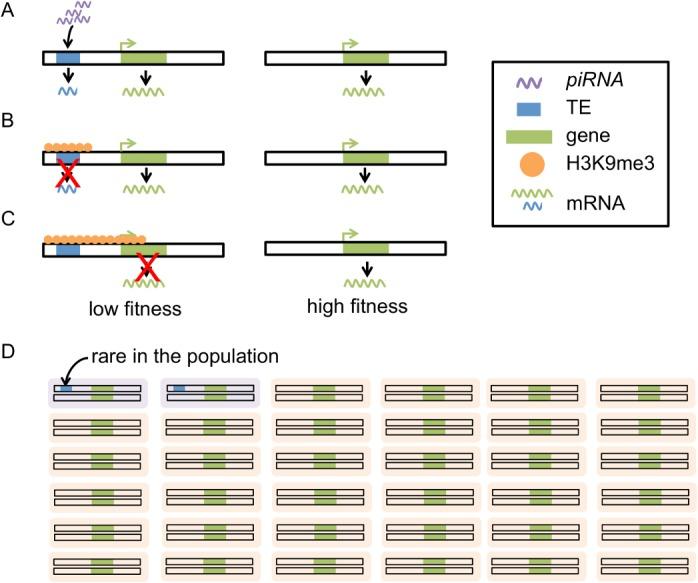
The piwi-interacting RNAs (piRNA) are small RNAs that target selfish transposable elements (TEs) in many animal genomes. Until now, piRNAs' role in TE population dynamics has only been discussed in the context of their suppression of TE transposition, which alone is not sufficient to account for the skewed frequency spectrum and stable containment of TEs. On the other hand, euchromatic TEs can be epigenetically silenced via piRNA-dependent heterochromatin formation and, similar to the widely known "Position-effect variegation", heterochromatin induced by TEs can "spread" into nearby genes. We hypothesized that the piRNA-mediated spread of heterochromatin from TEs into adjacent genes has deleterious functional effects and leads to selection against individual TEs. Unlike previously identified deleterious effects of TEs due to the physical disruption of DNA, the functional effect we investigated here is mediated through the epigenetic influences of TEs. We found that the repressive chromatin mark, H3K9me, is elevated in sequences adjacent to euchromatic TEs at multiple developmental stages in Drosophila melanogaster. Furthermore, the heterochromatic states of genes depend not only on the number of and distance from adjacent TEs, but also on the likelihood that their nearest TEs are targeted by piRNAs. These variations in chromatin status probably have functional consequences, causing genes near TEs to have lower expression. Importantly, we found stronger selection against TEs that lead to higher H3K9me enrichment of adjacent genes, demonstrating the pervasive evolutionary consequences of TE-induced epigenetic silencing. Because of the intrinsic biological mechanism of piRNA amplification, spread of TE heterochromatin could result in the theoretically required synergistic deleterious effects of TE insertions for stable containment of TE copy number. The indirect deleterious impact of piRNA-mediated epigenetic silencing of TEs is a previously unexplored, yet important, element for the evolutionary dynamics of TEs.
Piwi相互作用RNA(piRNA)是一类小分子RNA,可靶向许多动物基因组中的自私转座元件(TE)。到目前为止,piRNA在TE群体动态中的作用仅在其抑制TE转座的背景下进行过讨论,而仅靠这一点不足以解释TE的偏态频谱和稳定控制。另一方面,常染色质TE可通过依赖piRNA的异染色质形成在表观遗传上被沉默,并且类似于广为人知的“位置效应斑驳”,由TE诱导的异染色质可以“扩散”到附近的基因中。我们假设piRNA介导的异染色质从TE扩散到相邻基因中具有有害的功能影响,并导致对单个TE的选择。与先前确定的由于DNA物理破坏而导致的TE有害影响不同,我们在此研究的功能影响是通过TE的表观遗传影响介导的。我们发现,在黑腹果蝇的多个发育阶段,与常染色质TE相邻的序列中,抑制性染色质标记H3K9me升高。此外,基因的异染色质状态不仅取决于相邻TE的数量和距离,还取决于其最接近的TE被piRNA靶向的可能性。染色质状态的这些变化可能具有功能后果,导致TE附近的基因表达较低。重要的是,我们发现对导致相邻基因H3K9me富集更高的TE有更强的选择作用,这证明了TE诱导的表观遗传沉默具有普遍的进化后果。由于piRNA扩增的内在生物学机制,TE异染色质的扩散可能导致理论上所需的TE插入的协同有害效应,以稳定控制TE拷贝数。piRNA介导的TE表观遗传沉默的间接有害影响是TE进化动态中一个以前未被探索但很重要的因素。


 Zotero 插件