
胶质母细胞瘤细胞在人肿瘤相关小胶质细胞/巨噬细胞和单核细胞衍生的巨噬细胞中诱导不同的谷氨酸能基因表达。
Glioblastoma cells induce differential glutamatergic gene expressions in human tumor-associated microglia/macrophages and monocyte-derived macrophages.
作者信息
Choi Judy, Stradmann-Bellinghausen Beate, Yakubov Eduard, Savaskan Nicolai E, Régnier-Vigouroux Anne
机构信息
a Johannes Gutenberg University of Mainz; Mainz, Germany.
出版信息
Cancer Biol Ther. 2015;16(8):1205-13. doi: 10.1080/15384047.2015.1056406. Epub 2015 Jun 5.
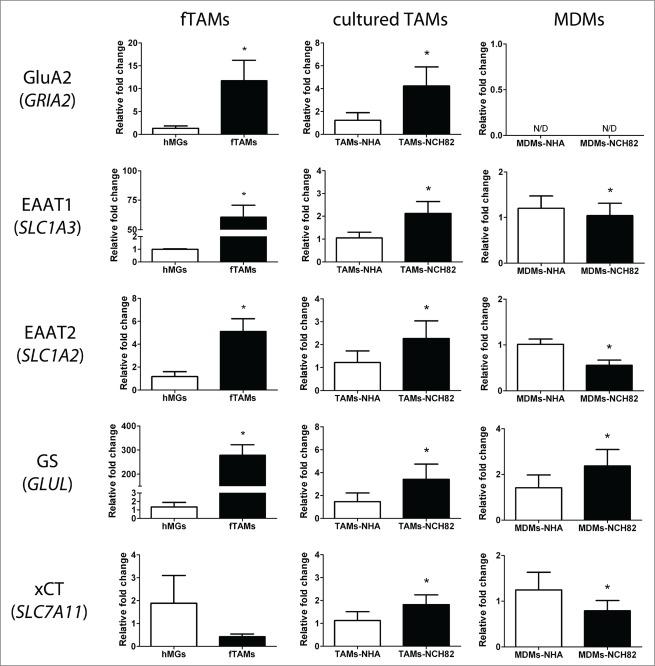
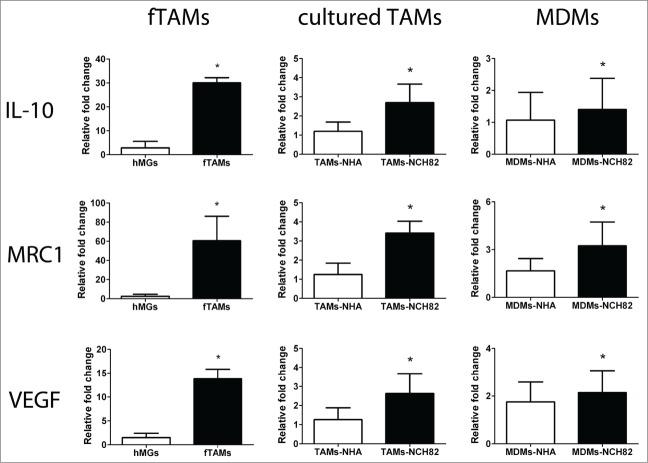
Glioblastoma cells produce and release high amounts of glutamate into the extracellular milieu and subsequently can trigger seizure in patients. Tumor-associated microglia/macrophages (TAMs), consisting of both parenchymal microglia and monocytes-derived macrophages (MDMs) recruited from the blood, are known to populate up to 1/3 of the glioblastoma tumor environment and exhibit an alternative, tumor-promoting and supporting phenotype. However, it is unknown how TAMs respond to the excess extracellular glutamate in the glioblastoma microenvironment. We investigated the expressions of genes related to glutamate transport and metabolism in human TAMs freshly isolated from glioblastoma resections. Quantitative real-time PCR analysis showed (i) significant increases in the expressions of GRIA2 (GluA2 or AMPA receptor 2), SLC1A2 (EAAT2), SLC1A3 (EAAT1), (ii) a near-significant decrease in the expression of SLC7A11 (cystine-glutamate antiporter xCT) and (iii) a remarkable increase in GLUL expression (glutamine synthetase) in these cells compared to adult primary human microglia. TAMs co-cultured with glioblastoma cells also exhibited a similar glutamatergic profile as freshly isolated TAMs except for a slight increase in SLC7A11 expression. We next analyzed these genes expressions in cultured human MDMs derived from peripheral blood monocytes for comparison. In contrast, MDMs co-cultured with glioblastoma cells compared to MDMs co-cultured with normal astrocytes exhibited decreased expressions in the tested genes except for GLUL. This is the first study to demonstrate transcriptional changes in glutamatergic signaling of TAMs in a glioblastoma microenvironment, and the findings here suggest that TAMs and MDMs might potentially elicit different cellular responses in the presence of excess extracellular glutamate.
胶质母细胞瘤细胞会产生并向细胞外环境释放大量谷氨酸,进而可能引发患者癫痫发作。肿瘤相关小胶质细胞/巨噬细胞(TAMs)由实质小胶质细胞和从血液中招募的单核细胞衍生巨噬细胞(MDMs)组成,已知其在胶质母细胞瘤肿瘤环境中占比高达三分之一,并呈现出一种促肿瘤和支持性的替代表型。然而,尚不清楚TAMs如何应对胶质母细胞瘤微环境中过量的细胞外谷氨酸。我们研究了从胶质母细胞瘤切除术中新鲜分离的人TAMs中与谷氨酸转运和代谢相关基因的表达。定量实时PCR分析显示:(i)GRIA2(GluA2或AMPA受体2)、SLC1A2(EAAT2)、SLC1A3(EAAT1)的表达显著增加;(ii)SLC7A11(胱氨酸-谷氨酸反向转运体xCT)的表达近乎显著下降;(iii)与成人原发性人小胶质细胞相比,这些细胞中GLUL表达(谷氨酰胺合成酶)显著增加。与胶质母细胞瘤细胞共培养的TAMs也表现出与新鲜分离的TAMs相似的谷氨酸能特征,只是SLC7A11表达略有增加。接下来,我们分析了从外周血单核细胞衍生的培养人MDMs中这些基因的表达以作比较。相比之下,与正常星形胶质细胞共培养的MDMs相比,与胶质母细胞瘤细胞共培养的MDMs在所测试的基因中除GLUL外表达均下降。这是第一项证明胶质母细胞瘤微环境中TAMs谷氨酸能信号转导转录变化的研究,此处的发现表明,在存在过量细胞外谷氨酸的情况下,TAMs和MDMs可能会引发不同的细胞反应。

 Zotero 插件