
使用无效工具变量的孟德尔随机化:通过Egger回归进行效应估计和偏差检测
Mendelian randomization with invalid instruments: effect estimation and bias detection through Egger regression.
作者信息
Bowden Jack, Davey Smith George, Burgess Stephen
机构信息
MRC Biostatistics Unit, Cambridge Institute of Public Health, Cambridge, UK, MRC Integrative Epidemiology Unit, University of Bristol, Bristol, UK and Department of Public Health and Primary Care, University of Cambridge, Cambridge, UK MRC Biostatistics Unit, Cambridge Institute of Public Health, Cambridge, UK, MRC Integrative Epidemiology Unit, University of Bristol, Bristol, UK and Department of Public Health and Primary Care, University of Cambridge, Cambridge, UK
MRC Biostatistics Unit, Cambridge Institute of Public Health, Cambridge, UK, MRC Integrative Epidemiology Unit, University of Bristol, Bristol, UK and Department of Public Health and Primary Care, University of Cambridge, Cambridge, UK.
出版信息
Int J Epidemiol. 2015 Apr;44(2):512-25. doi: 10.1093/ije/dyv080. Epub 2015 Jun 6.
BACKGROUND
The number of Mendelian randomization analyses including large numbers of genetic variants is rapidly increasing. This is due to the proliferation of genome-wide association studies, and the desire to obtain more precise estimates of causal effects. However, some genetic variants may not be valid instrumental variables, in particular due to them having more than one proximal phenotypic correlate (pleiotropy).
METHODS
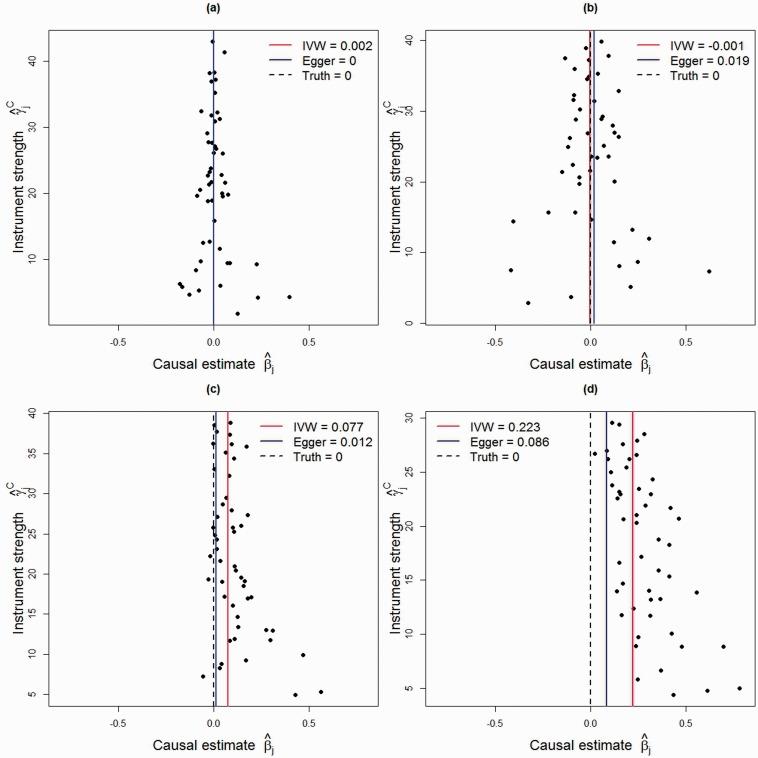
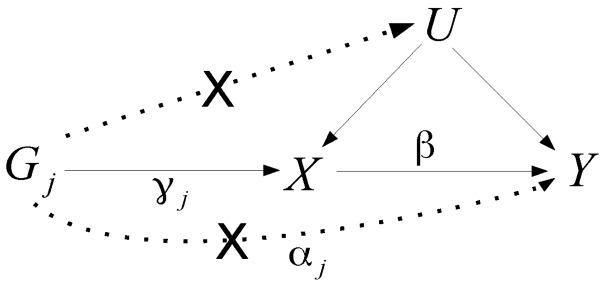
We view Mendelian randomization with multiple instruments as a meta-analysis, and show that bias caused by pleiotropy can be regarded as analogous to small study bias. Causal estimates using each instrument can be displayed visually by a funnel plot to assess potential asymmetry. Egger regression, a tool to detect small study bias in meta-analysis, can be adapted to test for bias from pleiotropy, and the slope coefficient from Egger regression provides an estimate of the causal effect. Under the assumption that the association of each genetic variant with the exposure is independent of the pleiotropic effect of the variant (not via the exposure), Egger's test gives a valid test of the null causal hypothesis and a consistent causal effect estimate even when all the genetic variants are invalid instrumental variables.
RESULTS
We illustrate the use of this approach by re-analysing two published Mendelian randomization studies of the causal effect of height on lung function, and the causal effect of blood pressure on coronary artery disease risk. The conservative nature of this approach is illustrated with these examples.
CONCLUSIONS
An adaption of Egger regression (which we call MR-Egger) can detect some violations of the standard instrumental variable assumptions, and provide an effect estimate which is not subject to these violations. The approach provides a sensitivity analysis for the robustness of the findings from a Mendelian randomization investigation.
背景
包含大量基因变异的孟德尔随机化分析数量正在迅速增加。这归因于全基因组关联研究的激增,以及获得更精确因果效应估计值的需求。然而,一些基因变异可能并非有效的工具变量,尤其是因为它们具有不止一个近端表型关联(多效性)。
方法
我们将使用多个工具变量的孟德尔随机化视为一种荟萃分析,并表明多效性导致的偏差可被视为类似于小型研究偏差。使用每个工具变量的因果估计值可以通过漏斗图直观显示,以评估潜在的不对称性。Egger回归是一种用于检测荟萃分析中小型研究偏差的工具,可用于检验多效性导致的偏差,并且Egger回归的斜率系数可提供因果效应的估计值。在每个基因变异与暴露的关联独立于该变异的多效性效应(不通过暴露)这一假设下,即使所有基因变异都是无效的工具变量,Egger检验也能对零因果假设进行有效检验,并提供一致的因果效应估计值。
结果
我们通过重新分析两项已发表的关于身高对肺功能的因果效应以及血压对冠心病风险的因果效应的孟德尔随机化研究,来说明这种方法的应用。这些例子展示了该方法的保守性。
结论
Egger回归的一种改编方法(我们称之为MR-Egger)可以检测到一些对标准工具变量假设的违反情况,并提供不受这些违反情况影响的效应估计值。该方法为孟德尔随机化研究结果的稳健性提供了敏感性分析。


 Zotero 插件