
SERBP1在S期通过调控CtIP翻译来影响同源重组介导的DNA修复。
SERBP1 affects homologous recombination-mediated DNA repair by regulation of CtIP translation during S phase.
作者信息
Ahn Jang-Won, Kim Sunjik, Na Wooju, Baek Su-Jin, Kim Jeong-Hwan, Min Keehong, Yeom Jeonghun, Kwak Hoyun, Jeong Sunjoo, Lee Cheolju, Kim Seon-Young, Choi Cheol Yong
机构信息
Department of Biological Sciences, Sungkyunkwan University, Suwon 440-746, Republic of Korea.
Human Genomics Research Center, KRIBB, Daejeon 305-806, Republic of Korea Department of Functional Genomics, University of Science of Technology, Daejeon 305-350, Republic of Korea.
出版信息
Nucleic Acids Res. 2015 Jul 27;43(13):6321-33. doi: 10.1093/nar/gkv592. Epub 2015 Jun 11.
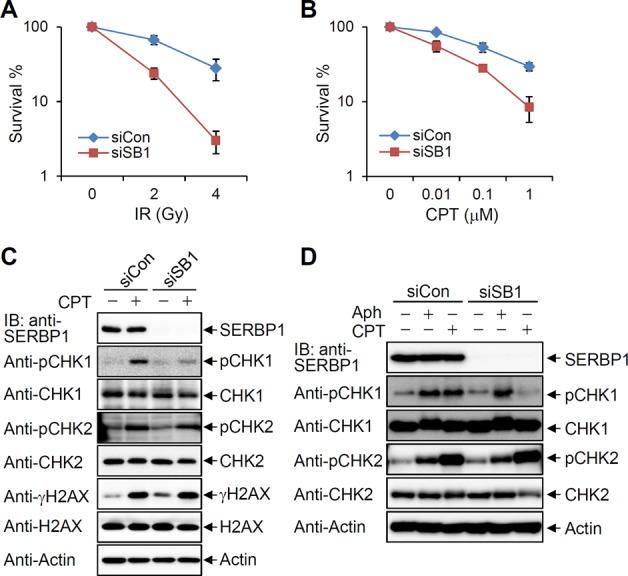
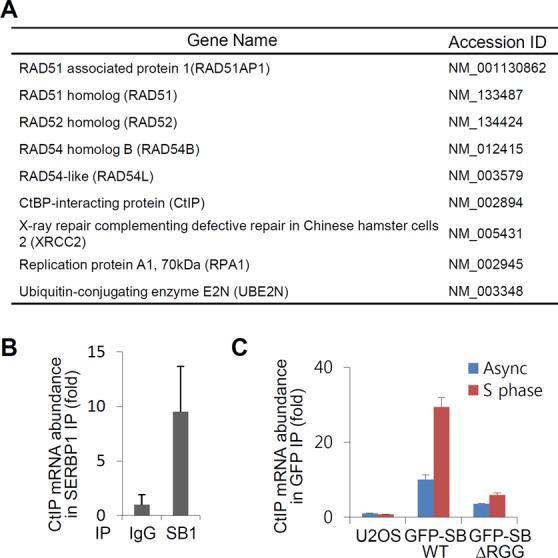
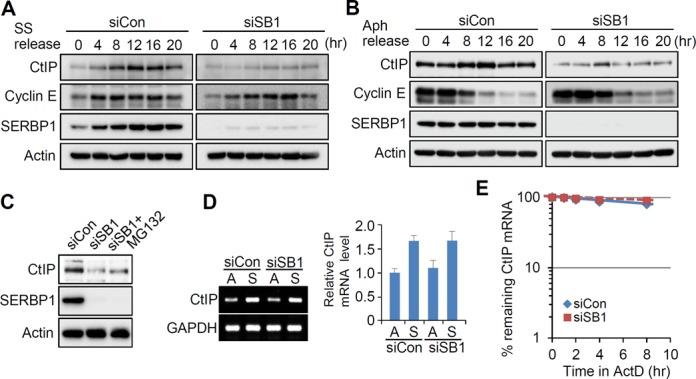
DNA double-strand breaks (DSBs) are the most severe type of DNA damage and are primarily repaired by non-homologous end joining (NHEJ) and homologous recombination (HR) in the G1 and S/G2 phase, respectively. Although CtBP-interacting protein (CtIP) is crucial in DNA end resection during HR following DSBs, little is known about how CtIP levels increase in an S phase-specific manner. Here, we show that Serpine mRNA binding protein 1 (SERBP1) regulates CtIP expression at the translational level in S phase. In response to camptothecin-mediated DNA DSBs, CHK1 and RPA2 phosphorylation, which are hallmarks of HR activation, was abrogated in SERBP1-depleted cells. We identified CtIP mRNA as a binding target of SERBP1 using RNA immunoprecipitation-coupled RNA sequencing, and confirmed SERBP1 binding to CtIP mRNA in S phase. SERBP1 depletion resulted in reduction of polysome-associated CtIP mRNA and concomitant loss of CtIP expression in S phase. These effects were reversed by reconstituting cells with wild-type SERBP1, but not by SERBP1 ΔRGG, an RNA binding defective mutant, suggesting regulation of CtIP translation by SERBP1 association with CtIP mRNA. These results indicate that SERBP1 affects HR-mediated DNA repair in response to DNA DSBs by regulation of CtIP translation in S phase.
DNA双链断裂(DSB)是最严重的DNA损伤类型,在G1期和S/G2期分别主要通过非同源末端连接(NHEJ)和同源重组(HR)进行修复。尽管CtBP相互作用蛋白(CtIP)在DSB后HR过程中的DNA末端切除中起关键作用,但对于CtIP水平如何以S期特异性方式增加却知之甚少。在这里,我们表明丝氨酸蛋白酶抑制剂mRNA结合蛋白1(SERBP1)在S期翻译水平上调节CtIP表达。响应喜树碱介导的DNA DSB,SERBP1缺失细胞中CHK1和RPA2磷酸化(HR激活的标志)被消除。我们使用RNA免疫沉淀耦合RNA测序将CtIP mRNA鉴定为SERBP1的结合靶标,并证实SERBP1在S期与CtIP mRNA结合。SERBP1缺失导致S期多核糖体相关的CtIP mRNA减少以及CtIP表达随之丧失。用野生型SERBP1重建细胞可逆转这些效应,但RNA结合缺陷突变体SERBP1ΔRGG则不能,这表明SERBP1与CtIP mRNA结合调节CtIP翻译。这些结果表明,SERBP1通过在S期调节CtIP翻译来影响对DNA DSB的HR介导的DNA修复。




 Zotero 插件