
通过冷冻透射电子显微镜图像分析和动态光散射监测全氟碳纳米乳液的稳定性
Monitoring the Stability of Perfluorocarbon Nanoemulsions by Cryo-TEM Image Analysis and Dynamic Light Scattering.
作者信息
Grapentin Christoph, Barnert Sabine, Schubert Rolf
机构信息
Department of Pharmaceutical Technology and Biopharmacy, Albert Ludwig University Freiburg i. Br., Freiburg im Breisgau, Germany.
出版信息
PLoS One. 2015 Jun 22;10(6):e0130674. doi: 10.1371/journal.pone.0130674. eCollection 2015.
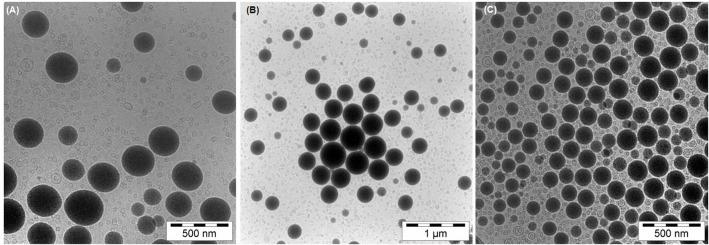
Perfluorocarbon nanoemulsions (PFC-NE) are disperse systems consisting of nanoscale liquid perfluorocarbon droplets stabilized by an emulsifier, usually phospholipids. Perfluorocarbons are chemically inert and non-toxic substances that are exhaled after in vivo administration. The manufacture of PFC-NE can be done in large scales by means of high pressure homogenization or microfluidization. Originally investigated as oxygen carriers for cases of severe blood loss, their application nowadays is more focused on using them as marker agents in 19F Magnetic Resonance Imaging (19F MRI). 19F is scarce in organisms and thus PFC-NE are a promising tool for highly specific and non-invasive imaging of inflammation via 19F MRI. Neutrophils, monocytes and macrophages phagocytize PFC-NE and subsequently migrate to inflamed tissues. This technique has proven feasibility in numerous disease models in mice, rabbits and mini pigs. The translation to clinical trials in human needs the development of a stable nanoemulsion whose droplet size is well characterized over a long storage time. Usually dynamic light scattering (DLS) is applied as the standard method for determining particle sizes in the nanometer range. Our study uses a second method, analysis of transmission electron microscopy images of cryo-fixed samples (Cryo-TEM), to evaluate stability of PFC-NE in comparison to DLS. Four nanoemulsions of different composition are observed for one year. The results indicate that DLS alone cannot reveal the changes in particle size, but can even mislead to a positive estimation of stability. The combination with Cryo-TEM images gives more insight in the particulate evolution, both techniques supporting one another. The study is one further step in the development of analytical tools for the evaluation of a clinically applicable perfluorooctylbromide nanoemulsion.
全氟碳纳米乳剂(PFC-NE)是一种分散体系,由纳米级液态全氟碳液滴组成,通常由乳化剂(通常为磷脂)稳定。全氟碳是化学惰性和无毒的物质,体内给药后会呼出。PFC-NE的制造可以通过高压均质化或微流控技术大规模进行。最初研究其作为严重失血情况下的氧载体,如今其应用更多地集中在将它们用作19F磁共振成像(19F MRI)中的标记剂。19F在生物体中稀缺,因此PFC-NE是通过19F MRI对炎症进行高特异性和非侵入性成像的有前途的工具。中性粒细胞、单核细胞和巨噬细胞吞噬PFC-NE,随后迁移到炎症组织。该技术已在小鼠、兔子和小型猪的众多疾病模型中证明了可行性。向人体临床试验的转化需要开发一种稳定的纳米乳剂,其液滴尺寸在长时间储存期间得到很好的表征。通常,动态光散射(DLS)被用作测定纳米范围内粒径的标准方法。我们的研究使用第二种方法,即分析冷冻固定样品的透射电子显微镜图像(冷冻透射电子显微镜),与DLS相比评估PFC-NE的稳定性。观察了四种不同组成的纳米乳剂一年。结果表明,仅DLS不能揭示粒径的变化,甚至可能导致对稳定性的积极估计产生误导。与冷冻透射电子显微镜图像相结合能更深入了解颗粒的演变,两种技术相互支持。该研究是开发用于评估临床适用的全氟辛基溴纳米乳剂的分析工具的又一步。


 Zotero 插件