
通过热成像评估按摩和抽吸技术在治疗乳房胀痛中的应用。
Assessment of techniques of massage and pumping in the treatment of breast engorgement by thermography.
作者信息
Heberle Anita Batista dos Santos, de Moura Marcos Antônio Muniz, de Souza Mauren Abreu, Nohama Percy
机构信息
Hospital Universitário Regional de Maringá, Universidade Estadual de Maringá, Maringá, PR, Brazil.
Escola Politécnica, Pontifícia Universidade Católica do Paraná, Curitiba, PR, Brazil.
出版信息
Rev Lat Am Enfermagem. 2014 Mar-Apr;22(2):277-85. doi: 10.1590/0104-1169.3238.2413.
OBJECTIVE
to evaluate techniques of massage and pumping in the treatment of postpartum breast engorgement through thermography.
METHOD
the study was conducted in the Human Milk Bank of a hospital in Curitiba, Brazil. We randomly selected 16 lactating women with engorgement with the classification lobar, ampullary and glandular, moderate and intense. We compared the differential patterns of temperature, before and after the treatment by means of massage and pumping.
RESULTS
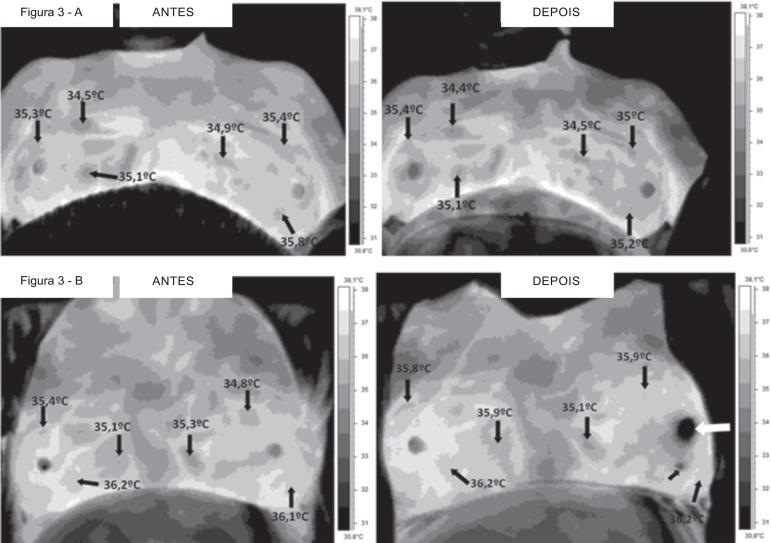
we found a negative gradient of 0.3°C of temperature between the pre- and post-treatment in the experimental group. Breasts with intense engorgement were 0.7°C warmer when compared with moderate engorgement.
CONCLUSION
massage and electromechanical pumping were superior to manual methods when evaluated by thermography.
REBEC
U1111-1136-9027.
目的
通过热成像评估按摩和抽吸技术在治疗产后乳房胀痛中的应用。
方法
该研究在巴西库里蒂巴一家医院的母乳库进行。我们随机选择了16名患有乳房胀痛的哺乳期妇女,其胀痛程度分为叶状、壶腹状和腺状,且有中度和重度之分。我们通过按摩和抽吸治疗前后比较了温度的差异模式。
结果
我们发现实验组治疗前后温度呈0.3°C的负梯度变化。与中度乳房胀痛相比,重度乳房胀痛的乳房温度高0.7°C。
结论
通过热成像评估,按摩和电动抽吸优于手动方法。
注册号
U1111-1136-9027。

 Zotero 插件