
整合基因组学在原发性儿童胚胎性肿瘤中鉴定出一种新的、类似非典型畸胎瘤/横纹肌样瘤(AT/RT)但INI1呈阳性的脑肿瘤亚型。
Integrated genomics has identified a new AT/RT-like yet INI1-positive brain tumor subtype among primary pediatric embryonal tumors.
作者信息
Ho Donald Ming-Tak, Shih Chuan-Chi, Liang Muh-Lii, Tsai Chan-Yen, Hsieh Tsung-Han, Tsai Chin-Han, Lin Shih-Chieh, Chang Ting-Yu, Chao Meng-En, Wang Hsei-Wei, Wong Tai-Tong
机构信息
Department of Pathology and Laboratory Medicine, Taipei Veterans General Hospital, Taipei, Taiwan.
School of Medicine, National Yang-Ming University, Taipei, Taiwan.
出版信息
BMC Med Genomics. 2015 Jun 25;8:32. doi: 10.1186/s12920-015-0103-3.
BACKGROUND
Pediatric embryonal brain tumors (PEBTs), which encompass medulloblastoma (MB), primitive neuroectodermal tumor (PNET) and atypical teratoid/rhabdoid tumor (AT/RT), are the second most prevalent pediatric brain tumor type. AT/RT is highly malignant and is often misdiagnosed as MB or PNET. The distinction of AT/RT from PNET/MB is of clinical significance because the survival rate of patients with AT/RT is substantially lower. The diagnosis of AT/RT relies primarily on morphologic assessment and immunohistochemical (IHC) staining for a few known markers such as the lack of INI1 protein expression. However, in our clinical practice we have observed several AT/RT-like tumors, that fulfilled histopathological and all other biomarker criteria for a diagnosis of AT/RT, yet retained INI1 immunoreactivity. Recent studies have also reported preserved INI1 immunoreactivity among certain diagnosed AT/RTs. It is therefore necessary to re-evaluate INI1(+), AT/RT-like cases.
METHOD
Sanger sequencing, array CGH and mRNA microarray analyses were performed on PEBT samples to investigate their genomic landscapes.
RESULTS
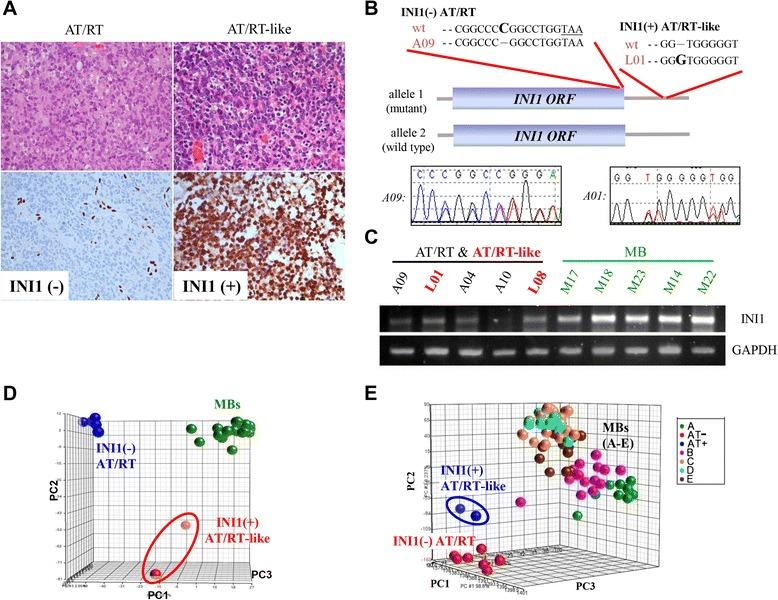
Patients with AT/RT and those with INI(+) AT/RT-like tumors showed a similar survival rate, and global array CGH analysis and INI1 gene sequencing showed no differential chromosomal aberration markers between INI1(-) AT/RT and INI(+) AT/RT-like cases. We did not misdiagnose MBs or PNETs as AT/RT-like tumors because transcriptome profiling revealed that not only did AT/RT and INI(+) AT/RT-like cases express distinct mRNA and microRNA profiles, their gene expression patterns were different from those of MBs and PNETs. The most similar transcriptome profile to that of AT/RTs was the profile of embryonic stem cells. However; the transcriptome profile of INI1(+) AT/RT-like tumors was more similar to that of somatic neural stem cells, while the profile of MBs was closer to that of fetal brain tissue. Novel biomarkers were identified that can be used to distinguish INI1(-) AT/RTs, INI1(+) AT/RT-like cases and MBs.
CONCLUSION
Our studies revealed a novel INI1(+) ATRT-like subtype among Taiwanese pediatric patients. New diagnostic biomarkers, as well as new therapeutic tactics, can be developed according to the transcriptome data that were unveiled in this work.
背景
小儿胚胎性脑肿瘤(PEBTs)包括髓母细胞瘤(MB)、原始神经外胚层肿瘤(PNET)和非典型畸胎样/横纹肌样肿瘤(AT/RT),是小儿脑肿瘤中第二常见的类型。AT/RT高度恶性,常被误诊为MB或PNET。将AT/RT与PNET/MB区分开来具有临床意义,因为AT/RT患者的生存率要低得多。AT/RT的诊断主要依靠形态学评估和对一些已知标志物的免疫组化(IHC)染色,如INI1蛋白表达缺失。然而,在我们的临床实践中,我们观察到一些类似AT/RT的肿瘤,它们满足了组织病理学和所有其他生物标志物标准,但仍保留INI1免疫反应性。最近的研究也报道了某些已确诊的AT/RT中存在保留的INI1免疫反应性。因此,有必要重新评估INI1(+)、类似AT/RT的病例。
方法
对PEBT样本进行桑格测序、阵列比较基因组杂交(array CGH)和mRNA微阵列分析,以研究其基因组图谱。
结果
AT/RT患者和INI(+)类似AT/RT肿瘤患者的生存率相似,全局阵列比较基因组杂交分析和INI1基因测序显示INI1(-) AT/RT和INI(+)类似AT/RT病例之间没有差异染色体畸变标志物。我们没有将MB或PNET误诊为类似AT/RT的肿瘤,因为转录组分析表明,不仅AT/RT和INI(+)类似AT/RT病例表达不同的mRNA和微小RNA谱,它们的基因表达模式也与MB和PNET不同。与AT/RT最相似的转录组谱是胚胎干细胞的谱。然而,INI1(+)类似AT/RT肿瘤的转录组谱与体神经干细胞的更相似,而MB的谱更接近胎儿脑组织的谱。确定了可用于区分INI1(-) AT/RTs、INI1(+)类似AT/RT病例和MB的新型生物标志物。
结论
我们的研究在台湾小儿患者中发现了一种新的INI1(+)类似ATRT的亚型。可根据本研究揭示的转录组数据开发新的诊断生物标志物以及新的治疗策略。


 Zotero 插件