
白化大鼠睾丸中慢性酒精中毒介导的代谢紊乱
Chronic alcoholism-mediated metabolic disorders in albino rat testes.
作者信息
Shayakhmetova Ganna M, Bondarenko Larysa B, Matvienko Anatoliy V, Kovalenko Valentina M
机构信息
General Toxicology Department, SI "Institute of Pharmacology & Toxicology", National Academy of Medical Sciences of Ukraine, Kyiv, 03680, Ukraine.
出版信息
Interdiscip Toxicol. 2014 Sep;7(3):165-72. doi: 10.2478/intox-2014-0023. Epub 2014 Dec 30.
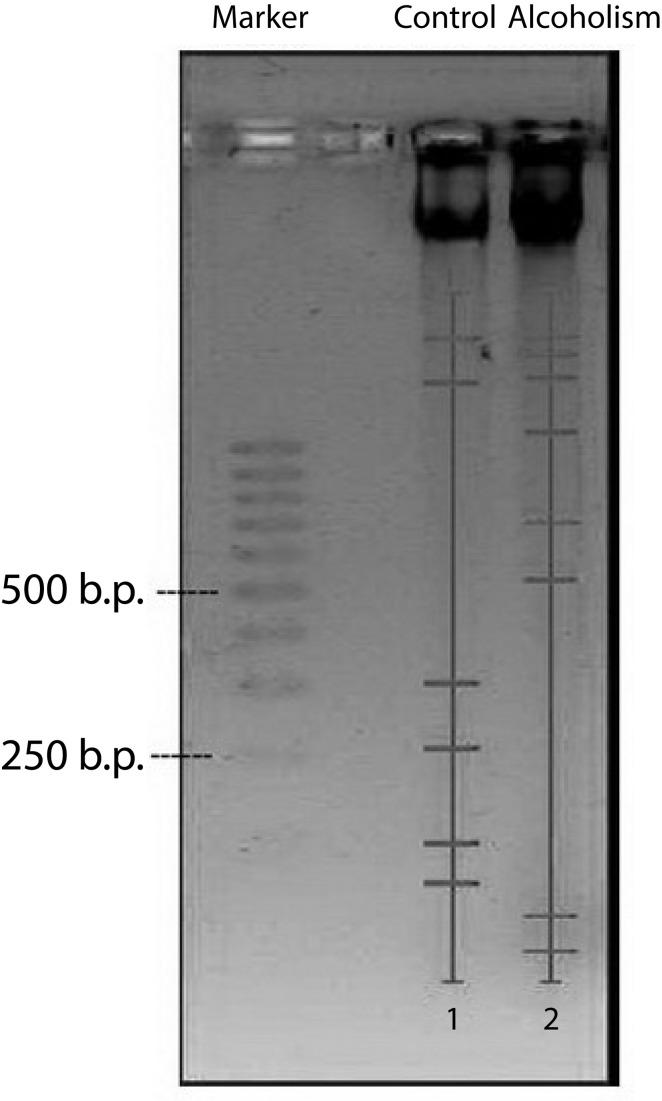
There is good evidence for impairment of spermatogenesis and reductions in sperm counts and testosterone levels in chronic alcoholics. The mechanisms for these effects have not yet been studied in detail. The consequences of chronic alcohol consumption on the structure and/or metabolism of testis cell macromolecules require to be intensively investigated. The present work reports the effects of chronic alcoholism on contents of free amino acids, levels of cytochrome P450 3A2 (CYP3A2) mRNA expression and DNA fragmentation, as well as on contents of different cholesterol fractions and protein thiol groups in rat testes. Wistar albino male rats were divided into two groups: I - control (intact animals), II - chronic alcoholism (15% ethanol self-administration during 150 days). Following 150 days of alcohol consumption, testicular free amino acid content was found to be significantly changed as compared with control. The most profound changes were registered for contents of lysine (-53%) and methionine (+133%). The intensity of DNA fragmentation in alcohol-treated rat testes was considerably increased, on the contrary CYP3A2 mRNA expression in testis cells was inhibited, testicular contents of total and etherified cholesterol increased by 25% and 45% respectively, and protein SH-groups decreased by 13%. Multidirectional changes of the activities of testicular dehydrogenases were detected. We thus obtained complex assessment of chronic alcoholism effects in male gonads, affecting especially amino acid, protein, ATP and NADPH metabolism. Our results demonstrated profound changes in testes on the level of proteome and genome. We suggest that the revealed metabolic disorders can have negative implication on cellular regulation of spermatogenesis under long-term ethanol exposure.
有充分证据表明,慢性酗酒者存在精子发生受损、精子数量减少和睾酮水平降低的情况。这些影响的机制尚未得到详细研究。慢性酒精摄入对睾丸细胞大分子结构和/或代谢的影响需要深入研究。本研究报告了慢性酗酒对大鼠睾丸中游离氨基酸含量、细胞色素P450 3A2(CYP3A2)mRNA表达水平和DNA片段化的影响,以及对不同胆固醇组分和蛋白质硫醇基团含量的影响。Wistar白化雄性大鼠分为两组:I组——对照组(完整动物),II组——慢性酗酒组(150天内自行饮用15%乙醇)。在饮用酒精150天后,发现睾丸游离氨基酸含量与对照组相比有显著变化。赖氨酸含量(-53%)和蛋氨酸含量(+133%)变化最为显著。酒精处理的大鼠睾丸中DNA片段化强度显著增加,相反,睾丸细胞中CYP3A2 mRNA表达受到抑制,睾丸中总胆固醇和醚化胆固醇含量分别增加了25%和45%,蛋白质SH基团减少了13%。检测到睾丸脱氢酶活性的多向变化。因此,我们对慢性酗酒对雄性性腺的影响进行了综合评估,尤其影响氨基酸、蛋白质、ATP和NADPH代谢。我们的结果表明,睾丸在蛋白质组和基因组水平上发生了深刻变化。我们认为,所揭示的代谢紊乱可能对长期乙醇暴露下精子发生的细胞调节产生负面影响。
 Zotero 插件