
《开斋节期间糖尿病管理的推荐意见:2015 年更新》。
Recommendations for management of diabetes during Ramadan: update 2015.
机构信息
EDC, Center for Diabetes Education , McDonough, Georgia , USA.
Department of Internal Medicine , Mansura University , Mansura , Egypt.
出版信息
BMJ Open Diabetes Res Care. 2015 Jun 16;3(1):e000108. doi: 10.1136/bmjdrc-2015-000108. eCollection 2015.
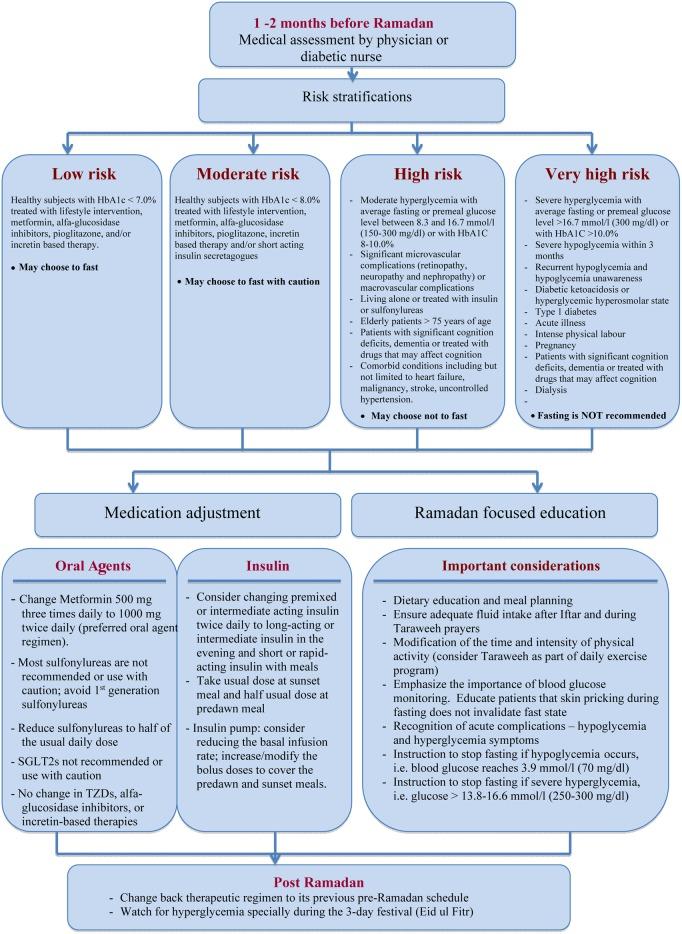
Since the first ADA working group report on the recommendations for management of diabetes during Ramadan in 2005 and our update in 2010, we received many inquiries asking for regular updates on information regarding education, nutritional habits and new oral and injectable agents that may be useful for the management of patients with diabetes during Ramadan. Patients can be stratified into their risk of hypoglycemia and/or complications prior to the start of the fasting period of Ramadan. Those at high risk of hypoglycemia and with multiple diabetic complications should be advised against prolonged fasting. Even in the lower hypoglycemia risk group, adverse effects may still occur. In order to minimize adverse side effects during fasting in patients with diabetes and improve or maintain glucose control, education and discussion of glucose monitoring and treatment regimens should occur several weeks prior to Ramadan. Agents such as metformin, thiazolidinediones and dipeptidyl peptidase-4 inhibitors appear to be safe and do not need dose adjustment. Most sulfonylureas may not be used safely during Ramadan except with extreme caution; besides, older agents, such as chlorpropamide or glyburide, should not be used. Reduction of the dosage of sulfonylurea is needed depending on the degree of control prior to fasting. Misconceptions and local habits should be addressed and dealt with in any educational intervention and therapeutic planning with patients with diabetes. In this regard, efforts are still needed for controlled prospective studies in the field of efficacy and safety of the different interventions during the Ramadan Fast.
自 2005 年首个 ADA 工作组关于斋月期间糖尿病管理建议的报告和 2010 年的更新以来,我们收到了许多询问,要求定期更新有关教育、营养习惯和新的口服和注射药物的信息,这些信息可能对斋月期间糖尿病患者的管理有用。患者可以根据低血糖和/或并发症的风险在斋月禁食期开始前进行分层。低血糖风险高且有多种糖尿病并发症的患者应避免长时间禁食。即使在低血糖风险较低的患者中,仍可能出现不良反应。为了最大限度地减少糖尿病患者在禁食期间的不良反应,并改善或维持血糖控制,应在斋月前数周进行血糖监测和治疗方案的教育和讨论。二甲双胍、噻唑烷二酮和二肽基肽酶-4 抑制剂等药物似乎是安全的,不需要调整剂量。除了极度谨慎之外,大多数磺酰脲类药物在斋月期间可能不安全,不应使用;此外,不应使用氯丙嗪或格列本脲等较旧的药物。磺酰脲类药物的剂量应根据禁食前的控制程度进行减少。在对糖尿病患者进行任何教育干预和治疗计划时,都应解决和处理误解和当地习惯。在这方面,仍需要在斋月禁食期间进行不同干预措施的疗效和安全性的对照前瞻性研究。
 Zotero 插件