
程序性死亡配体-1(PD-L1)与实体瘤生存:一项荟萃分析
PD-L1 and Survival in Solid Tumors: A Meta-Analysis.
作者信息
Wu Pin, Wu Dang, Li Lijun, Chai Ying, Huang Jian
机构信息
Department of Thoracic Surgery, Second Affiliated Hospital, Zhejiang University School of Medicine, Zhejiang University, Hangzhou, 310009, China; Cancer Institute (Key Laboratory of Cancer Prevention & Intervention, National Ministry of Education, Provincial Key Laboratory of Molecular Biology in Medical Sciences), Second Affiliated Hospital, Zhejiang University School of Medicine, Zhejiang University, Hangzhou, 310009, China.
Cancer Institute (Key Laboratory of Cancer Prevention & Intervention, National Ministry of Education, Provincial Key Laboratory of Molecular Biology in Medical Sciences), Second Affiliated Hospital, Zhejiang University School of Medicine, Zhejiang University, Hangzhou, 310009, China.
出版信息
PLoS One. 2015 Jun 26;10(6):e0131403. doi: 10.1371/journal.pone.0131403. eCollection 2015.
BACKGROUND
Numerous agents targeting PD-L1/PD-1 check-point are in clinical development. However, the correlation between PD-L1 expression and prognosis of solid tumor is still in controversial. Here, we elicit a systematic review and meta-analysis to investigate the potential value of PD-L1 in the prognostic prediction in human solid tumors.
METHODS
Electronic databases were searched for studies evaluating the expression of PD-L1 and overall survival (OS) of patients with solid tumors. Odds ratios (ORs) from individual studies were calculated and pooled by using a random-effect model, and heterogeneity and publication bias analyses were also performed.
RESULTS
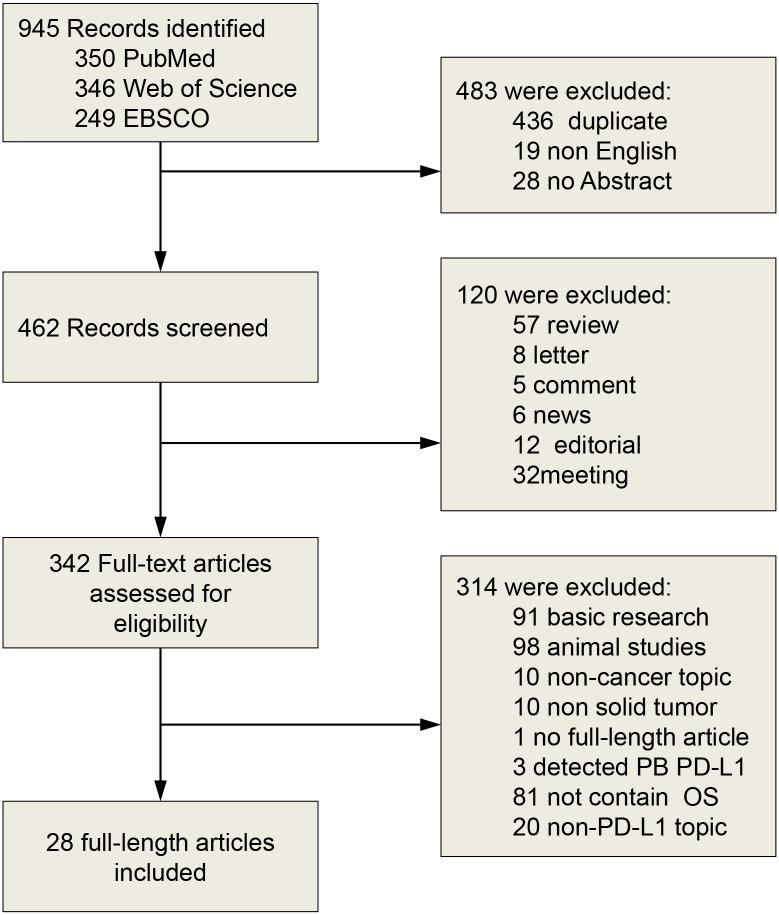
A total of 3107 patients with solid tumor from 28 published studies were included in the meta-analysis. The median percentage of solid tumors with PD-L1 overexpression was 52.5%. PD-L1 overexpression was associated with worse OS at both 3 years (OR = 2.43, 95% confidence interval (CI) = 1.60 to 3.70, P < 0.0001) and 5 years (OR = 2.23, 95% CI = 1.40 to 3.55, P = 0.0008) of solid tumors. Among the tumor types, PD-L1 was associated with worse 3 year-OS of esophageal cancer, gastric cancer, hepatocellular carcinoma, and urothelial cancer, and 5 year-OS of esophageal cancer, gastric cancer and colorectal cancer.
CONCLUSIONS
These results suggest that expression of PD-L1 is associated with worse survival in solid tumors. However, the correlations between PD-L1 and prognosis are variant among different tumor types. More studies are needed to investigate the clinical value of PD-L1 expression in prognostic prediction and treatment option.
背景
众多靶向程序性死亡受体配体1(PD-L1)/程序性死亡蛋白1(PD-1)检查点的药物正处于临床研发阶段。然而,PD-L1表达与实体瘤预后之间的相关性仍存在争议。在此,我们进行了一项系统评价和荟萃分析,以探讨PD-L1在人类实体瘤预后预测中的潜在价值。
方法
检索电子数据库,查找评估实体瘤患者PD-L1表达及总生存期(OS)的研究。计算各研究的比值比(OR),并采用随机效应模型进行汇总,同时进行异质性和发表偏倚分析。
结果
荟萃分析共纳入28项已发表研究中的3107例实体瘤患者。PD-L1过表达的实体瘤中位百分比为52.5%。PD-L1过表达与实体瘤3年(OR = 2.43,95%置信区间(CI)= 1.60至3.70,P < 0.0001)和5年(OR = 2.23,95% CI = 1.40至3.55,P = 0.0008)的较差OS相关。在肿瘤类型中,PD-L1与食管癌、胃癌、肝细胞癌和尿路上皮癌的3年较差OS以及食管癌、胃癌和结直肠癌的5年较差OS相关。
结论
这些结果表明,PD-L1表达与实体瘤较差的生存率相关。然而,PD-L1与预后之间的相关性在不同肿瘤类型中存在差异。需要更多研究来探讨PD-L1表达在预后预测和治疗选择中的临床价值。



 Zotero 插件