
灾难性卫生支出中社会经济不平等的测量与解释:来自陕西省农村地区的证据
Measurement and explanation of socioeconomic inequality in catastrophic health care expenditure: evidence from the rural areas of Shaanxi Province.
作者信息
Xu Yongjian, Gao Jianmin, Zhou Zhongliang, Xue Qinxiang, Yang Jinjuan, Luo Hao, Li Yanli, Lai Sha, Chen Gang
机构信息
School of Public Health, Health Science Center, Xi'an Jiaotong University, P.O Box 86, No. 76 West Yanta Road, Xi'an, Shaanxi, 710061, China.
School of Public Policy and Administration, Xi'an Jiaotong University, Xi'an, China.
出版信息
BMC Health Serv Res. 2015 Jul 3;15:256. doi: 10.1186/s12913-015-0892-2.
BACKGROUND
Policy interventions have been taken to protect households from facing unpredictable economic changes that may cause catastrophe in China. This study aims to estimate the change of overall proportion of households incurring catastrophic health care expenditure (CHE) and its income-related inequality in the rural areas of Shaanxi Province from 2008 to 2013.
METHODS
The data were drawn from the National Household Health Service Surveys of Shaanxi Province conducted in the years 2008 and 2013. In total, 3,217 households in 2008 and 13,085 households in 2013 were selected for analysis. A "Capacity to pay" approach was used to measure the incidence of CHE. The concentration index was employed to measure the extent of income-related inequality in CHE. A decomposition method, based on a logit model, was used to decompose the concentration index into its determining components.
RESULTS
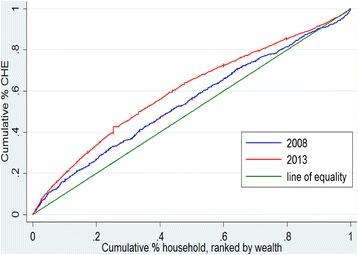
From 2008 to 2013, the overall proportion of households incurring CHE dropped from 17.19 % to 15.83 %, while conversely, the inequality in facing CHE strongly increased. The majority of observed inequalities in CHE were explained by household economic status and household size in 2013. In addition, the absence of commercial health insurance and having elderly members were also important contributors to inequality in CHE.
CONCLUSIONS
Even though we used a conservative method to measure CHE, the overall proportion of households incurring CHE in Shaanxi Province is still considerably high in both years. Furthermore, there exists a strong pro-rich inequality of CHE in rural areas of Shaanxi Province. Our study suggests that narrowing the gap of household economic status, improving the anti-risk capability of small scale households, establishing prepayment mechanisms in health insurance, strengthening the depth of reimbursement and subsidising vulnerable households in Shaanxi Province are helpful for both reducing the probability of incurring CHE and the pro-rich inequality in CHE.
背景
中国已采取政策干预措施,以保护家庭免受可能导致灾难的不可预测的经济变化影响。本研究旨在估计2008年至2013年陕西省农村地区发生灾难性医疗支出(CHE)的家庭总体比例变化及其与收入相关的不平等情况。
方法
数据来自2008年和2013年进行的陕西省全国家庭健康服务调查。总共选取了2008年的3217户家庭和2013年的13085户家庭进行分析。采用“支付能力”方法来衡量CHE的发生率。集中指数用于衡量CHE中与收入相关的不平等程度。基于logit模型的分解方法用于将集中指数分解为其决定因素。
结果
从2008年到2013年,发生CHE的家庭总体比例从17.19%降至15.83%,而相反,面临CHE的不平等程度大幅增加。2013年观察到的CHE不平等现象大多由家庭经济状况和家庭规模来解释。此外,缺乏商业健康保险和有老年成员也是CHE不平等的重要因素。
结论
尽管我们使用了保守的方法来衡量CHE,但陕西省这两年发生CHE的家庭总体比例仍然相当高。此外,陕西省农村地区存在严重的CHE有利于富人的不平等现象。我们的研究表明,缩小家庭经济状况差距、提高小规模家庭的抗风险能力、在医疗保险中建立预付款机制、加强报销深度以及补贴陕西省的弱势家庭,有助于降低发生CHE的概率以及CHE中有利于富人的不平等现象。
 Zotero 插件