
研究方案:以康复为重点的精神卫生保健规划与协调的跨国比较案例研究(COCAPP)。
Study protocol: cross-national comparative case study of recovery-focused mental health care planning and coordination (COCAPP).
作者信息
Simpson Alan, Hannigan Ben, Coffey Michael, Jones Aled, Barlow Sally, Cohen Rachel, Všetečková Jitka, Faulkner Alison, Haddad Mark
机构信息
Centre for Mental Health Research, School of Health Sciences, City University London, London, UK.
School of Healthcare Sciences, Cardiff University, Cardiff, UK.
出版信息
BMC Psychiatry. 2015 Jul 3;15:145. doi: 10.1186/s12888-015-0538-2.
BACKGROUND
The collaborative care planning study (COCAPP) is a cross-national comparative study of care planning and coordination in community mental healthcare settings. The context and delivery of mental health care is diverging between the countries of England and Wales whilst retaining points of common interest, hence providing a rich geographical comparison for research. Across England the key vehicle for the provision of recovery-focused, personalised, collaborative mental health care is the care programme approach (CPA). The CPA is a form of case management introduced in England in 1991, then revised in 2008. In Wales the CPA was introduced in 2003 but has now been superseded by The Mental Health (Care Co-ordination and Care and Treatment Planning) (CTP) Regulations (Mental Health Measure), a new statutory framework. In both countries, the CPA/CTP requires providers to: comprehensively assess health/social care needs and risks; develop a written care plan (which may incorporate risk assessments, crisis and contingency plans, advanced directives, relapse prevention plans, etc.) in collaboration with the service user and carer(s); allocate a care coordinator; and regularly review care. The overarching aim of this study is to identify and describe the factors that ensure CPA/CTP care planning and coordination is personalised, recovery-focused and conducted collaboratively.
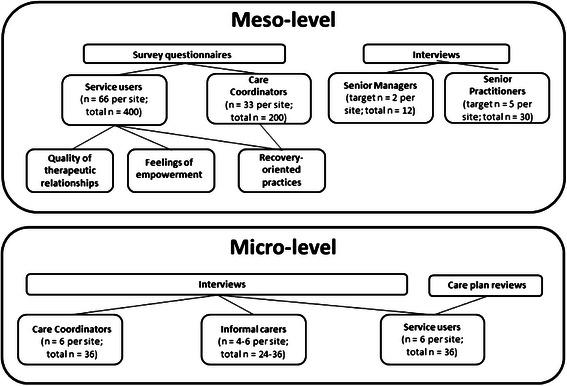
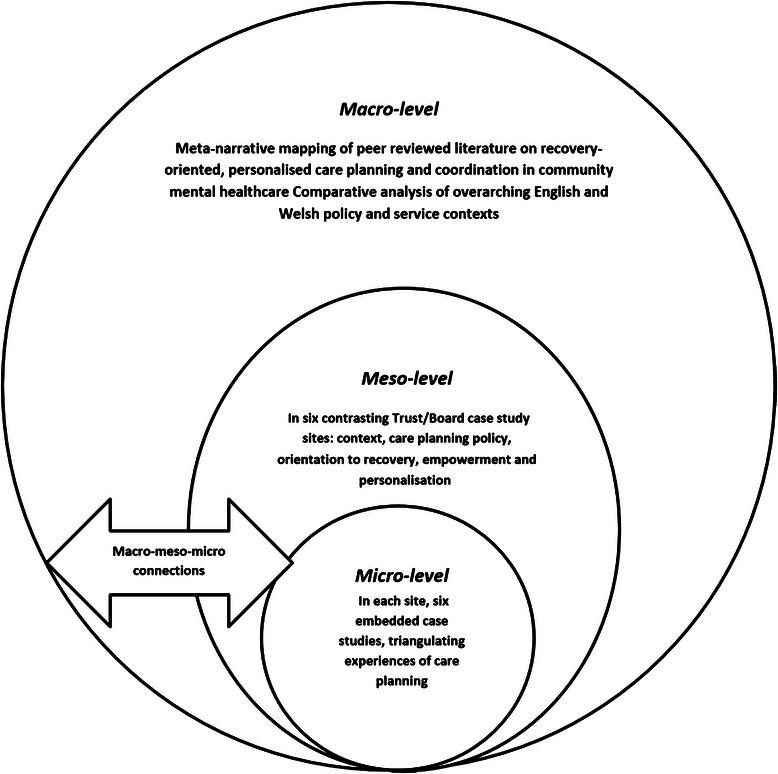
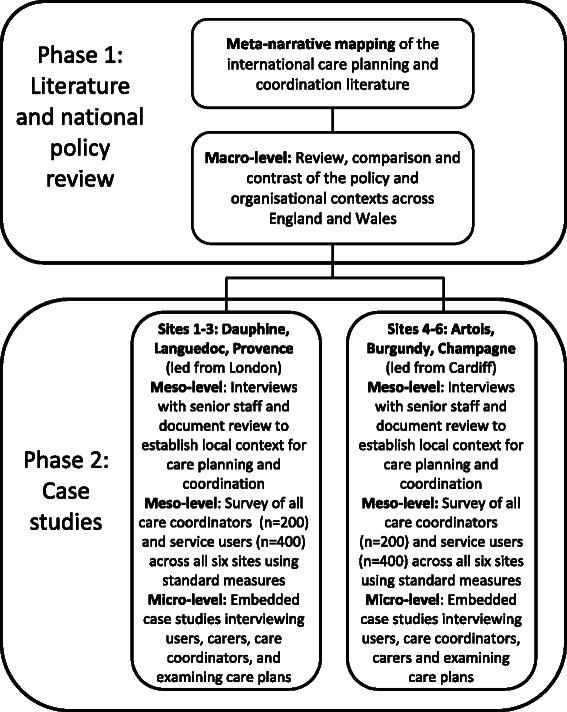
METHODS/DESIGN: COCAPP will employ a concurrent transformative mixed methods approach with embedded case studies. Phase 1 (Macro-level) will consider the national context through a meta-narrative mapping (MNM) review of national policies and the relevant research literature. Phase 2 (Meso-level and Micro-level) will include in-depth micro-level case studies of everyday 'frontline' practice and experience with detailed qualitative data from interviews and reviews of individual care plans. This will be nested within larger meso-level survey datasets, senior-level interviews and policy reviews in order to provide potential explanations and understanding.
DISCUSSION
COCAPP will help identify the key components that support and hinder the provision of personalised, recovery-focused care planning and provide an informed rationale for a future planned intervention and evaluation.
背景
协作护理计划研究(COCAPP)是一项关于社区精神卫生保健环境中护理计划与协调的跨国比较研究。英格兰和威尔士两国的精神卫生保健背景及服务提供情况虽存在差异,但仍有共同关注点,因此为研究提供了丰富的地域比较。在英格兰,提供以康复为重点、个性化且协作性的精神卫生保健的关键手段是护理计划方案(CPA)。CPA是1991年在英格兰引入的一种病例管理形式,2008年进行了修订。在威尔士,CPA于2003年引入,但现已被新的法定框架《精神卫生(护理协调及护理与治疗计划)(CTP)条例》(《精神卫生措施》)所取代。在这两个国家,CPA/CTP要求服务提供者:全面评估健康/社会护理需求及风险;与服务使用者及护理者协作制定书面护理计划(可能包括风险评估、危机及应急计划、预先指令、复发预防计划等);指定一名护理协调员;并定期审查护理情况。本研究的总体目标是确定并描述确保CPA/CTP护理计划与协调具有个性化、以康复为重点且协作开展的因素。
方法/设计:COCAPP将采用一种同时进行的变革性混合方法,并嵌入案例研究。第一阶段(宏观层面)将通过对国家政策和相关研究文献的元叙事映射(MNM)综述来考量国家背景。第二阶段(中观层面和微观层面)将包括对日常“一线”实践与经验的深入微观层面案例研究,以及来自个体护理计划访谈和审查的详细定性数据。这将嵌套于更大规模的中观层面调查数据集、高层访谈及政策审查之中,以便提供潜在解释与理解。
讨论
COCAPP将有助于确定支持和阻碍提供个性化、以康复为重点的护理计划的关键要素,并为未来计划的干预与评估提供明智的理论依据。
 Zotero 插件