
小鼠图像引导激光诱导脉络膜新生血管模型的优化
Optimization of an Image-Guided Laser-Induced Choroidal Neovascularization Model in Mice.
作者信息
Gong Yan, Li Jie, Sun Ye, Fu Zhongjie, Liu Chi-Hsiu, Evans Lucy, Tian Katherine, Saba Nicholas, Fredrick Thomas, Morss Peyton, Chen Jing, Smith Lois E H
机构信息
Department of Ophthalmology, Boston Children's Hospital, Harvard Medical School, Boston, Massachusetts, United States of America.
Department of Ophthalmology, Boston Children's Hospital, Harvard Medical School, Boston, Massachusetts, United States of America; Department of Ophthalmology, Sichuan Provincial Hospital and Sichuan Academy of Medical Science, Chengdu, Sichuan, People's Republic of China.
出版信息
PLoS One. 2015 Jul 10;10(7):e0132643. doi: 10.1371/journal.pone.0132643. eCollection 2015.
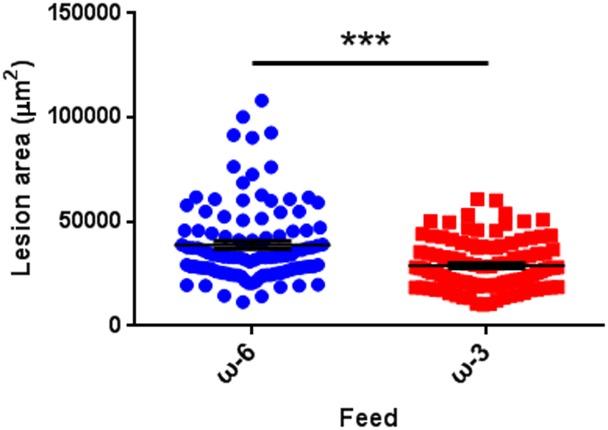
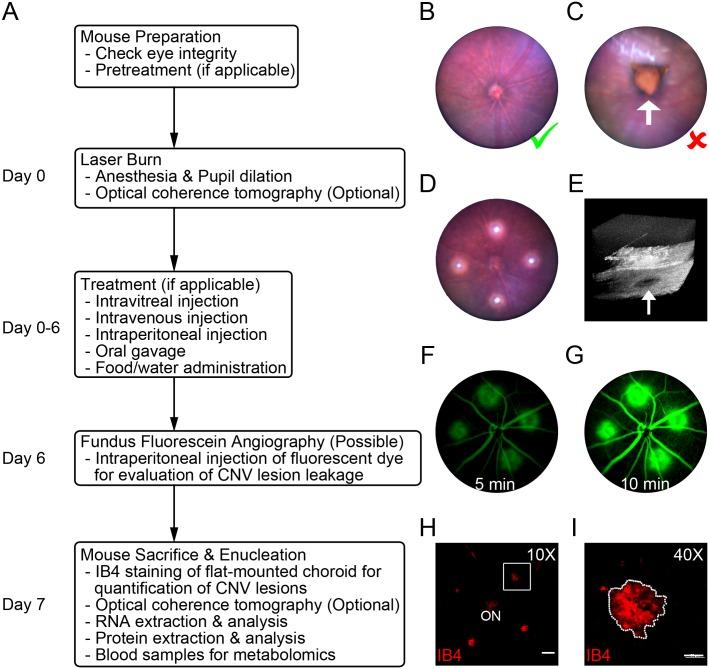
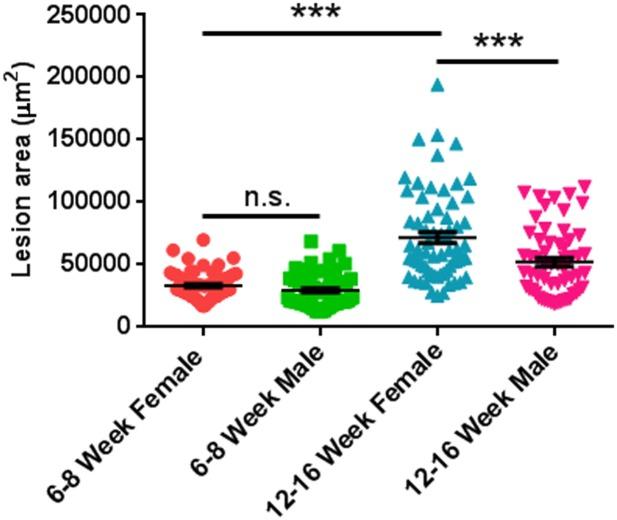
The mouse model of laser-induced choroidal neovascularization (CNV) has been used in studies of the exudative form of age-related macular degeneration using both the conventional slit lamp and a new image-guided laser system. A standardized protocol is needed for consistent results using this model, which has been lacking. We optimized details of laser-induced CNV using the image-guided laser photocoagulation system. Four lesions with similar size were consistently applied per eye at approximately double the disc diameter away from the optic nerve, using different laser power levels, and mice of various ages and genders. After 7 days, the mice were sacrificed and retinal pigment epithelium/choroid/sclera was flat-mounted, stained with Isolectin B4, and imaged. Quantification of the area of the laser-induced lesions was performed using an established and constant threshold. Exclusion criteria are described that were necessary for reliable data analysis of the laser-induced CNV lesions. The CNV lesion area was proportional to the laser power levels. Mice at 12-16 weeks of age developed more severe CNV than those at 6-8 weeks of age, and the gender difference was only significant in mice at 12-16 weeks of age, but not in those at 6-8 weeks of age. Dietary intake of omega-3 long-chain polyunsaturated fatty acid reduced laser-induced CNV in mice. Taken together, laser-induced CNV lesions can be easily and consistently applied using the image-guided laser platform. Mice at 6-8 weeks of age are ideal for the laser-induced CNV model.
激光诱导脉络膜新生血管(CNV)小鼠模型已被用于湿性年龄相关性黄斑变性的研究,使用的是传统裂隙灯和新型图像引导激光系统。使用该模型需要一个标准化方案以获得一致的结果,但目前一直缺乏这样的方案。我们使用图像引导激光光凝系统优化了激光诱导CNV的细节。在离视神经约两倍视盘直径的位置,对每只眼睛持续施加四个大小相似的损伤,使用不同的激光功率水平,涉及不同年龄和性别的小鼠。7天后,处死小鼠,将视网膜色素上皮/脉络膜/巩膜平铺,用异凝集素B4染色并成像。使用既定且恒定的阈值对激光诱导损伤的面积进行量化。描述了激光诱导CNV损伤可靠数据分析所需的排除标准。CNV损伤面积与激光功率水平成正比。12 - 16周龄的小鼠比6 - 8周龄的小鼠发生更严重的CNV,性别差异仅在12 - 16周龄的小鼠中显著,而在6 - 8周龄的小鼠中不显著。饮食中摄入ω-3长链多不饱和脂肪酸可减少小鼠激光诱导的CNV。综上所述,使用图像引导激光平台可以轻松且一致地诱导CNV损伤。6 - 8周龄的小鼠是激光诱导CNV模型的理想选择。


 Zotero 插件