
分析抗癌组蛋白去乙酰化酶抑制剂对疟原虫和锥虫寄生虫的抗寄生虫活性。
Profiling the anti-protozoal activity of anti-cancer HDAC inhibitors against Plasmodium and Trypanosoma parasites.
作者信息
Engel Jessica A, Jones Amy J, Avery Vicky M, Sumanadasa Subathdrage D M, Ng Susanna S, Fairlie David P, Skinner-Adams Tina, Andrews Katherine T
机构信息
Eskitis Institute for Drug Discovery, Griffith University, Queensland, Australia.
Institute for Molecular Bioscience, The University of Queensland, Brisbane, Q4072, Australia.
出版信息
Int J Parasitol Drugs Drug Resist. 2015 Jun 20;5(3):117-26. doi: 10.1016/j.ijpddr.2015.05.004. eCollection 2015 Dec.
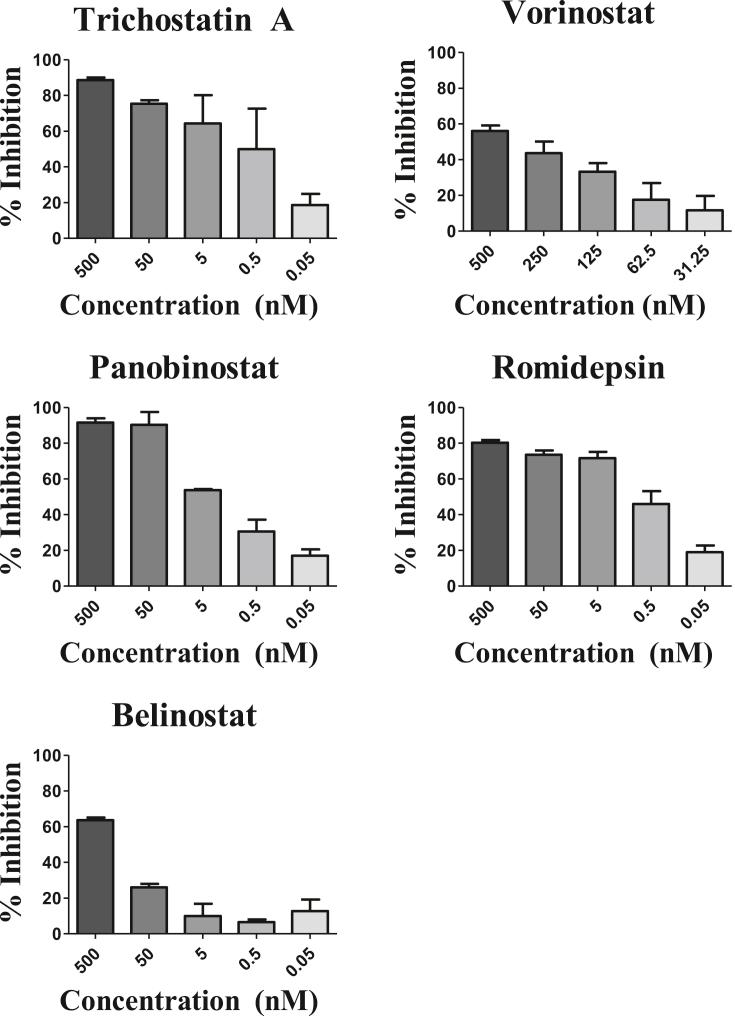
Histone deacetylase (HDAC) enzymes work together with histone acetyltransferases (HATs) to reversibly acetylate both histone and non-histone proteins. As a result, these enzymes are involved in regulating chromatin structure and gene expression as well as other important cellular processes. HDACs are validated drug targets for some types of cancer, with four HDAC inhibitors clinically approved. However, they are also showing promise as novel drug targets for other indications, including malaria and other parasitic diseases. In this study the in vitro activity of four anti-cancer HDAC inhibitors was examined against parasites that cause malaria and trypanosomiasis. Three of these inhibitors, suberoylanilide hydroxamic acid (SAHA; vorinostat(®)), romidepsin (Istodax(®)) and belinostat (Beleodaq(®)), are clinically approved for the treatment of T-cell lymphoma, while the fourth, panobinostat, has recently been approved for combination therapy use in certain patients with multiple myeloma. All HDAC inhibitors were found to inhibit the growth of asexual-stage Plasmodium falciparum malaria parasites in the nanomolar range (IC50 10-200 nM), while only romidepsin was active at sub-μM concentrations against bloodstream form Trypanosoma brucei brucei parasites (IC50 35 nM). The compounds were found to have some selectivity for malaria parasites compared with mammalian cells, but were not selective for trypanosome parasites versus mammalian cells. All compounds caused hyperacetylation of histone and non-histone proteins in P. falciparum asexual stage parasites and inhibited deacetylase activity in P. falciparum nuclear extracts in addition to recombinant PfHDAC1 activity. P. falciparum histone hyperacetylation data indicate that HDAC inhibitors may differentially affect the acetylation profiles of histone H3 and H4.
组蛋白去乙酰化酶(HDAC)与组蛋白乙酰转移酶(HATs)共同作用,对组蛋白和非组蛋白进行可逆性乙酰化修饰。因此,这些酶参与调控染色质结构、基因表达以及其他重要的细胞过程。HDAC是某些类型癌症的已验证药物靶点,有四种HDAC抑制剂已获临床批准。然而,它们作为包括疟疾和其他寄生虫病在内的其他适应症的新型药物靶点也显示出前景。在本研究中,检测了四种抗癌HDAC抑制剂对导致疟疾和锥虫病的寄生虫的体外活性。其中三种抑制剂,辛二酰苯胺异羟肟酸(SAHA;伏立诺他(®))、罗米地辛(Istodax(®))和贝利司他(Beleodaq(®)),已获临床批准用于治疗T细胞淋巴瘤,而第四种抑制剂帕比司他最近已获批准用于某些多发性骨髓瘤患者的联合治疗。所有HDAC抑制剂均被发现可在纳摩尔范围内抑制恶性疟原虫无性期疟原虫的生长(IC50为10 - 200 nM),而只有罗米地辛在亚微摩尔浓度下对布氏布氏锥虫血流型寄生虫具有活性(IC50为35 nM)。与哺乳动物细胞相比,这些化合物对疟原虫具有一定的选择性,但对锥虫寄生虫与哺乳动物细胞之间没有选择性。所有化合物均导致恶性疟原虫无性期寄生虫中组蛋白和非组蛋白的高乙酰化,并抑制恶性疟原虫核提取物中的去乙酰化酶活性以及重组PfHDAC1的活性。恶性疟原虫组蛋白高乙酰化数据表明,HDAC抑制剂可能会对组蛋白H3和H4的乙酰化谱产生不同影响。


 Zotero 插件