
循环肿瘤细胞在接受辅助或挽救性放射治疗的前列腺癌患者中的意义。
The significance of circulating tumor cells in prostate cancer patients undergoing adjuvant or salvage radiation therapy.
作者信息
Lowes L E, Lock M, Rodrigues G, D'Souza D, Bauman G, Ahmad B, Venkatesan V, Allan A L, Sexton T
机构信息
Department of Anatomy and Cell Biology, Schulich School of Medicine and Dentistry, Western University, London, Ontario, Canada.
London Regional Cancer Program, London Health Sciences Centre, London, Ontario, Canada.
出版信息
Prostate Cancer Prostatic Dis. 2015 Dec;18(4):358-64. doi: 10.1038/pcan.2015.36. Epub 2015 Aug 4.
BACKGROUND
Following radical prostatectomy, success of adjuvant and salvage radiation therapy (RT) is dependent on the absence of micrometastatic disease. However, reliable prognostic/predictive factors for determining this are lacking. Therefore, novel biomarkers are needed to assist with clinical decision-making in this setting. Enumeration of circulating tumor cells (CTCs) using the regulatory-approved CellSearch System (CSS) is prognostic in metastatic prostate cancer. We hypothesize that CTCs may also be prognostic in the post-prostatectomy setting.
METHODS
Patient blood samples (n=55) were processed on the CSS to enumerate CTCs at 0, 6, 12 and 24 months after completion of RT. CTC values were correlated with predictive/prognostic factors and progression-free survival.
RESULTS
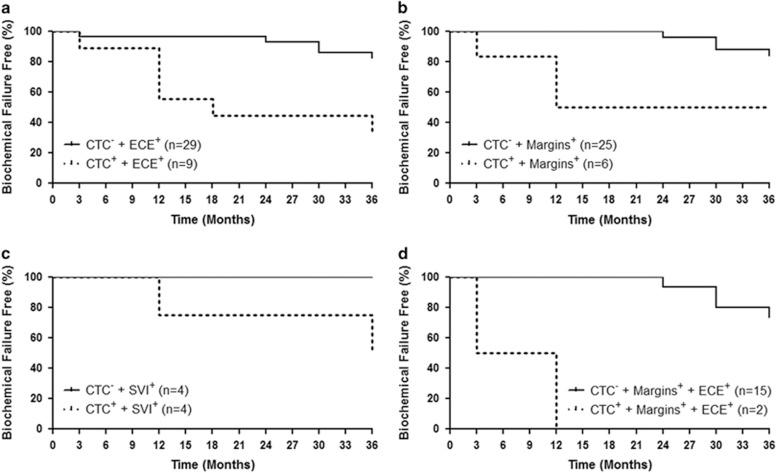
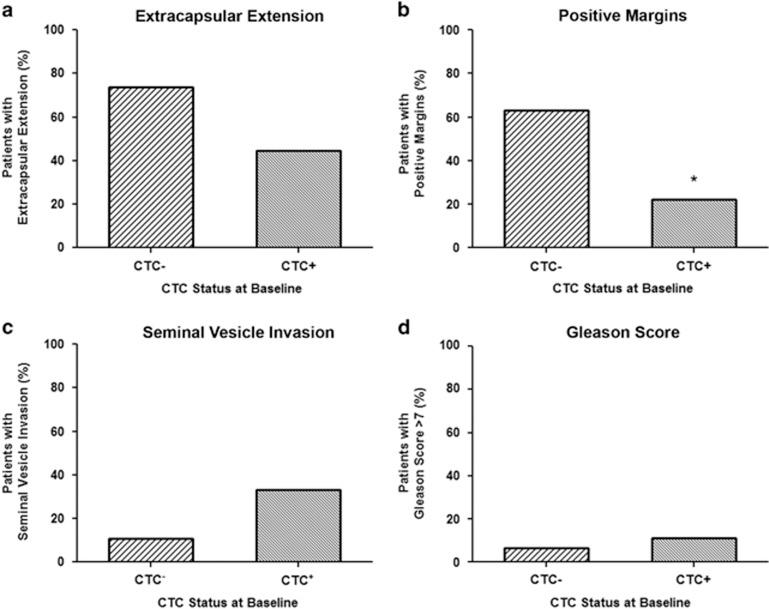
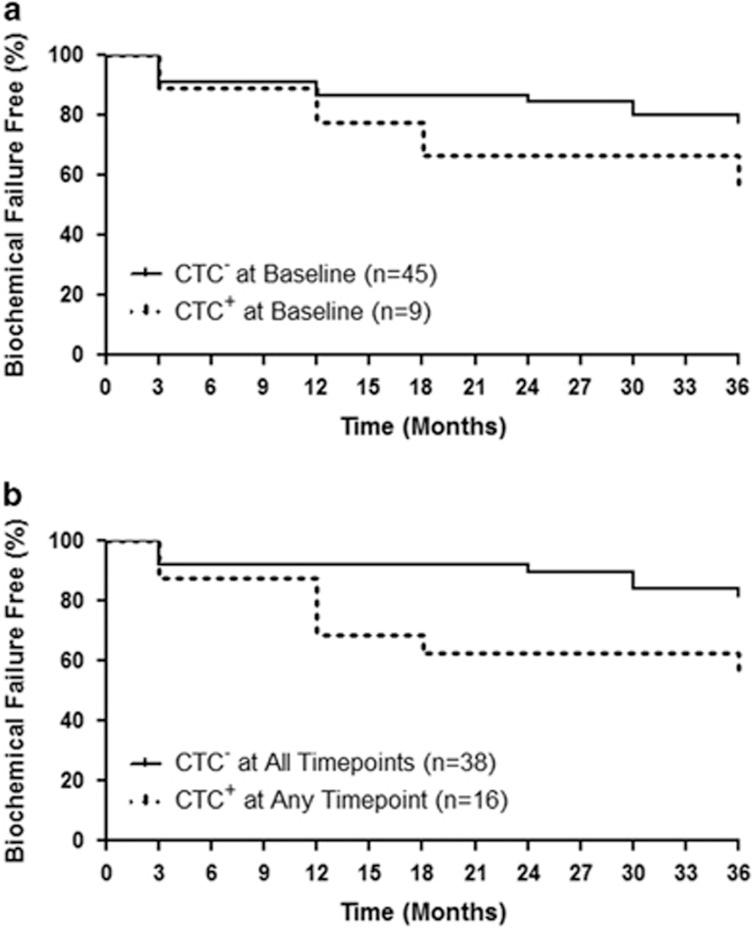
CTC status (presence/absence) correlated significantly with positive margins (increased likelihood of CTC(neg) disease; P=0.032), and trended toward significance with the presence of seminal vesicle invasion (CTC(pos); P=0.113) and extracapsular extension (CTC(neg); P=0.116). Although there was a trend toward a decreased time to biochemical failure (BCF) in baseline CTC-positive patients (n=9), this trend was not significant (hazard ratio (HR)=0.3505; P=0.166). However, CTC-positive status at any point (n=16) predicted for time to BCF (HR=0.2868; P=0.0437).
CONCLUSIONS
One caveat of this study is the small sample size utilized (n=55) and the low number of patients with CTC-positive disease (n=16). However, our results suggest that CTCs may be indicative of disseminated disease and assessment of CTCs during RT may be helpful in clinical decision-making to determine, which patients may benefit from RT versus those who may benefit more from systemic treatments.
背景
根治性前列腺切除术后,辅助性和挽救性放射治疗(RT)的成功取决于无微转移疾病。然而,目前缺乏用于确定这一点的可靠预后/预测因素。因此,需要新的生物标志物来辅助这一情况下的临床决策。使用监管批准的循环肿瘤细胞(CTC)检测系统(CSS)对循环肿瘤细胞进行计数在转移性前列腺癌中具有预后价值。我们假设CTC在前列腺切除术后的情况下也可能具有预后价值。
方法
对55例患者的血液样本在CSS上进行处理,以在放疗完成后0、6、12和24个月对CTC进行计数。CTC值与预测/预后因素及无进展生存期相关。
结果
CTC状态(存在/不存在)与手术切缘阳性显著相关(CTC阴性疾病的可能性增加;P = 0.032),并且在存在精囊侵犯(CTC阳性;P = 0.113)和包膜外扩展(CTC阴性;P = 0.116)时呈显著趋势。尽管基线CTC阳性患者(n = 9)的生化复发(BCF)时间有缩短趋势,但这一趋势并不显著(风险比(HR)= 0.3505;P = 0.166)。然而,任何时间点的CTC阳性状态(n = 16)可预测BCF时间(HR = 0.2868;P = 0.0437)。
结论
本研究的一个注意事项是样本量较小(n = 55)以及CTC阳性疾病患者数量较少(n = 16)。然而,我们的结果表明,CTC可能提示存在播散性疾病,放疗期间对CTC的评估可能有助于临床决策,以确定哪些患者可能从放疗中获益,哪些患者可能从全身治疗中获益更多。


 Zotero 插件