
开发和利用一种新型突变雄激素受体建模策略,以确定晚期前列腺癌治疗的新靶点。
Development and exploitation of a novel mutant androgen receptor modelling strategy to identify new targets for advanced prostate cancer therapy.
作者信息
O'Neill Daniel, Jones Dominic, Wade Mark, Grey James, Nakjang Sirintra, Guo Wenrui, Cork David, Davies Barry R, Wedge Steve R, Robson Craig N, Gaughan Luke
机构信息
AstraZeneca, Innovative Medicines, Discovery Sciences, Cambridge Science Park, Cambridge, CB4 0WG, UK.
Northern Institute for Cancer Research, Newcastle University, Newcastle Upon Tyne, NE2 4HH, UK.
出版信息
Oncotarget. 2015 Sep 22;6(28):26029-40. doi: 10.18632/oncotarget.4347.
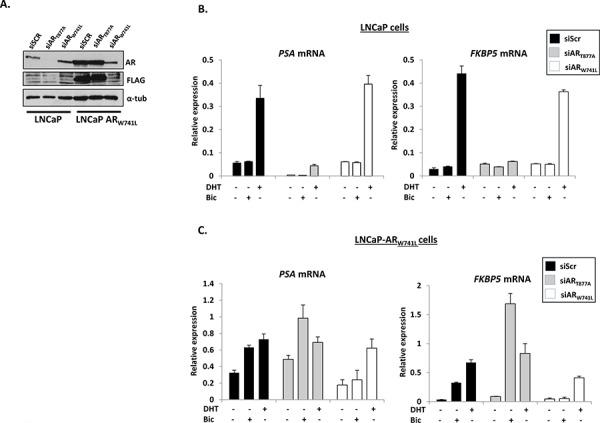
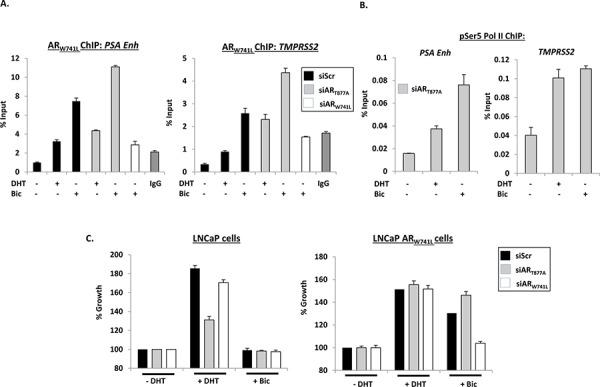
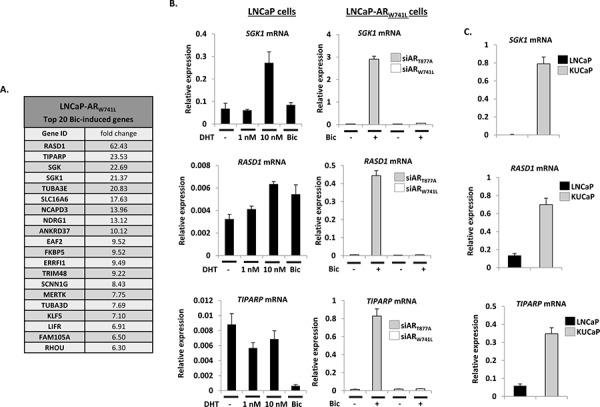
The persistence of androgen receptor (AR) signalling in castrate-resistant prostate cancer (CRPC) highlights the unmet clinical need for the development of more effective AR targeting therapies. A key mechanism of therapy-resistance is by selection of AR mutations that convert anti-androgens to agonists enabling the retention of androgenic signalling in CRPC. To improve our understanding of these receptors in advanced disease we developed a physiologically-relevant model to analyse the global functionality of AR mutants in CRPC. Using the bicalutamide-activated AR(W741L/C) mutation as proof of concept, we demonstrate that this mutant confers an androgenic-like signalling programme and growth promoting phenotype in the presence of bicalutamide. Transcriptomic profiling of AR(W741L) highlighted key genes markedly up-regulated by the mutant receptor, including TIPARP, RASD1 and SGK1. Importantly, SGK1 expression was found to be highly expressed in the KUCaP xenograft model and a CRPC patient biopsy sample both of which express the bicalutamide-activated receptor mutant. Using an SGK1 inhibitor, AR(W741L) transcriptional and growth promoting activity was reduced indicating that exploiting functional distinctions between receptor isoforms in our model may provide new and effective therapies for CRPC patients.
雄激素受体(AR)信号在去势抵抗性前列腺癌(CRPC)中的持续存在凸显了开发更有效AR靶向疗法的未满足临床需求。治疗抵抗的一个关键机制是通过选择AR突变,这些突变将抗雄激素转化为激动剂,从而使CRPC中雄激素信号得以保留。为了增进我们对晚期疾病中这些受体的理解,我们开发了一种生理相关模型来分析CRPC中AR突变体的整体功能。以比卡鲁胺激活的AR(W741L/C)突变作为概念验证,我们证明该突变体在比卡鲁胺存在的情况下赋予了雄激素样信号程序和生长促进表型。AR(W741L)的转录组分析突出了该突变受体显著上调的关键基因,包括TIPARP、RASD1和SGK1。重要的是,发现SGK1在KUCaP异种移植模型和CRPC患者活检样本中高表达,这两者均表达比卡鲁胺激活的受体突变体。使用SGK1抑制剂,AR(W741L)的转录和生长促进活性降低,这表明利用我们模型中受体亚型之间的功能差异可能为CRPC患者提供新的有效治疗方法。



 Zotero 插件