
猫口腔鳞状细胞癌中信号转导和转录激活因子3(STAT3)的表达、信号传导及抑制作用的特征分析
Characterization of STAT3 expression, signaling and inhibition in feline oral squamous cell carcinoma.
作者信息
Brown Megan E, Bear Misty D, Rosol Thomas J, Premanandan Chris, Kisseberth William C, London Cheryl A
机构信息
Department of Veterinary Clinical Sciences, College of Veterinary Medicine, The Ohio State University, Columbus, OH, USA.
Department of Veterinary Biosciences, College of Veterinary Medicine, The Ohio State University, Columbus, OH, USA.
出版信息
BMC Vet Res. 2015 Aug 14;11:206. doi: 10.1186/s12917-015-0505-7.
BACKGROUND
Signal transducer and activator of transcription 3 (STAT3) plays a critical role in tumor development by regulating signaling pathways involved in cell proliferation, survival, metastasis and angiogenesis. STAT3 is activated in many cancers, including head and neck squamous cell carcinoma (HNSCC) in people. Feline oral squamous cell carcinoma (OSCC) is similar to advanced or recurrent HNSCC as it is poorly responsive to traditional therapies and carries a poor long-term prognosis. The purpose of this study was to characterize expression and activation of STAT3 in feline OSCC cell lines and tumor samples and to investigate the biologic activity of a novel, allosteric STAT3 inhibitor, LLL12, in feline OSCC cell lines.
RESULTS
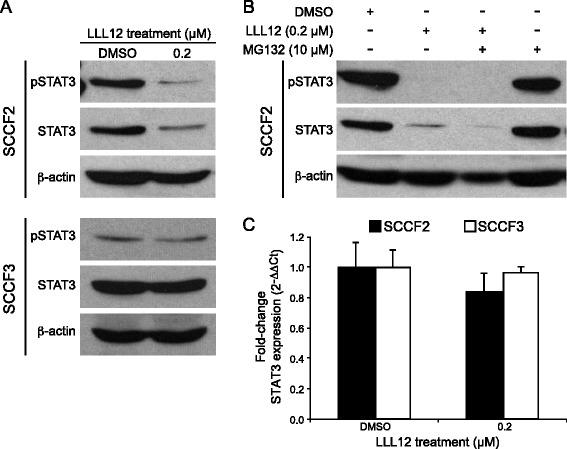
We evaluated 3 feline OSCC cell lines and one of these (SCCF2) exhibited high levels of constitutive STAT3 phosphorylation and high sensitivity to LLL12 treatment. Exposure of SCCF2 cells to LLL12 resulted in decreased expression of pSTAT3 and total STAT3, apoptosis as assessed by caspase 3/7 activation, inhibition of colony formation and reduced expression of the STAT3 transcriptional target survivin. In contrast, the STAT3 transcriptional targets VEGF and MCL-1 increased after LLL12 treatment. This was, in part, likely due to LLL12 mediated upregulation of HIF-1α, which is known to drive VEGF and MCL-1 expression. The OSCC cell lines with low basal STAT3 phosphorylation did not exhibit these effects, suggesting that STAT3 inhibition was responsible for the observed results. Lastly, immunohistochemistry for pSTAT3 was performed using a feline OSCC tissue microarray, demonstrating expression in 48 % of samples tested.
CONCLUSIONS
These data demonstrate that LLL12 has biologic activity against a feline OSCC cell line expressing pSTAT3 and that STAT3 represents a target for therapeutic intervention in this disease. However, given the up-regulation of several STAT3 transcriptional targets following treatment, further investigation of STAT3 and its related signaling pathways in OSCC is warranted.
背景
信号转导与转录激活因子3(STAT3)通过调节参与细胞增殖、存活、转移和血管生成的信号通路,在肿瘤发展中发挥关键作用。STAT3在许多癌症中被激活,包括人类的头颈部鳞状细胞癌(HNSCC)。猫口腔鳞状细胞癌(OSCC)与晚期或复发性HNSCC相似,因为它对传统疗法反应不佳且长期预后不良。本研究的目的是表征STAT3在猫OSCC细胞系和肿瘤样本中的表达与激活情况,并研究新型变构STAT3抑制剂LLL12在猫OSCC细胞系中的生物活性。
结果
我们评估了3种猫OSCC细胞系,其中一种(SCCF2)表现出高水平的组成型STAT3磷酸化,并且对LLL12处理高度敏感。将SCCF2细胞暴露于LLL12导致pSTAT3和总STAT3表达降低,通过caspase 3/7激活评估的细胞凋亡,集落形成受到抑制,以及STAT3转录靶点survivin的表达降低。相比之下,LLL12处理后,STAT3转录靶点VEGF和MCL-1增加。这部分可能是由于LLL12介导的HIF-1α上调,已知HIF-1α可驱动VEGF和MCL-1表达。基础STAT3磷酸化水平低的OSCC细胞系未表现出这些效应,表明STAT3抑制是观察到的结果的原因。最后,使用猫OSCC组织微阵列进行pSTAT3免疫组织化学检测,结果显示在所测试的48%的样本中存在表达。
结论
这些数据表明LLL12对表达pSTAT3的猫OSCC细胞系具有生物活性,并且STAT3是该疾病治疗干预的一个靶点。然而,鉴于治疗后几个STAT3转录靶点上调,有必要进一步研究OSCC中STAT3及其相关信号通路。




 Zotero 插件