
采用基因组与临床风险评估相结合的方法理解和预测自杀倾向。
Understanding and predicting suicidality using a combined genomic and clinical risk assessment approach.
作者信息
Niculescu A B, Levey D F, Phalen P L, Le-Niculescu H, Dainton H D, Jain N, Belanger E, James A, George S, Weber H, Graham D L, Schweitzer R, Ladd T B, Learman R, Niculescu E M, Vanipenta N P, Khan F N, Mullen J, Shankar G, Cook S, Humbert C, Ballew A, Yard M, Gelbart T, Shekhar A, Schork N J, Kurian S M, Sandusky G E, Salomon D R
机构信息
Department of Psychiatry, Indiana University School of Medicine, Indianapolis, IN, USA.
Stark Neuroscience Research Institute, Indiana University School of Medicine, Indianapolis, IN, USA.
出版信息
Mol Psychiatry. 2015 Nov;20(11):1266-85. doi: 10.1038/mp.2015.112. Epub 2015 Aug 18.
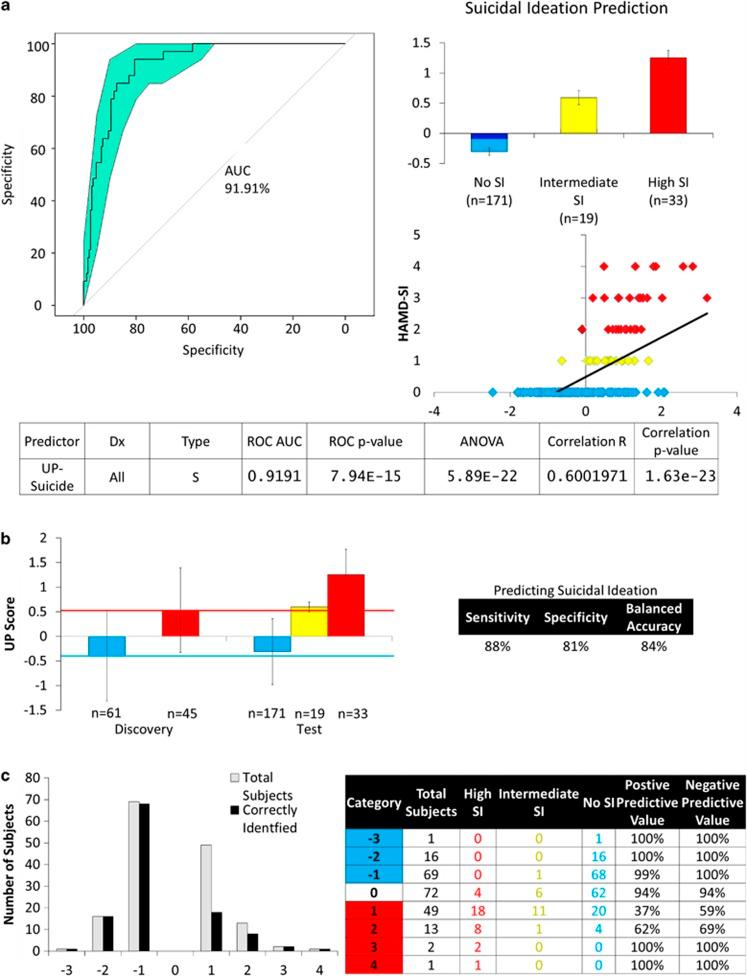
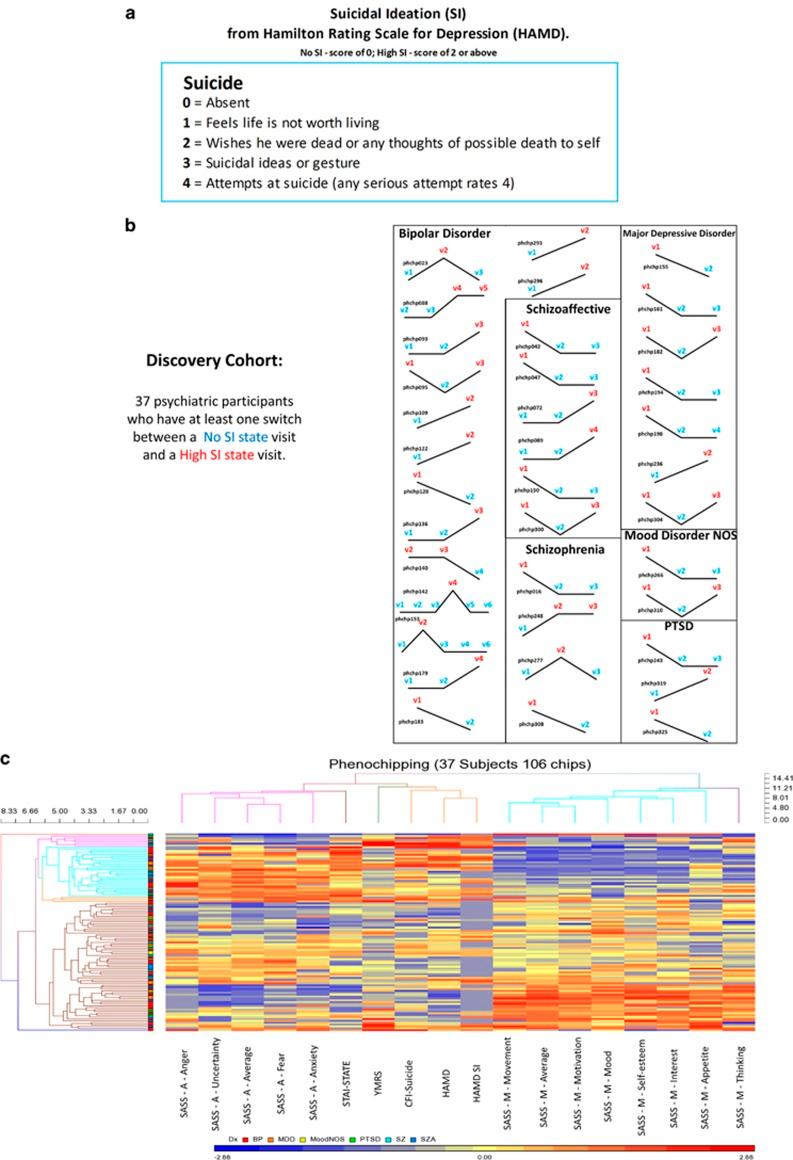
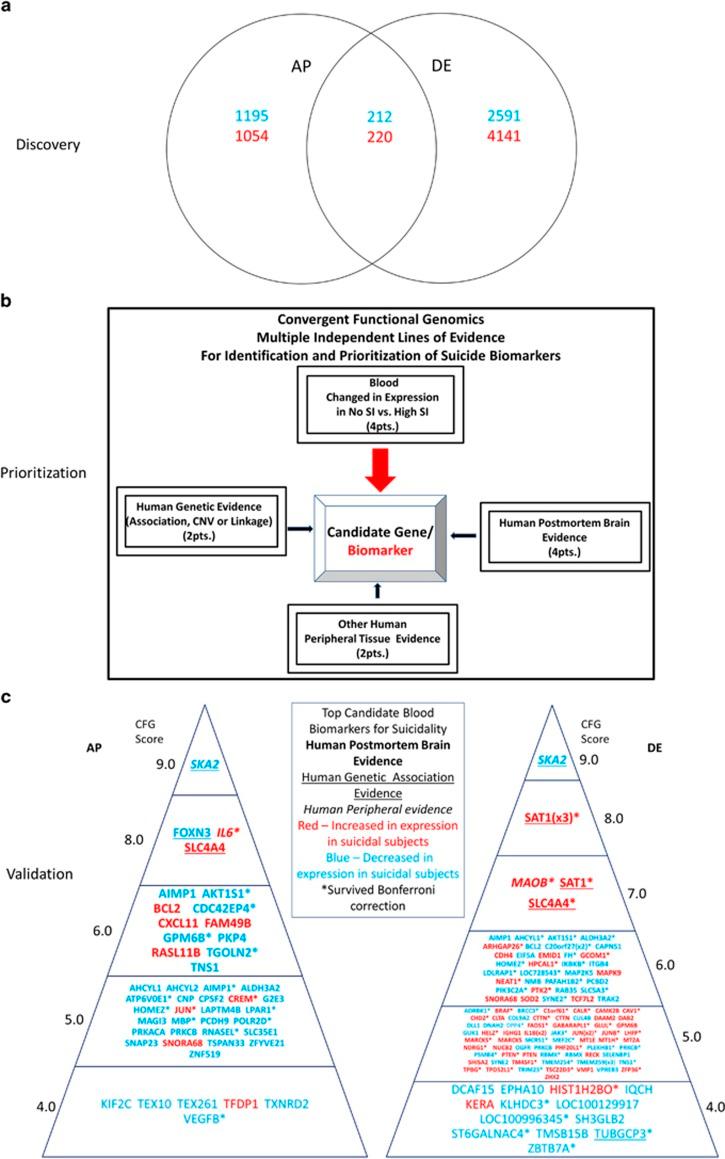
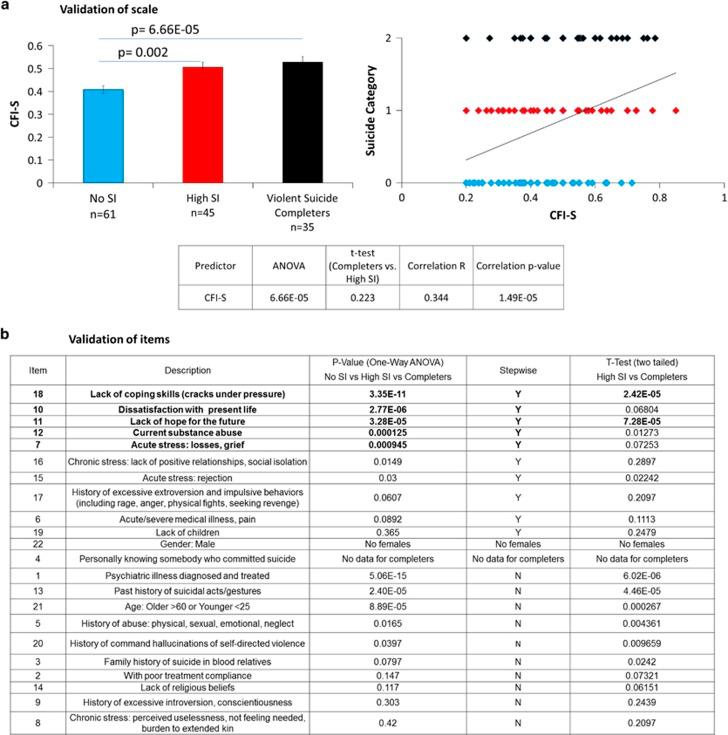
Worldwide, one person dies every 40 seconds by suicide, a potentially preventable tragedy. A limiting step in our ability to intervene is the lack of objective, reliable predictors. We have previously provided proof of principle for the use of blood gene expression biomarkers to predict future hospitalizations due to suicidality, in male bipolar disorder participants. We now generalize the discovery, prioritization, validation, and testing of such markers across major psychiatric disorders (bipolar disorder, major depressive disorder, schizoaffective disorder, and schizophrenia) in male participants, to understand commonalities and differences. We used a powerful within-participant discovery approach to identify genes that change in expression between no suicidal ideation and high suicidal ideation states (n=37 participants out of a cohort of 217 psychiatric participants followed longitudinally). We then used a convergent functional genomics (CFG) approach with existing prior evidence in the field to prioritize the candidate biomarkers identified in the discovery step. Next, we validated the top biomarkers from the prioritization step for relevance to suicidal behavior, in a demographically matched cohort of suicide completers from the coroner's office (n=26). The biomarkers for suicidal ideation only are enriched for genes involved in neuronal connectivity and schizophrenia, the biomarkers also validated for suicidal behavior are enriched for genes involved in neuronal activity and mood. The 76 biomarkers that survived Bonferroni correction after validation for suicidal behavior map to biological pathways involved in immune and inflammatory response, mTOR signaling and growth factor regulation. mTOR signaling is necessary for the effects of the rapid-acting antidepressant agent ketamine, providing a novel biological rationale for its possible use in treating acute suicidality. Similarly, MAOB, a target of antidepressant inhibitors, was one of the increased biomarkers for suicidality. We also identified other potential therapeutic targets or biomarkers for drugs known to mitigate suicidality, such as omega-3 fatty acids, lithium and clozapine. Overall, 14% of the top candidate biomarkers also had evidence for involvement in psychological stress response, and 19% for involvement in programmed cell death/cellular suicide (apoptosis). It may be that in the face of adversity (stress), death mechanisms are turned on at a cellular (apoptosis) and organismal level. Finally, we tested the top increased and decreased biomarkers from the discovery for suicidal ideation (CADM1, CLIP4, DTNA, KIF2C), prioritization with CFG for prior evidence (SAT1, SKA2, SLC4A4), and validation for behavior in suicide completers (IL6, MBP, JUN, KLHDC3) steps in a completely independent test cohort of psychiatric participants for prediction of suicidal ideation (n=108), and in a future follow-up cohort of psychiatric participants (n=157) for prediction of psychiatric hospitalizations due to suicidality. The best individual biomarker across psychiatric diagnoses for predicting suicidal ideation was SLC4A4, with a receiver operating characteristic (ROC) area under the curve (AUC) of 72%. For bipolar disorder in particular, SLC4A4 predicted suicidal ideation with an AUC of 93%, and future hospitalizations with an AUC of 70%. SLC4A4 is involved in brain extracellular space pH regulation. Brain pH has been implicated in the pathophysiology of acute panic attacks. We also describe two new clinical information apps, one for affective state (simplified affective state scale, SASS) and one for suicide risk factors (Convergent Functional Information for Suicide, CFI-S), and how well they predict suicidal ideation across psychiatric diagnoses (AUC of 85% for SASS, AUC of 89% for CFI-S). We hypothesized a priori, based on our previous work, that the integration of the top biomarkers and the clinical information into a universal predictive measure (UP-Suicide) would show broad-spectrum predictive ability across psychiatric diagnoses. Indeed, the UP-Suicide was able to predict suicidal ideation across psychiatric diagnoses with an AUC of 92%. For bipolar disorder, it predicted suicidal ideation with an AUC of 98%, and future hospitalizations with an AUC of 94%. Of note, both types of tests we developed (blood biomarkers and clinical information apps) do not require asking the individual assessed if they have thoughts of suicide, as individuals who are truly suicidal often do not share that information with clinicians. We propose that the widespread use of such risk prediction tests as part of routine or targeted healthcare assessments will lead to early disease interception followed by preventive lifestyle modifications and proactive treatment.
在全球范围内,每40秒就有一人死于自杀,这是一场本可预防的悲剧。我们进行干预的能力的一个限制因素是缺乏客观、可靠的预测指标。我们之前已为在男性双相情感障碍参与者中使用血液基因表达生物标志物来预测未来因自杀倾向而住院提供了原理证明。我们现在将此类标志物的发现、优先级排序、验证和测试推广到男性参与者的主要精神疾病(双相情感障碍、重度抑郁症、精神分裂症和精神分裂症)中,以了解其共性和差异。我们采用了一种强大的参与者内部发现方法来识别在无自杀意念和高自杀意念状态之间表达发生变化的基因(在纵向跟踪的217名精神疾病参与者队列中,有37名参与者)。然后,我们使用收敛功能基因组学(CFG)方法并结合该领域现有的先前证据,对在发现步骤中确定的候选生物标志物进行优先级排序。接下来,我们在与验尸官办公室人口统计学匹配的自杀完成者队列(n = 26)中验证了优先级排序步骤中排名靠前的生物标志物与自杀行为的相关性。仅针对自杀意念的生物标志物富含参与神经元连接和精神分裂症的基因,也针对自杀行为进行了验证的生物标志物富含参与神经元活动和情绪的基因。在针对自杀行为进行验证后,经过Bonferroni校正后幸存的76种生物标志物映射到参与免疫和炎症反应、mTOR信号传导和生长因子调节的生物途径。mTOR信号传导对于速效抗抑郁药氯胺酮的作用是必需的,这为其可能用于治疗急性自杀倾向提供了新的生物学原理。同样,抗抑郁抑制剂的靶点MAOB是自杀倾向增加的生物标志物之一。我们还确定了其他已知可减轻自杀倾向的药物的潜在治疗靶点或生物标志物,如ω-3脂肪酸、锂和氯氮平。总体而言,排名靠前的候选生物标志物中有14%也有证据表明参与心理应激反应,19%参与程序性细胞死亡/细胞自杀(凋亡)。可能在面对逆境(压力)时,死亡机制在细胞(凋亡)和机体水平上被开启。最后,我们在一个完全独立的精神疾病参与者测试队列(n = 108)中测试了在发现自杀意念(CADM1、CLIP4、DTNA、KIF2C)、使用CFG根据先前证据进行优先级排序(SAT1、SKA2、SLC4A4)以及在自杀完成者中验证行为(IL6、MBP、JUN、KLHDC3)步骤中排名靠前的增加和减少的生物标志物对自杀意念的预测能力,并在一个未来的精神疾病参与者随访队列(n = 157)中测试其对因自杀倾向导致的精神疾病住院的预测能力。在精神疾病诊断中预测自杀意念的最佳个体生物标志物是SLC4A4,其曲线下面积(AUC)的受试者工作特征(ROC)为72%。特别是对于双相情感障碍,SLC4A4预测自杀意念时的AUC为93%,预测未来住院时的AUC为70%。SLC4A4参与调节脑细胞外空间pH值。脑pH值与急性惊恐发作的病理生理学有关。我们还描述了两个新的临床信息应用程序,一个用于情感状态(简化情感状态量表,SASS),一个用于自杀风险因素(自杀收敛功能信息,CFI-S),以及它们在精神疾病诊断中预测自杀意念的效果如何(SASS的AUC为85%,CFI-S的AUC为89%)。基于我们之前的工作,我们预先假设将排名靠前的生物标志物和临床信息整合到一个通用预测指标(UP - Suicide)中,将在精神疾病诊断中显示出广谱预测能力。事实上,UP - Suicide能够在精神疾病诊断中预测自杀意念,AUC为92%。对于双相情感障碍,它预测自杀意念时的AUC为98%,预测未来住院时的AUC为94%。值得注意的是,我们开发的两种测试(血液生物标志物和临床信息应用程序)都不需要询问被评估个体是否有自杀念头,因为真正有自杀倾向的个体通常不会与临床医生分享该信息。我们建议将此类风险预测测试作为常规或有针对性的医疗保健评估的一部分广泛使用,这将导致早期疾病拦截,随后进行预防性生活方式调整和积极治疗。


 Zotero 插件