
辅料对BCS III类化合物渗透性的影响及生物豁免的意义
The Effect of Excipients on the Permeability of BCS Class III Compounds and Implications for Biowaivers.
作者信息
Parr Alan, Hidalgo Ismael J, Bode Chris, Brown William, Yazdanian Mehran, Gonzalez Mario A, Sagawa Kazuko, Miller Kevin, Jiang Wenlei, Stippler Erika S
机构信息
GlaxoSmithKline Inc., Research Triangle Park, North Carolina, 27709, USA.
Absorption Systems LP, Exton, Pennsylvania, 19341-2556, USA.
出版信息
Pharm Res. 2016 Jan;33(1):167-76. doi: 10.1007/s11095-015-1773-4. Epub 2015 Aug 19.
PURPOSE
Currently, the FDA allows biowaivers for Class I (high solubility and high permeability) and Class III (high solubility and low permeability) compounds of the Biopharmaceutics Classification System (BCS). Scientific evidence should be provided to support biowaivers for BCS Class I and Class III (high solubility and low permeability) compounds.
METHODS
Data on the effects of excipients on drug permeability are needed to demonstrate that commonly used excipients do not affect the permeability of BCS Class III compounds, which would support the application of biowaivers to Class III compounds. This study was designed to generate such data by assessing the permeability of four BCS Class III compounds and one Class I compound in the presence and absence of five commonly used excipients.
RESULTS
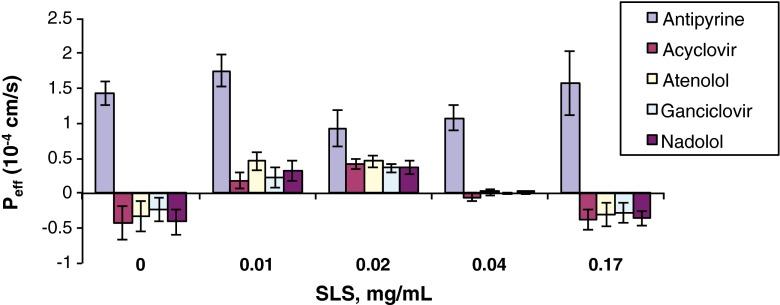
The permeability of each of the compounds was assessed, at three to five concentrations, with each excipient in two different models: Caco-2 cell monolayers, and in situ rat intestinal perfusion. No substantial increases in the permeability of any of the compounds were observed in the presence of any of the tested excipients in either of the models, with the exception of disruption of Caco-2 cell monolayer integrity by sodium lauryl sulfate at 0.1 mg/ml and higher.
CONCLUSION
The results suggest that the absorption of these four BCS Class III compounds would not be greatly affected by the tested excipients. This may have implications in supporting biowaivers for BCS Class III compounds in general.
目的
目前,美国食品药品监督管理局(FDA)允许对生物药剂学分类系统(BCS)中的I类(高溶解性和高渗透性)和III类(高溶解性和低渗透性)化合物进行生物豁免。应提供科学证据以支持对BCS I类和III类(高溶解性和低渗透性)化合物的生物豁免。
方法
需要有关辅料对药物渗透性影响的数据,以证明常用辅料不会影响BCS III类化合物的渗透性,这将支持对III类化合物应用生物豁免。本研究旨在通过评估四种BCS III类化合物和一种I类化合物在有和没有五种常用辅料存在情况下的渗透性来生成此类数据。
结果
在两种不同模型中,以三至五种浓度评估每种化合物与每种辅料的渗透性:Caco-2细胞单层模型和大鼠原位肠灌注模型。在任何一种模型中,在任何测试辅料存在的情况下,均未观察到任何化合物的渗透性有实质性增加,但0.1 mg/ml及更高浓度的十二烷基硫酸钠会破坏Caco-2细胞单层的完整性。
结论
结果表明,这四种BCS III类化合物的吸收不会受到测试辅料的很大影响。这可能总体上对支持BCS III类化合物的生物豁免有影响。


 Zotero 插件