
一组患有恶性黑色素瘤肺转移患者的分子特征:BRAF、NRAS和EGFR评估的启示
Molecular characterization of a selected cohort of patients affected by pulmonary metastases of malignant melanoma: Hints from BRAF, NRAS and EGFR evaluation.
作者信息
Ulivieri Alessandra, Cardillo Giuseppe, Manente Liborio, Paone Gregorino, Mancuso Andrea Petricca, Vigna Leonardo, Di Stasio Enrico, Gasbarra Rita, Girlando Salvatore, Leone Alvaro
机构信息
Anatomic Pathology Unit, San Camillo-Forlanini Hospitals, Rome, Italy.
Laboratory of Biomedical research "Fondazione Niccolò Cusano per la Ricerca Medico-Scientifica" Niccolò Cusano University of Rome, Rome, Italy.
出版信息
Oncotarget. 2015 Aug 14;6(23):19868-79. doi: 10.18632/oncotarget.4503.
BACKGROUND
Melanoma is highly curable in early stages but holds devastating consequences in advanced phases with a median survival of 6-10 months. Lungs are a common metastasis target, but despite this, limited data are available on the molecular status of pulmonary lesions.
MATERIALS AND METHODS
25 patients with surgically resected melanoma lung metastases were screened for BRAF, NRAS, CKIT and EGFR alterations. The results were correlated with time to lung metastasis (TLM), relapse-free survival after metastasectomy (RFS) and overall survival (OS).
RESULTS
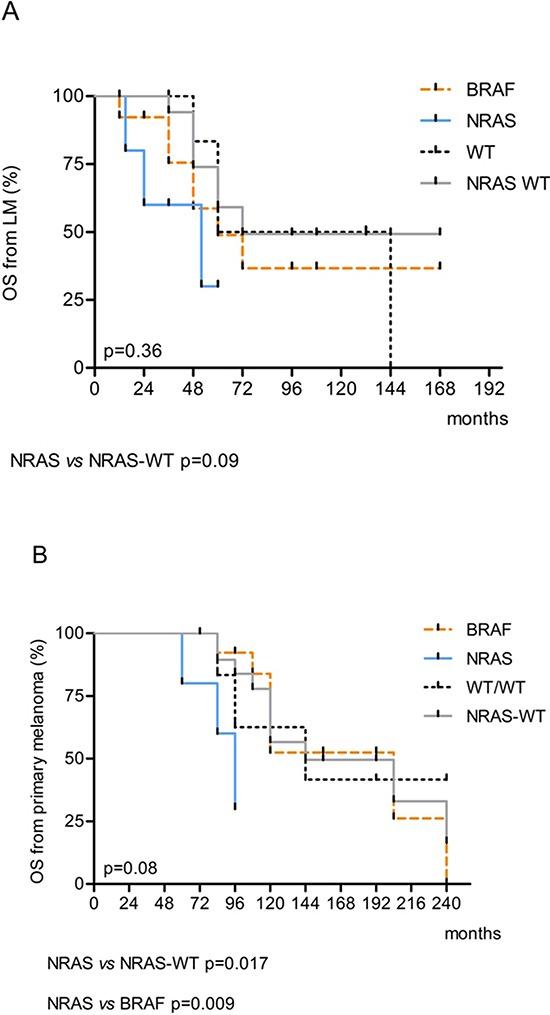
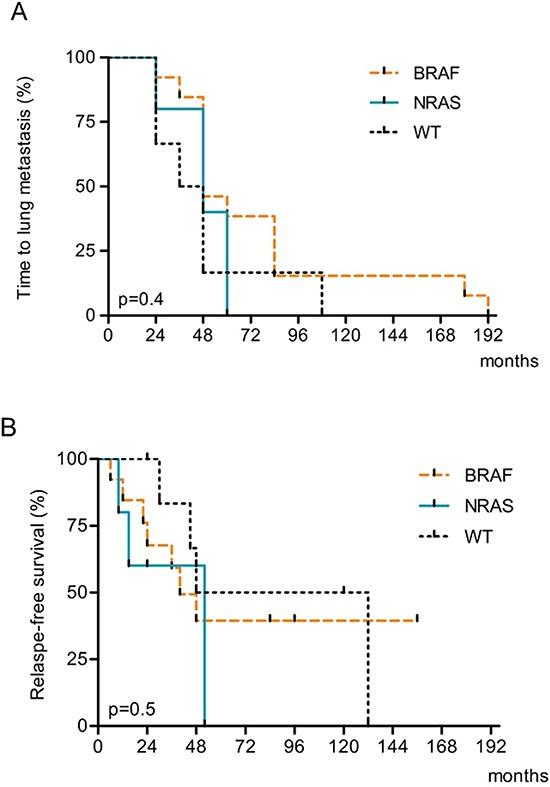
BRAF or NRAS were mutated in 52% and 20% of cases while CKIT was unaffected. Chromosome 7 polysomy was detected in 47% of cases with 17.5% showing EGFR amplification and concomitant BRAF mutation. NRAS mutated patients developed LM within 5 yrs from primary melanoma with larger lesions compared with BRAF (mean diameter 3.3 ± 2.2cm vs 1.9 ± 1.1cm, p = 0.2). NRAS was also associated with a shorter median RFS and OS after metastasectomy. Moreover, Cox regression analysis revealed that NRAS mutation was the only predictive factor of shorter survival from primary melanoma (p = 0.039, OR = 5.5 (1.1-27.6)).
CONCLUSIONS
Molecular characterization identifies advanced melanoma subgroups with distinct prognosis and therapeutic options. The presence of NRAS mutation was associated to a worse disease evolution.
背景
黑色素瘤在早期阶段具有较高的治愈率,但在晚期阶段会产生毁灭性后果,中位生存期为6至10个月。肺部是常见的转移靶点,但尽管如此,关于肺部病变分子状态的数据有限。
材料与方法
对25例手术切除的黑色素瘤肺转移患者进行BRAF、NRAS、CKIT和EGFR改变的筛查。结果与肺转移时间(TLM)、转移灶切除术后无复发生存期(RFS)和总生存期(OS)相关。
结果
52%的病例中BRAF或NRAS发生突变,20%的病例中CKIT未受影响。47%的病例检测到7号染色体多体性,17.5%显示EGFR扩增并伴有BRAF突变。NRAS突变患者在原发性黑色素瘤发生后5年内发生肺转移,与BRAF突变患者相比,转移灶更大(平均直径3.3±2.2cm对1.9±1.1cm,p = 0.2)。NRAS突变还与转移灶切除术后较短的中位RFS和OS相关。此外,Cox回归分析显示NRAS突变是原发性黑色素瘤生存期较短的唯一预测因素(p = 0.039,OR = 5.5(1.1 - 27.6))。
结论
分子特征鉴定出具有不同预后和治疗选择的晚期黑色素瘤亚组。NRAS突变的存在与疾病进展较差相关。

 Zotero 插件