
急性白血病中的III类受体酪氨酸激酶——生物学功能与现代实验室分析
Class III Receptor Tyrosine Kinases in Acute Leukemia - Biological Functions and Modern Laboratory Analysis.
作者信息
Berenstein Rimma
机构信息
Department of Hematology, Oncology and Tumourimmunology, Charité Universitätsmedizin Berlin, Berlin, Germany.
出版信息
Biomark Insights. 2015 Aug 5;10(Suppl 3):1-14. doi: 10.4137/BMI.S22433. eCollection 2015.
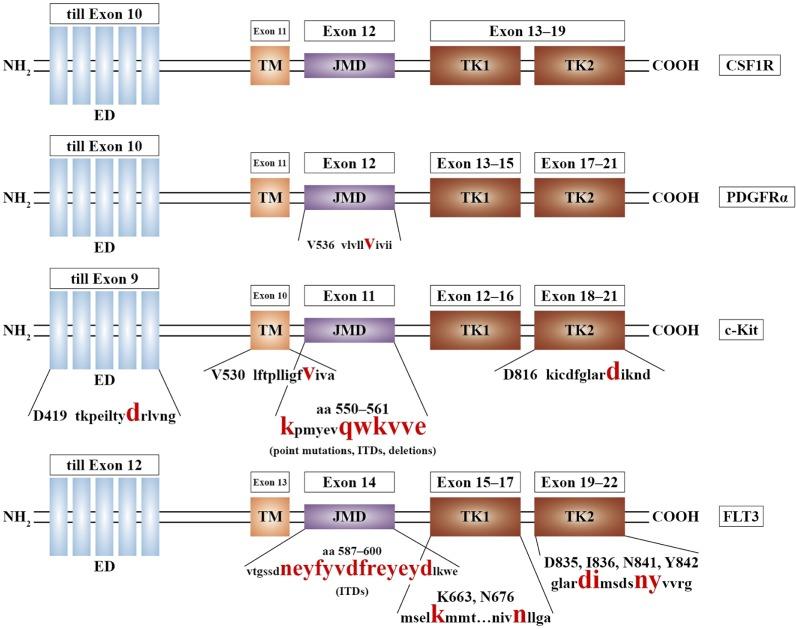
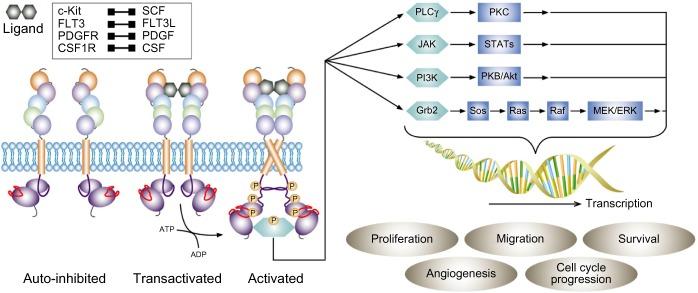
Acute myeloid leukemia (AML) is a complex disease caused by deregulation of multiple signaling pathways. Mutations in class III receptor tyrosine kinases (RTKs) have been implicated in alteration of cell signals concerning the growth and differentiation of leukemic cells. Point mutations, insertions, or deletions of RTKs as well as chromosomal translocations induce constitutive activation of the receptor, leading to uncontrolled proliferation of undifferentiated myeloid blasts. Aberrations can occur in all domains of RTKs causing either the ligand-independent activation or mimicking the activated conformation. The World Health Organization recommended including RTK mutations in the AML classification since their detection in routine laboratory diagnostics is a major factor for prognostic stratification of patients. Polymerase chain reaction (PCR)-based methods are well-validated for the detection of fms-related tyrosine kinase 3 (FLT3) mutations and can easily be applied for other RTKs. However, when methodological limitations are reached, accessory techniques can be applied. For a higher resolution and more quantitative approach compared to agarose gel electrophoresis, PCR fragments can be separated by capillary electrophoresis. Furthermore, high-resolution melting and denaturing high-pressure liquid chromatography are reliable presequencing screening methods that reduce the sample amount for Sanger sequencing. Because traditional DNA sequencing is time-consuming, next-generation sequencing (NGS) is an innovative modern possibility to analyze a high amount of samples simultaneously in a short period of time. At present, standardized procedures for NGS are not established, but when this barrier is resolved, it will provide a new platform for rapid and reliable laboratory diagnostic of RTK mutations in patients with AML. In this article, the biological and physiological role of RTK mutations in AML as well as possible laboratory methods for their detection will be reviewed.
急性髓系白血病(AML)是一种由多种信号通路失调引起的复杂疾病。III类受体酪氨酸激酶(RTK)的突变与白血病细胞生长和分化相关的细胞信号改变有关。RTK的点突变、插入或缺失以及染色体易位会导致受体的组成性激活,从而导致未分化髓系母细胞的不受控制的增殖。RTK的所有结构域都可能出现异常,导致配体非依赖性激活或模拟激活构象。世界卫生组织建议将RTK突变纳入AML分类,因为在常规实验室诊断中检测到这些突变是患者预后分层的主要因素。基于聚合酶链反应(PCR)的方法已被充分验证用于检测fms相关酪氨酸激酶3(FLT3)突变,并且可以很容易地应用于其他RTK。然而,当达到方法学限制时,可以应用辅助技术。与琼脂糖凝胶电泳相比,为了获得更高分辨率和更定量的方法,可以通过毛细管电泳分离PCR片段。此外,高分辨率熔解和变性高效液相色谱是可靠的预测序筛选方法,可减少桑格测序的样本量。由于传统的DNA测序耗时,下一代测序(NGS)是一种创新的现代方法,可以在短时间内同时分析大量样本。目前,NGS的标准化程序尚未建立,但当这一障碍得到解决时,它将为AML患者RTK突变的快速可靠实验室诊断提供一个新平台。在本文中,将综述RTK突变在AML中的生物学和生理学作用以及检测它们的可能实验室方法。

 Zotero 插件